


When Joe Eszterhas wrote Basic Instinct (1992), the breakout erotic thriller for which he was paid a then-record-breaking $3 million, he set it in a city that embodied the rejection of bourgeois morality, a place where transgression required little explanation and even less apology.
Just to make sure the audience understands exactly what kind of world they’re entering, Basic Instinct opens with a stylized, explicit sex scene that abruptly turns violent when a shadowy blonde reaches for an ice pick mid-coitus, turning her partner’s petit mort into a Grand Guignol vignette. It’s less a shock than a statement of intent: Like the guitarist’s amp in This Is Spinal Tap, this one goes to eleven.
The pursuit of justice falls to detective Nick Curran (Michael Douglas), a homicide cop clawing his way back to credibility after killing two tourists in a shooting at Fisherman’s Wharf. The next morning, he arrives at the crime scene: a Pacific Heights mansion, where he learns the victim is former rock star Johnny Boz, the kind of countercultural figure San Francisco had already begun to absorb into wealth and respectability. Douglas, who built a career playing charismatic men with dubious morals, is perfectly cast here.
There, as a forensic team studies the residue of excess — cocaine, the remnants of indulgence revealed by black light — a superior reminds Curran that the victim wasn’t just another casualty. Boz was a friend of the mayor.
Curran and partner Gus Moran (George Dzundza) pay a visit to Catherine Tramell (Sharon Stone), the last person seen with the victim. The script places her at 162 Divisadero, but location managers put her in a neoclassical Pacific Heights mansion (2930 Vallejo St.) built for influential San Francisco real estate developer Oscar Heuter. Shot from above as they approach its portico, the detectives look like supplicants visiting a temple. Dwarfed and encircled by columns in a low-angle shot as they wait to be admitted, Tramell’s wealth strips the cops of their power.
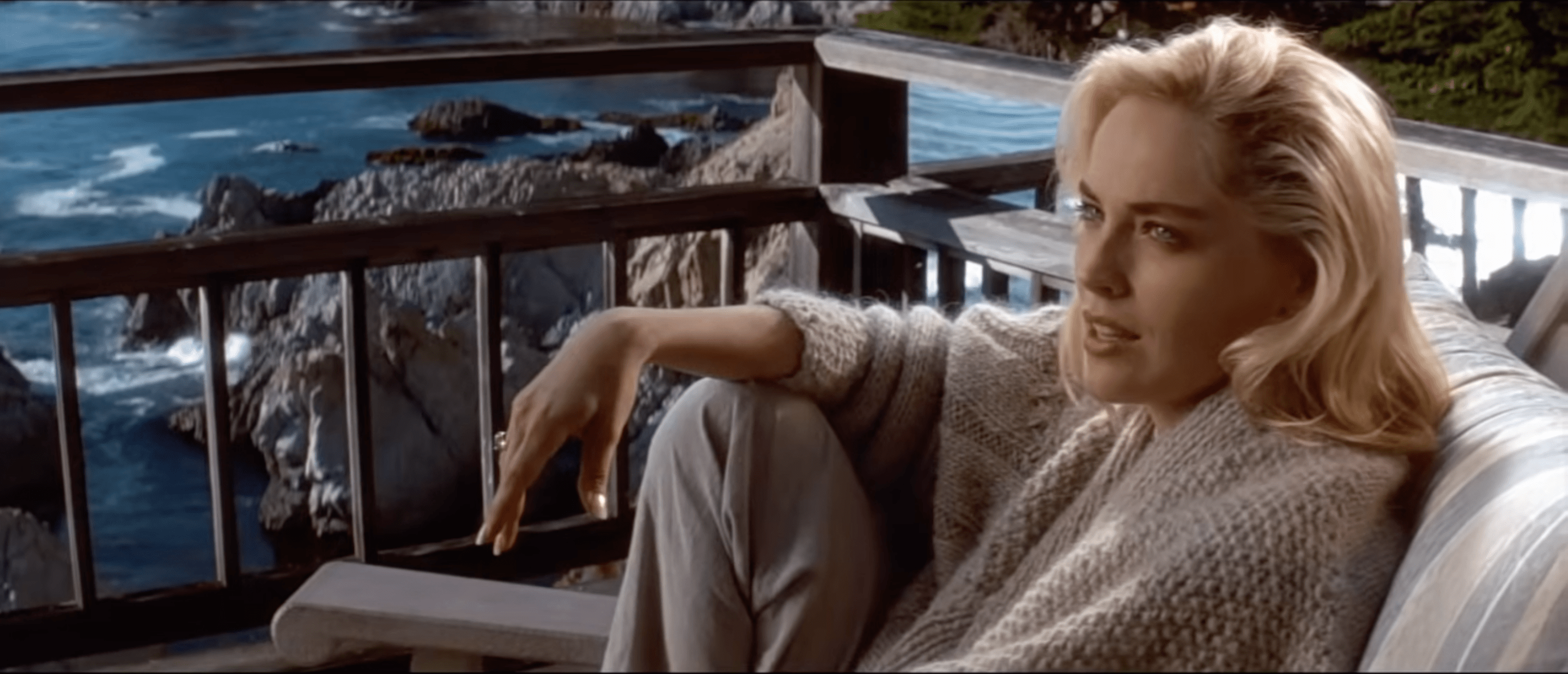
Inside, their disorientation deepens after they encounter her lover Roxy (Leilani Sarelle) and realize that their suspect, a bestselling author, isn’t just rich and polyamorous but bisexual. When they finally track down Tramell reclining above a secluded cove at her Stinson Beach house (actually shot at a sprawling compound in Carmel-by-the-Sea), she toys with the detectives before dismissing them with casual authority. Stone plays her with a feline stillness that borders on indifference, staying one step removed, the way rich people do when they assume the room will adjust to them. The detectives struggle to orient themselves not only to her sexuality, but to the ease with which she seems unbothered by the very binaries that still structure their thinking.
As imagined by Eszterhas and directed by Paul Verhoeven, San Francisco is smoothed out, professionalized, and aspirational. Boz’s barn-sized queer-friendly Fillmore disco existed only on a Burbank soundstage, and Stetson’s Bar, where the detectives argue over Tramell’s manipulations, was a redressed Rawhide II (280 7th St.), the city’s only country-western LGBTQ bar.
Even the spaces that should anchor Curran feel altered. When he checks in for a mandatory session with his psychiatrist and clandestine lover (Jeanne Tripplehorn), SFPD Homicide looks like a mid-level law firm with paneled corridors, potted plants, and recessed lighting. In earlier San Francisco procedurals, the Hall of Justice at 850 Bryant St. is a place of scuffed linoleum lit by fluorescent glare.
The film’s most famous sequence, the interrogation scene, completes the inversion. Tramell doesn’t evade the system; she occupies it. Controlling the room, the cadence, and the attention of her interrogators, she turns the scrutiny back on them, like the hippies on Haight Street who jogged alongside tourist buses holding up mirrors. Seated alone in the center of the line-up room after refusing an attorney, she projects control like a routine from Flashdance (1983), and they take the bait. Eszterhas, who co-wrote Flashdance with Tom Hedley, had staged the setup before, but here he strips it of music, leaving nothing but power.
By the scene’s end, the cops are reduced to horny Torquemadas, mistaking their arousal for righteousness. Tramell, meanwhile, remains self-possessed, amused, and ultimately untouched.
The city she inhabits, a place where artists create their own ethical frameworks and appetite outruns consequence, wasn’t invented entirely for the screen. It was an extrapolation of the writer’s lived experience in San Francisco.
József Antal Eszterhás was born in Hungary at the end of World War II and raised in Cleveland after spending his early years in refugee camps. He went on to build a very American life as a reporter, husband, and father operating inside a bourgeois system he understood and, by all accounts, respected.
“My picture was on the side of the Plain Dealer’s circulation trucks,” he reminisced on his blog. “I won a bunch of local and statewide journalism awards. I was nominated for a Pulitzer Prize.” By the early seventies, though, Eszterhas had caught the eye of Hunter S. Thompson, who brought him to Rolling Stone, a place where the line between participating and reporting had already started to blur.
In the magazine’s San Francisco offices, nearly every form of pleasure was available to those who partook. Not merely in sex and drugs, but in a culture that treated transgression not as a form of authenticity.
Eszterhas embraced it all. And it cost him.
“Life had become wretched excess,” he admitted. The family he’d built in the Rust Belt did not survive inside the life he created after moving to Tiburon, but in making the transition to Hollywood during the high-concept style of the ‘80s, he resolves that tension in his work. In Eszterhas’ idealized version of San Francisco, pleasure-seeking carried no penalty or shame — especially when you have money.
Eszterhas couldn’t sustain a world where freedom outruns responsibility, but he offers it to his characters without hesitation. Three years after Basic Instinct, he explored (or exploited) the same themes in Jade, directed by William Friedkin. (This one was sold as a two-page treatment for $2.5 million.)
Once again, San Francisco elites move through a city where sex, power, and secrecy intertwine, this time with Linda Fiorentino as Trina Gavin, the wife of a defense attorney who’s leading a parallel life the men around her can neither control nor comprehend.
Like Tramell, Gavin is wealthy, sexual, and unapologetic. “I cheated on my husband,” she shrugs. “I didn’t know I could be arrested for it.”
What links Basic Instinct and Jade isn’t just their fixation on sex and power, but the suggestion that Midwestern ideas about identity are simply incompatible with San Francisco’s permissive climate. Eszterhas amplifies the city’s self-image into something operatic: Creative people and wealthy elites lead authentic lives, while the moralists who object are probably hiding something.
In the decades since these Eszterhas fantasies, libertine San Francisco has been fully captured by libertarians, the pleasure of fucking supplanted by the pursuit of fuck-you money. Today’s elites simulate transgression by outsourcing their Burning Man camps and microdosing their way through curated rebellion, but the people who created those scenes have been pushed out, their spaces repackaged as shifting mores mainstreamed and commodified sexual expression.
“San Francisco values” still signifies something, but mostly as a relic, now more often invoked by our city’s critics than its residents.
Like renovated Victorians, the old myths have been repackaged and sold as something new.