


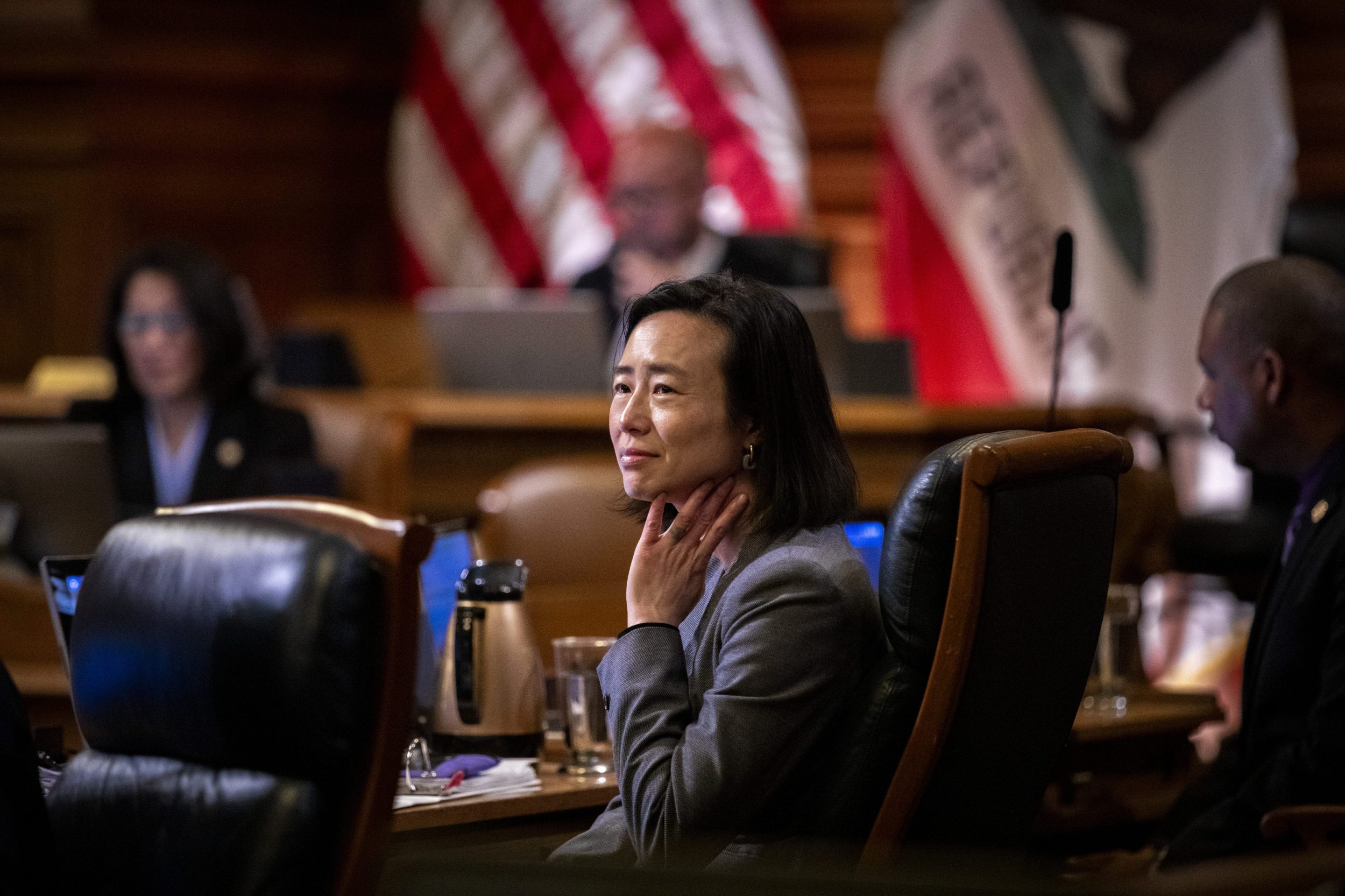

The party was raucous at El Rio as Connie Chan and her supporters celebrated her primary election win on the night of June 2. The supervisor’s first call after her comeback win for the nomination was, naturally, Nancy Pelosi.
Chan recalled that Pelosi was buoyed by the win she’d helped bring about, but had her eye on the congressional nominee’s next move. “She was excited but she’s very strategic, very smart,” Chan told me on the phone. “She wanted us to be cautious and learn more, not just that night but also in the coming days.”
That careful, slow-and-steady approach is of a piece with Chan’s campaign to replace Pelosi in Washington. Chan’s campaign kicked off later than that of her better-funded competitors, Saikat Chakrabarti and Scott Wiener; at times she looked to be straggling badly behind them. Despite fewer donation dollars to spend and less presence on the airwaves, however, Chan pulled off a comeback after being down double-digit percentage points to Chakrabarti.
Chan doesn’t downplay the crucial impact of Pelosi’s last-minute endorsement on May 18, just two weeks out from Election Day.
“Even in April and May, some people we met thought she was on the ballot. It really wasn’t until she endorsed us, the news gave people a jolt that we’re for real,” Chan said.
With the top-two winners headed to the November general election, voters will hear a lot more from Chan and Wiener in the coming months. The latter has invested mightily into ads on TV and social media, earning a considerable lead in among primary voters, racking up 41 percent of them to Chan’s 30.
Chan is happy to flex her underdog status, proudly describing how her staff and volunteers beat Chakrabarti’s $10 million campaign for pennies on the dollar and talking tough about how she’ll compete against Wiener, a seasoned winner with deep institutional experience.
Now comes the hard part: winning.
As she continues to campaign, Chan spoke with me about the next steps for her agenda as well as her final summer leading city budget work on the Board of Supervisors.
This interview has been edited for length and clarity.
What’s the top priority for the campaign now?
We’re going to get a lot more specific with our policies for Congress. It’s been tough: We jumped in fairly late into the race in November, and launched the campaign officially a week before Thanksgiving. People weren’t even in town. (Laughs) And then, in the spring, we had to go from running a campaign to going right into city budget work. This whole time, I’ve been doing multiple jobs.
So a major, major aspect that’s changed is that I’m proud our City Hall team [worked with] Mayor Lurie and my colleagues on the Board to wrap up the budget.
I’m also stepping down as [budget] committee chair. I’ve been chair for four years now. I think it’s time for my colleagues to learn how to do this job, and transition smoothly from me. I’m happy to now be the assistant, and I’m excited about the [shift] in my day job and campaign work.
I made the decision [to step down] in December. I’ve been thinking about it since the last budget we wrapped last summer, actually.
On that subject: What do you think the public misunderstands about how the city’s budget got passed on June 26?
This budget, particularly, is the fruit of the labor of the last three fiscal years. We’ve been building up to this moment, when we can collectively have $1.3 billion on reserve. We’re able to have $8 million for the city’s fire apparatus. Free City College, immigrant resources. And you can see that some of these were funded in the past, not just in June.
For example, three or four years ago, we found the previous administration was hiring managers at twice the rate of line workers. Even though we knew that ratio was a problem, we couldn’t have changed it in one fiscal year. In the last three fiscal years, we made city departments recognize you can’t have a top-heavy operation. You will see this year that the departments are following through. We set standards that a ratio of anything under 10% [managers to workers] is acceptable.
That is a meaningful way to operate city departments more efficiently. It didn’t happen magically overnight.
What’s a political strategy or tactic that you think you can bring from your work in San Francisco to the federal level?
Generally, I think about the Trump administration’s efforts on DOGE-ing, we’ve seen detrimental cuts to things like USAID and the Department of Education and we want to reverse those cuts.
But we also understand that, fundamentally, the protection and integrity of the federal government happens through the effort of federal workers.
An example of something critical we’re going to bring to Capitol Hill is the idea to unionize policy aides. Recognizing that in order for us to rule out corruption in federal government and the White House, we need to make sure aides can be unionized and have protection and have a process for reporting grievances from any type of harassment, sexual or non-sexual. We want to affirm a whistleblower program that can yield results and protection.
You had less funding than your opponents leading into the primary. How much does that matter as you build the final stretch of the campaign?
I mean, in the beginning to the point when Speaker Emeritus Pelosi endorsed us, everyone counted us out. We had what I call, as a joke, “sympathy donations.” They want to support us but not because they think we’re going to win, just because they love what we’re about. It was a difficult dynamic to try and convince people we can win.
I did notice that your campaign was pretty quiet in terms of canvassing, mailers, and ads early on.
We’re thoughtful about how strategic we should be on how we spend and when. Nobody was really paying attention in [the winter]. But I need to be honest about the fact that, yeah, we struggled with resources. What we didn’t struggle with was the people who showed up to volunteer, to make calls, knock on doors.
You know, when I spoke with Saikat recently, he suggested that he intentionally didn’t want to lead an attack campaign against you, maybe as a progressive solidarity thing. What do you think?
I cannot speak for Saikat or Scott, but what I do know was that neither of them were really taking us seriously. Like, I don’t know whether they intentionally weren’t attacking us. Other than the reason that they just wanted to ignore us. It’s not just them, there were a lot of people counting us out!
Well, Scott Wiener has to take you seriously now. What are you going to do to differentiate your campaigns?
In the coming months, we’re really going to demonstrate the contrast between State Senator Wiener and I, not just in our approach to our communities but actual policies. I’ll say this now: One glaring difference between us is that, we may both say we support progressive taxation, but I support progressive taxation now and in the future, both locally and on the state level. Whereas State Senator Wiener is constantly doing different kinds of political calculations on changing his stances depending on the moment.
On a slightly related note: Why didn’t you get booed or confronted at Trans March, when so many other politicians, including Wiener, have?
To try and answer your question… It wasn’t my first Trans March, and when it comes down to a rally or a protest, I’ve joined that picket line all [the] time. I’ve gotten arrested twice as an elected official. And I deeply understand the importance of respecting the peoples’ space, that as elected officials, some of the most critical moments are a time to stand in a corner and listen.
That being said, I stand firm against hate, threats of violence, there’s really no place for that anywhere whether it’s Trans March or otherwise.
Did you catch a charge for that arrest at the May Day protest at SFO?
Yes, we got cited. But we have a very good labor attorney.