

The year is 2012. You’re sipping a cold brew and eating a cronut at the reclaimed-wood community table in an old warehouse-turned-cafe. On your screen, article after article prophesizes the collapse of a once-necessary household item: the cookbook. Online media, with its free blogs, YouTube tutorials, and onslaught of affiliate links, will reign. Julia Child has flown the organic co-op.
The year is 2026. Magazines are folding. “Authors” are tapping language models to generate mediocre books. Manifestos skip the printing press entirely and go straight to X. Hell, they’re making portrait-mode soap operas in two-minute increments on TikTok. Yet, despite all the mediums falling victim to digital enshittification, cookbooks are thriving.
Over a hundred cookbooks were released in the fall alone. Cookbook sales in the US increased eight percent year-over-year from 2010 to 2020. In 2025, baking cookbook sales leapt 80 percent over the year prior despite TikTok, Pinterest, Instagram, and Substack being more saturated than ever with recipe content.
Why?
“When you pick up a book and you open the cover, suddenly you're in that person's world,” said Brian Hogan Stewart, a culinary communications strategist and the founder of Cookbook Week, which ends tomorrow.
“People want to understand someone's viewpoint more, to understand the cuisine more, to understand how to work within a specific set of ingredients or a specific cuisine,” said Stewart. “It’s the opportunity to immerse yourself and explore something a little deeper.”
Recipe creators and chefs have been media personalities for decades now, first on television, then YouTube, and now, social media — each of these platforms more direct-to-audience than the previous. The pandemic initiated a coming of consciousness in the kitchen for people everywhere, some of whom never considered turning on the stove, but it also propelled consumers into a new era of parasociality. Followers of Molly Baz will buy her new cookbook, but they very well could have bought a tote bag in its place with similar enthusiasm so long as it’s a piece of her brand.
“I think [cookbooks and social media] live very much in sync with each other because you have something like a cookbook that is really tested and reliable and has that deeper storytelling that you might not have online, but it might be coming from one of your favorite food influencers,” said Stewart. “People want to have a piece of that relationship in their home kitchen.”
Social media also opened up more pathways for people to break into the culinary and cookbook world. With the rise of short-form video content, you don’t need to be a CIA graduate or have cut your teeth in Michelin kitchens to be considered a chef. Virality alone has turned home cooks and hobbyists into cookbook authors, and best-selling ones at that.
“We need cookbooks more than ever, but cookbooks have been improved as an industry because we have more diverse voices that are getting cookbook deals than ever before,” said Stewart. “There's real mass appeal for a lot of these authors, so they've built this approach where they're bringing people in who are not cookbook people.”
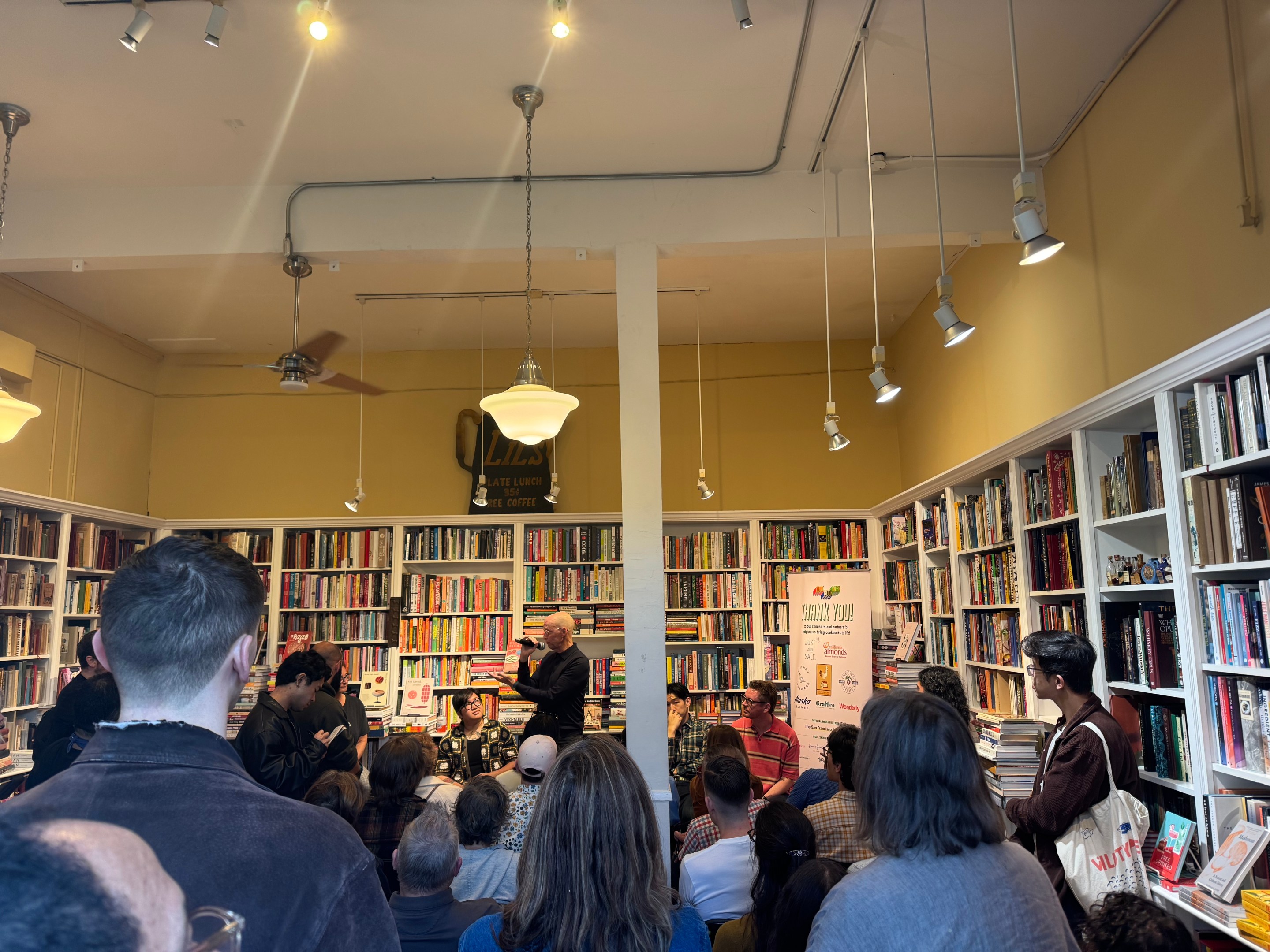
The evidence was written all over the room at Omnivore Books on Cesar Chavez Street on Wednesday night, where a packed house turned out to hear several cookbook authors discuss the relationship between their work and their audience. Some, such as Reilly Meehan and Violet Witchel, are trained chefs who parlayed their social media presence into cookbooks. All around me were people who didn’t seem to consider themselves food people, but were all internet people.
The chefs noted that recipe creation for social media and for print are very different. The algorithm rewards constant posting. This pace of recipe creation is a completely different beast than developing recipes for a book. Meehan told the audience that while his debut book A Little Bit Extra contains a lot of his personality, the recipes included may feel different than what goes online. Reels and TikToks serve the trend cycle, while the recipes included in his cookbook were in production for two years and can stand, he hopes, for decades to come.
While the internet demands quantity and frequency, a cookbook requires rigorous recipe testing, proofreading, design, and ultimately, much more of the recipe creator themselves.
“A cookbook is about building a world around a particular topic. It's art. So much goes into the creation of that volume of work from not only the recipes, but from the visuals, the photography, the food styling, and then the art direction, what the recipes look like on the page,” Hetty Lui McKinnon, a six-time cookbook author and chef, told Gazetteer SF.
“From the author's point of view, it captures a moment in time. It lets them establish a sense of place. It lets them establish expertise to the audience. Writing a recipe for a book is completely different to writing a recipe for an online audience,” McKinnon said. “For me, I develop very differently when I'm writing for a book because that recipe is part of a cohesive story.”
Still, even with so much faith in the genre, McKinnon wonders how long the market can keep this pace. The industry is catering to digital-minded consumers on a print schedule.
“The market is absolutely deluged with cookbook launches every season. It's almost like there are too many,” she said. “They need these social media personalities who have massive followings. And I get it. It's an economy of scales. It's supply and demand. They've got to meet that.”
McKinnon said she also fears that if the industry becomes too fixated on social media performance, it will leave less book opportunities for very qualified and talented chefs with smaller online presences. (And don’t forget, the algorithm is still racist, especially against women of color.)
Stewart’s sentiment that “we need cookbooks now more than ever” is a hard sell to someone who can find dozens of recipes within seconds online. But intellectual property is as valuable now as it’s ever been.
For consumers, context and quality matter, but perhaps the largest appeal right now is having something real. With every passing moment the internet becomes more saturated, “saved” folders face both accumulation and neglect, and we forget what our own palates prefer. Not only are people opting for less time online, but they’re drawn to something physical, something heirloom to smudge with oil-stained fingers and make a part of their lives.
Besides, the moment a recipe enters the digital realm, McKinnon explained, it’s vulnerable to being picked apart and reproduced by other creators or scraped by AI overviews and turned into a slop casserole, entirely void of context or flavor.
“When it goes online, it's not yours anymore. You lose authorship very quickly,” she said. “There are certain recipes that, when I develop them, I want them to stay as part of my intellectual property. The best way of doing that is putting it in a book.”