

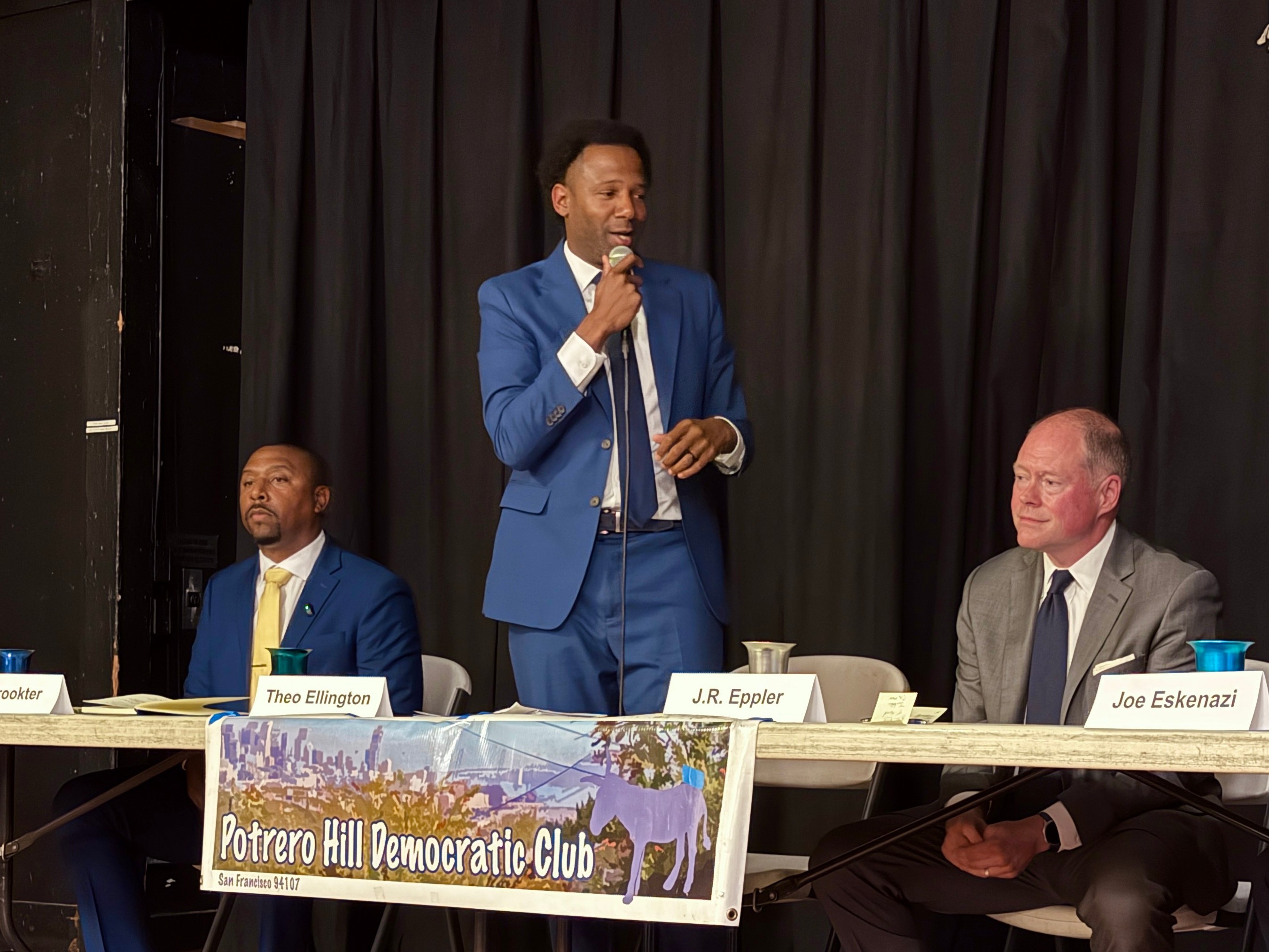

Three of the 10 (!) candidates vying to be supervisor for District 10 met at the Potrero Hill Neighborhood House on Tuesday night for a debate hosted by the Potrero Hill Democratic Club with the Potrero Boosters Neighborhood Association, and moderated by Mission Local’s Joe Eskenazi.
Laying out their vision for the district were Dion-Jay “DJ” Brookter, a community organizer and nonprofit director; Theo Ellington, a public policy director and lobbyist; and lawyer J.R. Eppler. District 10 comprises neighborhoods including Potrero Hill, Dogpatch, Bayview-Hunters Point, Visitacion Valley, and Sunnydale.
Their discussion on Tuesday was largely cordial, but tensions arose between Brookter and Ellington at a few points, with Eppler acting as third wheel. Here are the biggest takeaways from the fight for one of the most complicated districts in San Francisco.
District 10 demands more
If there was one consistent theme through the course of the debate, it was District 10’s history as an under-resourced community that has experienced some of the city’s worst developmental, environmental, and poverty crises. All three candidates mentioned the district’s inequitable allocation of budget resources and residents’ feelings of being unheard by City Hall.
The solution, at least according to Ellington: “We make sure that the southeast side of San Francisco gets the same energy, investment, and resources as the rest of the city.”
As Ellington put it, District 10 is about to see “unprecedented growth,” including housing construction and infrastructure upgrades, amid a rising population.
Brookter gave specific examples of the city’s failures: Workforce development programs in District 10 are getting “diced and sliced,” transit availability is lacking, roads remain broken.
Eppler then pointed to a study of the district’s parks: “We're the part of the city that has the kids in it, yet we have at least programming,” he said. “We're going out across town if we want to access summer programs.” He called this “inherently unfair for our neighbors.”
Confronting inequality
At various points in Tuesday’s debate, the candidates made reference to the fact that Potrero Hill and Bayview are two very different neighborhoods. It was hard not to notice the demographic of the crowd: Much whiter, and older, than you would expect further south in the district.
Nonetheless, equity was top of mind for much of the discussion. Early in the evening, moderator Joe Eskenazi asked the candidates whether the blitz of sidewalk-parking enforcement in Bayview-Hunters Point this year was equitable. All three said it wasn’t, though not in the same way.
Eppler took the most subtle approach, stating that enforcement “hurts the wrong people,” and observing that the district has more residents that rely on cars because of the lack of transit options. Ellington was more direct: “It was not equitable and in fact, it was racist, to be quite frank,” he said. He questioned why parking enforcement officers were escorted by police, describing it as a “recipe for disaster” in a predominantly Black neighborhood.
Brookter agreed. “As someone who was formerly on the San Francisco Police Commission, spending dollars to make sure that police officers are with folks who are ticketing in a neighborhood is absolutely asinine to me,” he said.
Not exactly the most pressing matter in Potrero Hill, perhaps, but it was one of many moments when the candidates basically reminded the crowd that District 10’s biggest issues frequently concentrate in Bayview-Hunters Point, including pollution, rundown housing complexes, and corruption. For generations, those residents have put up with conditions that “wouldn’t last a month and a half north of Market Street,” Eppler said.
“I know we're in the north part of the district, but these are our neighbors,” he told the Potrero Hill crowd. “These are the people that need to have safe drinking water, safe housing, safe air, dirt that's not toxic.”
Third Street deserves better
All of the candidates agreed that the stretch of Third Street that cuts through Bayview is struggling, with empty storefronts and a reputation for crime. However, when asked whether Third Street is safe, all three candidates enthusiastically answered “yes.”
Third Street may be a barometer for whether or not the new supervisor is succeeding. The corridor is “prime” for development, density, and regional transit, Ellington said. Brookter noted the number of families and young children that use the corridor daily, even if there is “a lot of work that still needs to be done.” Eppler told the crowd that he’s planning to celebrate his birthday this weekend at the “wonderful” Let’s Eat BBQ at Third Street and Shafter Avenue. All three agreed that, as the largest commercial corridor in District 10, Third Street deserves more than stagnation.
Practicing the knife fight in a phone booth
The spiciest moment of the debate came when Brookter and Ellington accused each other of being on the wrong side of the Naval Shipyard toxic waste scandal, in which Tetra Tech, the firm hired to clean up the site, falsified soil test results.
Ellington touted his experience organizing a group of homeowners and residents to sue Tetra Tech and multinational housing developer Lennar, which acquired a parcel on the shipyard site to build apartments. “That is the type of supervisor you have in me. Someone who is going to hold developers accountable, someone who is going to hold big corporations accountable,” he said.
The line triggered a sharp rebuttal from Brookter. “We actually just heard someone share they went after and sued Tetra Tech and some of the big developers, but what we should make sure [to] note is that it was for that own individual’s gain and profits,” Brookter said, not deigning to even name Ellington, who was a plaintiff in the lawsuit. Brookter also boasted that he had worked “with those same developers,” extracting development fees to create new jobs and community resources such as a math academy.
Ellington got 30 seconds to rebut, and he went for a classic campaign-trail attack: “This is a pure example of what you get when you haven’t spent enough time in this neighborhood,” he said.
“You cannot hold someone accountable when your former organization has taken over $10 million from Lennar over the past decade,” Ellington added, referring to Brookter’s work with the nonprofit Young Community Developers. “That’s not accountability. There’s another word for that.”
That swing elicited a murmur from the crowd, but others in the audience looked confused by the veiled references and personal jabs. Eppler, for one, decided to stay out of the fracas, choosing only to directly answer Eskenazi’s question about whether “Parcel A,” the one section of the shipyard that has been developed, is safe. (He said it is, but that the city needs to independently review testing at the shipyard.)
However, Eppler didn’t hold back at the end of the debate, when each candidate got a chance to ask a question to one person on the panel.
Eppler went after Ellington’s history lobbying City Hall on behalf of the property management software company RealPage in 2024 at a time when the company was being investigated by the federal government for allowing corporate landlords to collude and inflate rent prices. “Given what we knew then about how this software could hurt people who are just trying to meet their basic needs, why did you agree to represent them?” Eppler asked.
Ellington downplayed the situation, saying that he merely “facilitated meetings” between RealPage and San Francisco officials as policy director for law firm Brownstein. He then challenged critics to look at the public record of his meetings as a lobbyist: “You can see who I met with, what I met with them about, how long I met with them, and what date I met with them,” Ellington said with a smile.
When it was his turn to ask a question, Brookter doubled down on Eppler’s line of questioning, criticizing Ellington for receiving “significant campaign and financial support from technology, AI, real estate, and other wealthy interests.”
“I've heard from community members who are increasingly concerned,” Brookter said.
“I would love to meet that community person you got the question from and have a conversation with them one-on-one,” Ellington told Brookter with a hint of sarcasm.
Despite the jabs, the evening ended in demure handshakes and a smiling photo op for the three candidates.