

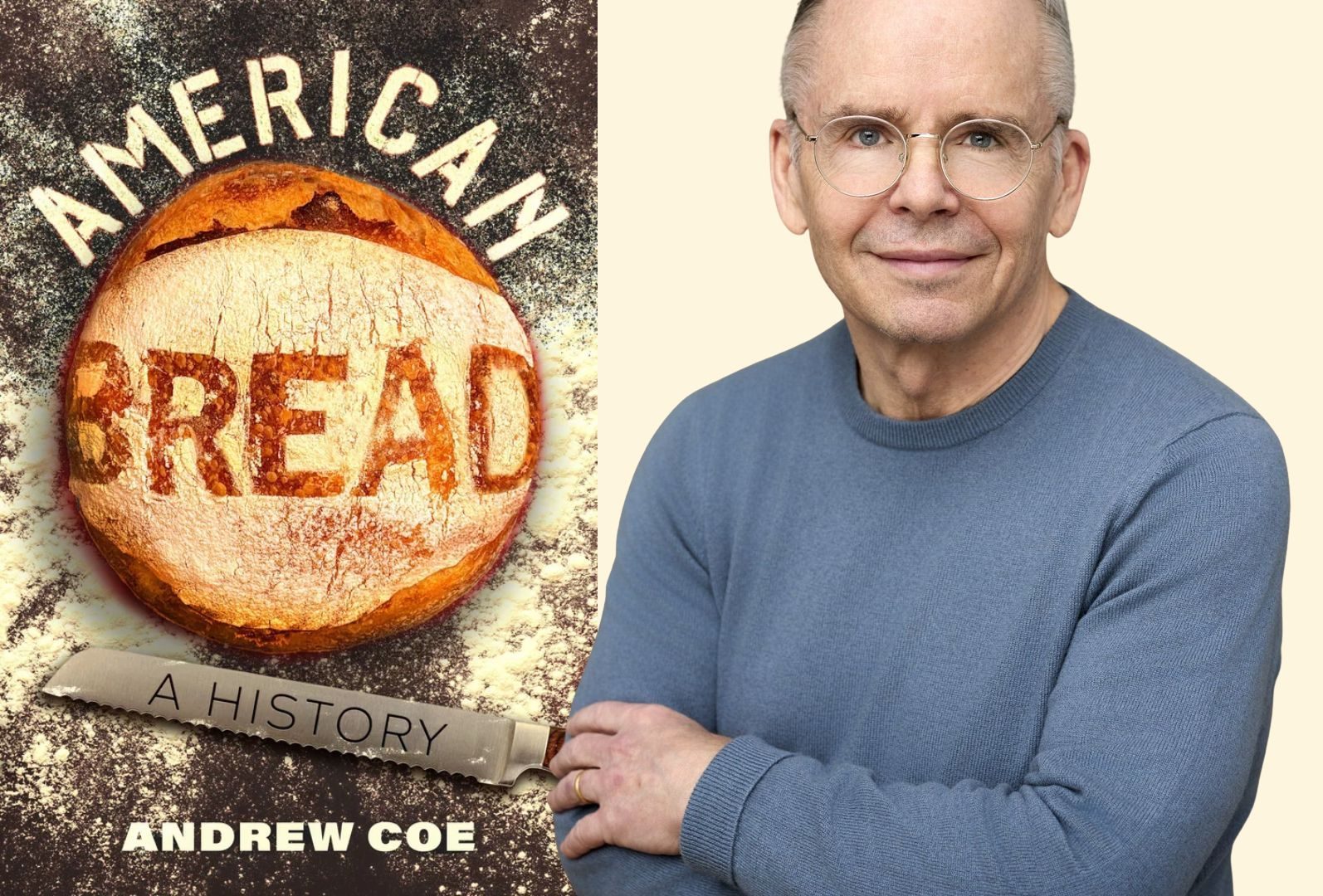

Unsurprisingly, there are dozens of mentions of San Francisco in food scholar Andrew Coe’s latest book, American Bread: A History, a historical and cultural chronicle of the beloved carbohydrate published last week by University of California Press.
San Francisco was the place, after all, where the French came in search of gold and brought along with them an affinity for baking and, according to legend, a few precious sourdough leavenings. (One of these French businesses was the now 177-year-old Boudin Bakery.) It’s also the place where, over 100 years after the Argonauts arrived, House of Bagels began making their sourdough bagels; and where hippies, drawn to Haight-Ashbury with the dream of building a community that needn’t money or order, became disciples of whole wheat and fed a neighborhood free loaves. More recently, it’s the place where Chad Robertson and Elisabeth Prueitt opened their first location of, now, several, Tartine Bakery on Guerrero and 18th Streets.
Coe is also the author of Chop Suey: A Cultural History of Chinese Food in the United States. He and his wife Jane Ziegelman won a James Beard Award for A Square Meal: A Culinary History of the Great Depression. But for Brooklyn-based Coe, nothing compares to bread. (He was making a traditional Jewish corn rye bread at home as we spoke on Tuesday.)
On Saturday, the Bay Area Culinary Historians will host Coe at the San Francisco City College’s Culinary Arts building for a book lecture and tasting of historically important breads. We spoke about his book, bread’s evolving status in American pantries, and where he’ll be shopping in San Francisco.
This conversation has been edited for length and clarity.
You've written about the history of Chinese food in the US, you've written a book on the Great Depression, you've written a pirate book. Why was bread the next focus for you?
Well, a simple answer in one sentence: I love bread.
Period.
And also, I'm a food historian and I was coming out of Covid looking around for the next book that I wanted to write. I just realized that there was a huge gap in the literature and nobody had written about bread.
What about bread and its history was so compelling to you that you felt like it was bookworthy?
I really like the atmosphere of the bakery and I think that bakers are amazing people. They work long and hard for relatively little pay and they don't get nearly as much press and adulation as chefs, but I think they're just as worthy as — if not more than — a lot of chefs.
And then, just looking at bread history, what really intrigued me is the fact that bread goes all the way back to the arrival of the first Europeans in North America around 1600 — it actually goes further back if you include Native American breads — and is important in every phase in our history.
If you look at the kind of bread that we eat today, you can see that history is imprinted in these loaves.
I loved how there's this theme throughout the book as bread being for the people. You mentioned that for the French, the ability to find bread meant the difference between life and death, or how NorCal hippie communes baked bread and gave it out for free as a way to sustain their alternative lifestyle. Where do you think bread sits culturally today?
I think there are two major trends going on with American bread today. One is that industrially produced, supermarket-bought white-pan loaves, i.e. Wonder bread and the like, are still the number one bread in America.
But on the other hand, people are becoming dissatisfied with that, and there are a lot of other bread traditions which are growing in the United States, such as the artisan bread movement. The artisan bread movement harkens back to those kinds of breads that the early colonists made. These breads also reflect the influence of and our admiration for the great traditional bread-making styles of Europe, particularly, France and Italy.
What you just said right now, how the plastic sleeve white bread is still the most popular bread in America — what are your thoughts on the war on gluten in the US, culturally and nutritionally? Cutting out bread seems to be the first recommended line of defense for most health issues.
There's a long history of health food fads, some of which I document in my book, particularly with Sylvester Graham and whole wheat bread.
Many people who have not been diagnosed with gluten intolerance seem to feel that if they cut out gluten in their diet, they’ll feel better.
And perhaps it does, but sometimes I wonder whether this is something based on how it affects their stomach or also something which is psychological — because you know, when people begin to cut out certain ingredients from their diet like gluten, sugar, fats, or whatever, it makes them feel more in control of their diet. And I think having that control makes them feel better.
That’s my theory for this, but I’m not a doctor or a scientist.
Your book talks a lot about San Francisco sourdough specifically.
Yes well, one of the things that happened in San Francisco is that bread actually got sourer — more sour than sourdough is in France. But the people developed a taste for it and they wanted their breads more and more sour. San Francisco sourdough has that particular tang which you're not going to find in French bread in France.
I think just through making bread after bread after bread over decades and decades, you know, the particular mix of lactic acid bacteria and wild yeast became very distinctive to San Francisco and that's how the San Francisco sourdough patisserie started.
You’re coming to San Francisco this week. Are there any particular bakeries that are a must-hit when you're in town?
Well, I'm trying to hit as many bakeries as possible. I'm going to Acme in Berkeley and I'll probably go to Tartine, maybe Jane the Bakery, Josey Baker.
That’s the whole point of this trip, to talk about bread, but also to eat bread and visit bakeries. San Francisco and the Bay Area in general is arguably the best bread-baking area in the country, followed by New York and probably Portland, Maine.
Oh, I didn’t know that about Portland, Maine!
Yeah, it's definitely got something going on there. But, you know, I live in Brooklyn and Chad Robertson, the founder of Tartine, is opening a bakery in Brooklyn in the next couple of months. So, we'll see what happens there.
What’s your favorite kind of bread?
Well, I like sourdough and I'm actually making a traditional Jewish sourdough corn rye right now. But I'm a ‘variety is the spice of life’ kind of guy. I like all kinds of breads, I like bagels. I don't like to be locked into one bread because my tastebuds after a while will say, Let's try something different. I'm always moving on to the next.