
Plant-based butter alternatives like I Can’t Believe It’s Not Butter or Earth Balance have been on the market for decades, and while they do alright spread on a piece of toast, they perform poorly in baked goods. There’s just something about butter — fatty, melty, delicious — that is difficult to replicate with oils like avocado or sunflower mixed with plant proteins.
The founders of South Bay food tech startup Savor think they have the solution: carbon.
Savor uses a thermochemical process that combines heat, water, and pressure to turn carbon dioxide or methane into lipids. The lipids that they derive from the carbon are then mixed with simple ingredients such as rosemary and thyme oil, sunflower lecithin (a natural emulsifier), water, and beta carotene (a pigmented antioxidant found in carrots) to mimic the color, flavor, and function of dairy butter.
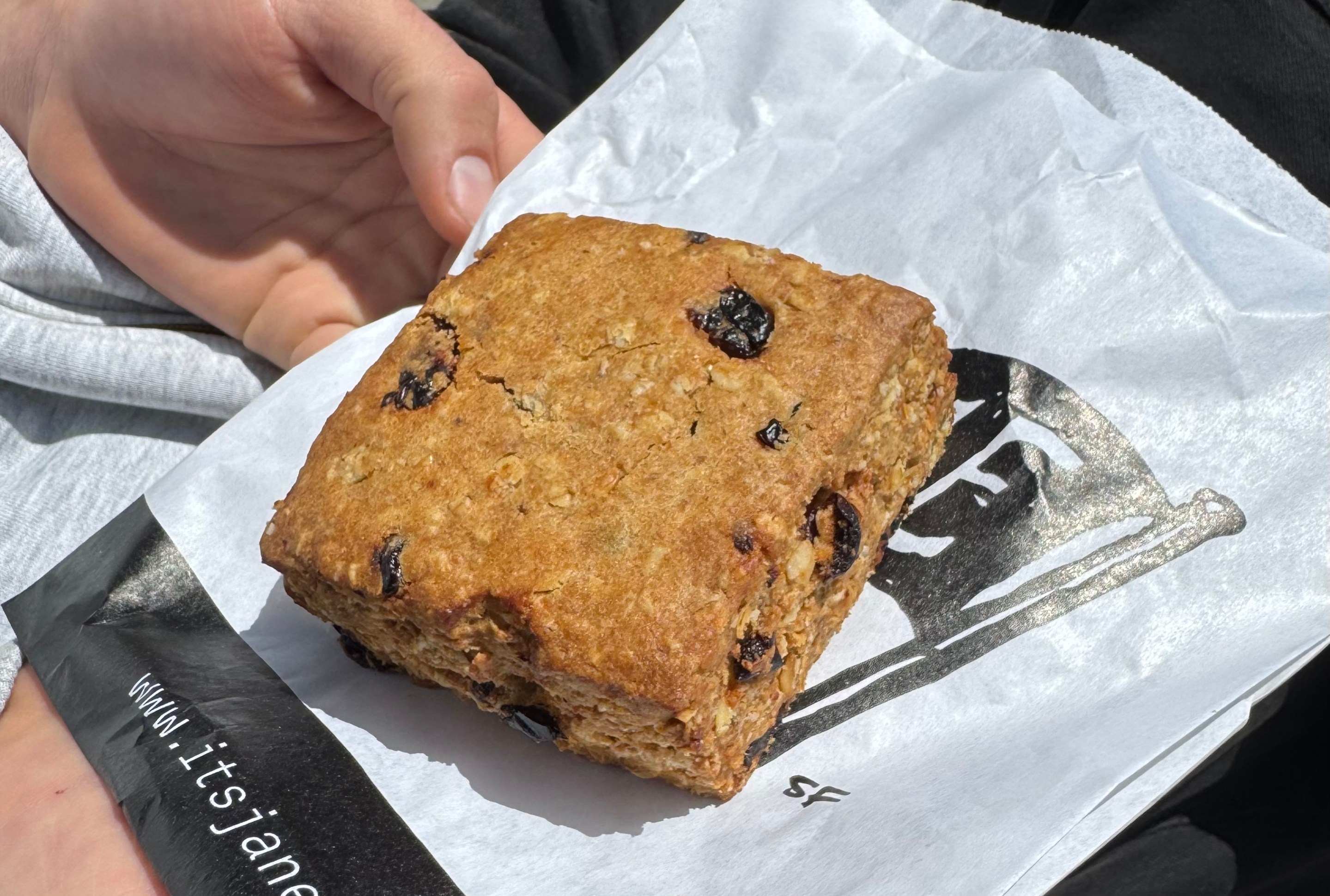
San Francisco bakeries like One65 and Jane the Bakery are starting to experiment with Savor’s carbon butter, offering vegan baked goods that better replicate the textures and flavors of the buttery originals. One65 now regularly offers products made with Savor carbon butter. Just north of the city, SingleThread in Healdsburg (recently named the best restaurant in the country) also offers dishes made with Savor carbon butter in their regular rotation. This past weekend, Jane the Bakery began selling vegan cherry scones made with it.
I went to Jane’s Geary location to taste the carbon-cherry-oat scones myself. They were undetectably dairy-free, which is to say, successful. The scone had a golden finish, held a tasty balance between dry and moist, and crumbled well. It was a bit more dense than other scones I frequent in the city, but my dining companion and I found that to be related to its oat content, not the butter’s performance.
Founder Amanda Michael said Jane the Bakery, which is known for its breads, massive cookies, and croissants, had been interested in finding a better alternative butter. “Butter substitutes are interesting because for so long, there haven’t been ones that are good enough to bake with,” she said. While certain recipes like cookie doughs can be more forgiving, she has not found a vegan butter that performs well in more technical pastries like croissants and macarons. That was until Savor approached her.
“From our first time, we found that it performed really well,” she said. “You know, we’re not looking to get rid of butter, but we’re always looking to expand our product line to be able to serve customers with different dietary requirements.”
Savor CEO Kathleen Alexander, who has a background in materials engineering, said that in addition to serving a dairy-free audience, the company aims to tackle some of the climate-related downsides of the dairy industry. Livestock production, which encompasses all dairy and meat agricultural farming, accounts for 14.5% of global greenhouse gas emissions, according to the UN Food and Agriculture Organization.
Generally, compared to unsalted butter with 80% fat (the norm for American butters), Savor claims its carbon butter generates roughly 67% fewer emissions per calorie.
Alexander and Ian McKay started Savor in 2022 and publications like Inc. and Time have praised them, but her team spent 2025 soliciting feedback, and hopefully, approval, from their only true target: chefs.
One of those chefs is Clement Goyffon of patisserie One65 on O’Farrell St. The patisserie sits on the first floor of a six-story Michelin-starred French dining concept run by Chef Claude Le Tohic. Goffyon was initially skeptical when Savor approached him early last year. “We bring everything from France,” Goyffon told Gazetteer. “The butter for the croissant is French butter, for the chocolate we use Valrhona,” a premium French chocolate.
Goyffon said Savor’s carbon butter does not yet have a strong enough buttery flavor to be used in his croissants. However, he says this milder flavor is what makes it good for the bonbons. “It's, like, very neutral. So for the chocolate, it’s perfect. I can use a raspberry puree and you can feel more of the raspberry,” he said. “I was not sure at the beginning, but now we have a lot of good feedback so we are pretty happy about it.”
People seem interested, at least for now. A line of over 100 people gathered at One65 in September to celebrate the launch of the patisserie’s partnership with Savor, eager to try the world’s first cookies and bonbons made from dairy- and allergen-free butter. A few weeks later, One65 quickly sold out of their holiday release of bonbon boxes made with it. At Jane on Saturday, there was no big marketing campaign ahead of the launch or fanfare beyond the bakery’s typical Saturday line, though I did see someone ahead of us order one of the vegan scones in addition to other goods.
Alexander says that as they scale up production significantly over the next few months, Savor plans to supply regularly to more restaurants. The company is currently only focused on selling to food businesses, not as a standalone retail product. ( Savor also recently expanded their offerings to personal care products.)
The Bay Area is currently booming with agriculture-free food tech startups, their creations popping up on menus across the city. Take Mission Barns’ cultivated pork products or Wildtype’s lab-grown salmon. Consumers seem to be open to it, as do chefs. But two major obstacles — scale and regulation — are slowing the path to market.
One such regulation is achieving a GRAS (Generally Recognized As Safe) designation, which allows legal sales in the U.S. market, a process Savor has completed. The company anticipates full commercial approval from the FDA later this year.
Analysts have been attempting to gauge and track how US consumers will respond to hyper-engineered, agriculture-free food products as they enter the mainstream. However, as San Francisco’s vegan restaurants and bakeries decline and meat makes a comeback, the reception of high-performing dairy-free ingredients may create new opportunities for what — and where — people with dietary restrictions can eat.
Like many alternative food companies, slow production and low yield could crush Savor. The same technology that Savor uses to make butter could also be used to create hydrocarbon fuels, according to a report by British chef and writer Anthony Warner for New Food Innovation. However, “The fact that it is not yet commercially viable to produce diesel in this way perhaps suggests that large scale production of bakery shortening might be an economic challenge,” Warner writes of Savor.
“Such technological solutions are useful to explore,” Warner writes, “but the jury is out on their potential to transform the food system.”
Editor’s note: This story has been updated to remove a reference to factories and landfills as a source for carbon. Those locations were mentioned as hypotheticals; non-dairy butter does not come from materials created there.