
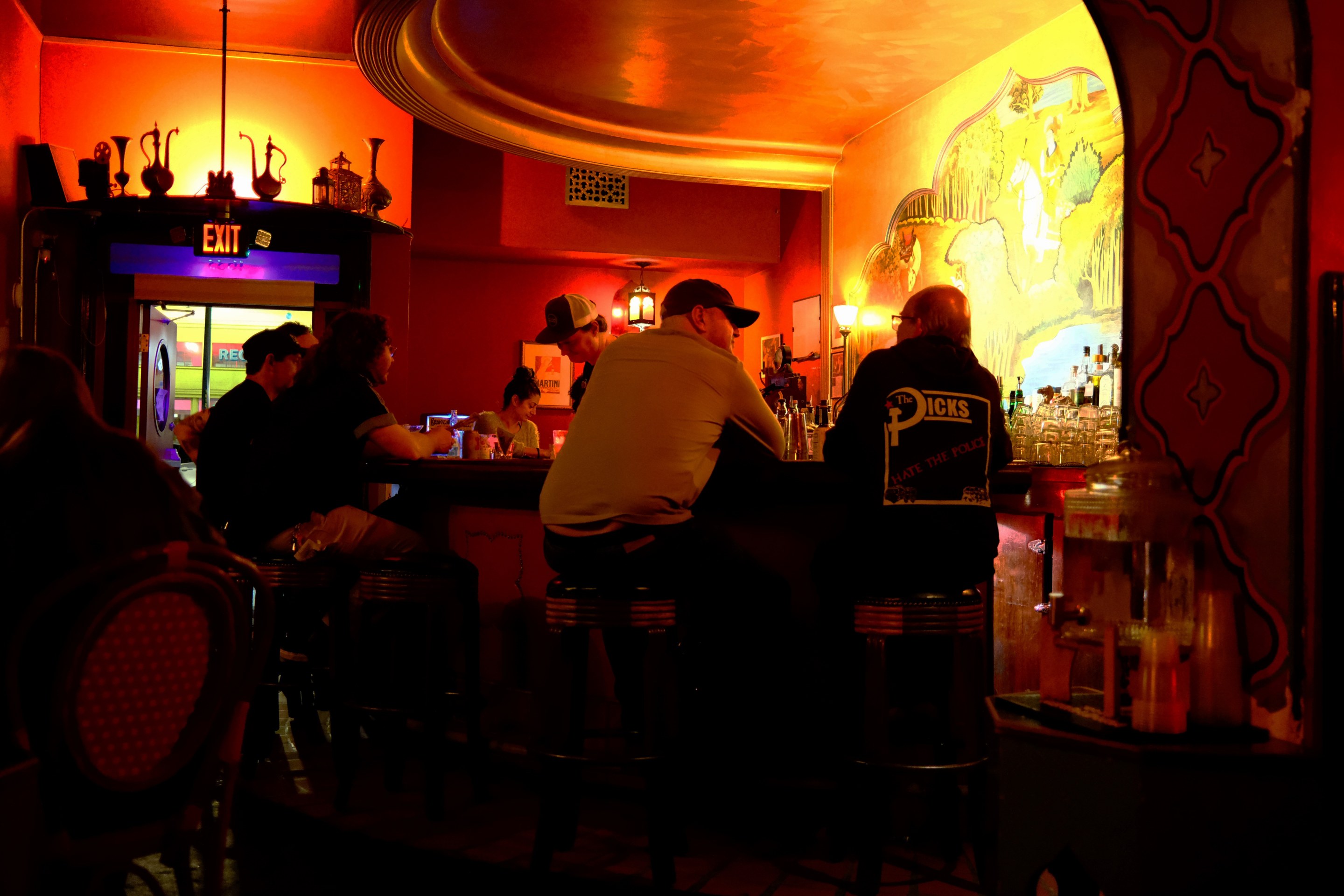

Welcome to Drinking Companion, a column about our favorite bars in San Francisco. Each month, we’ll be toasting the places that inspire us to get dressed, go out, and get a drink or two. Next up: Zam Zam.
The first sip of my gin martini was cool and clean, as Hemingway would put it, though his 15-to-1 gin-to-vermouth ratio is child’s play compared to what the folks at Zam Zam are stirring up.
Bruno Mooshei, the Haight Street bar’s former proprietor, believed a martini should be 1,000 parts gin to one part vermouth; stirred, not shaken; and never made with vodka. Stronger than his martinis, if such a thing could exist, was his belief that no one needed more than two drinks. Sensible, yes. Business-savvy, certainly not. I began to understand this after my second sip.
It drank like Freytag’s pyramid. Sublime, then suddenly, sharp and startling. The teeth it flashed in those first few sips began to bite. Soon I was fighting: my way through the drink; the urge to ask for another molecule of vermouth or four more olives; to continue writing in my notebook legibly.
I wondered: Who enjoys this? (Anthony Bourdain, evidently — he loved Zam Zam.) Is this even meant to be enjoyed?
The bar opened as Persian Aub Zam Zam in 1941 by Bruno’s father, Assyrian-born Samson Mooshei along with his brother in law, Malek. A nod to a sacred well in Mecca, the name means “Blessed Water” in Persian. (It later took on a slightly different meaning after being dubbed “the Holy Shrine of the Dry Martini” by columnist Herb Caen.) The bar’s interior is drenched in red and features Assyrian Art Deco influences. A massive mural behind the crescent wooden bar depicting a famous Persian love story was painted by the Mooshei’s original architect, Jon Oshanna, and later restored to free it of decades of cigarette tint. These days, there are two too many lamps lit inside, but that’s a forgivable offense for an otherwise perfect setting.
Zam Zam’s jukebox is, much like the rest of its interior, of a different era. It plays mostly a mix of oldies, jazz, blues, and pop hits from the 1940s through the 1970s. A handwritten plea taped to it appears years old: “Please no slow jazz, it’s Saturday night for crying out loud!” The music and its less-than-crisp sound fit the vibe perfectly, and people seem at peace with its agenda: No one so much as touched the jukebox all night.
Zam Zam was always known for holding its patrons to a certain standard: The Free Love movement of the 60s was no match for Mooshei, who simply did not stand for drugs, debauchery, or public displays of intimacy. Nor did he appreciate when patrons ordered beer over martinis or Manhattans, or when people sat at the tables instead of the bar. All were grounds for kicking someone out; it happened so frequently that it became a rite of passage. I, as a solo woman, certainly would have been booted during Mooshei’s time.
Mooshei spent 70 of his 80 years either behind the bar or in the flat above it; he passed in 2000, though not necessarily away — legend has it his spirit never left the bar. He beamed down at me from a framed photograph on the wall, watching as I bravely sipped the hell of his making. Across the way, a man talks about Mooshei as if he saw him here yesterday; he’s later appalled to hear it’s been at least a quarter century since Mooshei last stirred.
Regular-turned-owner Bob Clarke, who took over from Mooshei, has a slightly different way of running things. For starters, he hired bartenders: some prickly, some tender. The one who served me that night was like a sweet NorCal-coded, chainsmoking Michael Cera. That didn’t stop him from mixing a mean drink.
Zam Zam is still cash only, and you’d be a fool to rely on their ATM working. I watched Michael Cera field this all night: There were clearly some regulars who understand the bar’s ways; then there were people like me, not regulars but not requiring orientation; and the newbies, often on the younger side and in larger groups, immediately got the cash-only no-ATM spiel.
Though it's certainly a more lenient setting in the 21st century, my colleague Cydney Hayes summed it up well the other day: Zam Zam is a bar for adults.
Being of drinking age certainly doesn’t make you an adult; handling your martini up and dry without a shudder, and most importantly, handling your buzz, do. A cocktail lounge trapped in the body of a dive, Zam Zam is not a venue for funny business. Fun, sure, but in a low-voice kind of way. Around me, the entire bar could be broken down into groups of three at absolute maximum; most people were there in a pair or solo. Some solos became pairs as more regulars floated in.
No one stood. The martini alone, filled to the literal brim and nowhere near a pounder, makes Zam Zam sitting room only. But moreso, it feels like a place to sink in and relax.
If you sit there long enough, you’ll realize that there is a denouement to even the most aggressive of martinis; that Hemingway or Bourdain or I have no business writing after partaking in one; and that Zam Zam might be the only place you ever go for one (but never more than two) again.
Go if you like: Drinking a lot of water before bed.
Ask for: Do I need to tell you twice?
Leave: Apple Pay out of this
Avoid if you want: The daytime, shoppy-shop vibe of Haight-Ashbury
Zam Zam is open 1 p.m. to 2 a.m. on weekends and 3 p.m. to 2 a.m. on weekdays.