

On May 7, three days after San Francisco’s new RESET sobriety center opened, Mayor Daniel Lurie took to TikTok to trumpet how in its first 24 hours, the center had moved “dozens and dozens” of drug users off the street and into treatment.
The mayor’s post gave the impression RESET was off to a quick start, executing on his promise to arrest drug users at an unprecedented “speed and volume.”
That speed and volume may be a little slower and lower.
According to the sheriff’s office, RESET has admitted 320 people since it opened May 4. That’s an average of 18 people per day, which is below its total capacity of 25, especially if visitors aren’t staying at the center for a maximum 23-hour visit. It’s also a slowdown from the 140 people in its first week that a May 12 announcement by the mayor’s office touted.
But even 18 people per day may be an overestimate. For long stretches over the last two weeks — during the early morning, at midday, and late at night — Gazetteer SF can confirm that most of RESET’s 25 reclining chairs designed for people to rest, sober up, and get treatment went empty and unused.
Tara Moriarty, a spokesperson for the sheriff’s office, told Gazetteer that RESET is still in the early stages of its operation. Intermittent snapshots of how many chairs are occupied offers an incomplete picture, Moriarty asserted, and is not a measure of RESET’s success.
“As with any new initiative involving multiple partner agencies, operations continue to evolve and adapt in real time,” Moriarity explained via email.
Moriarty explained that one factor that may be getting in the way of more people being taken to RESET is previously alleged criminal activity: People with outstanding warrants for their arrest cannot be taken to the center, possibly precluding a large number of drug users from being admitted.
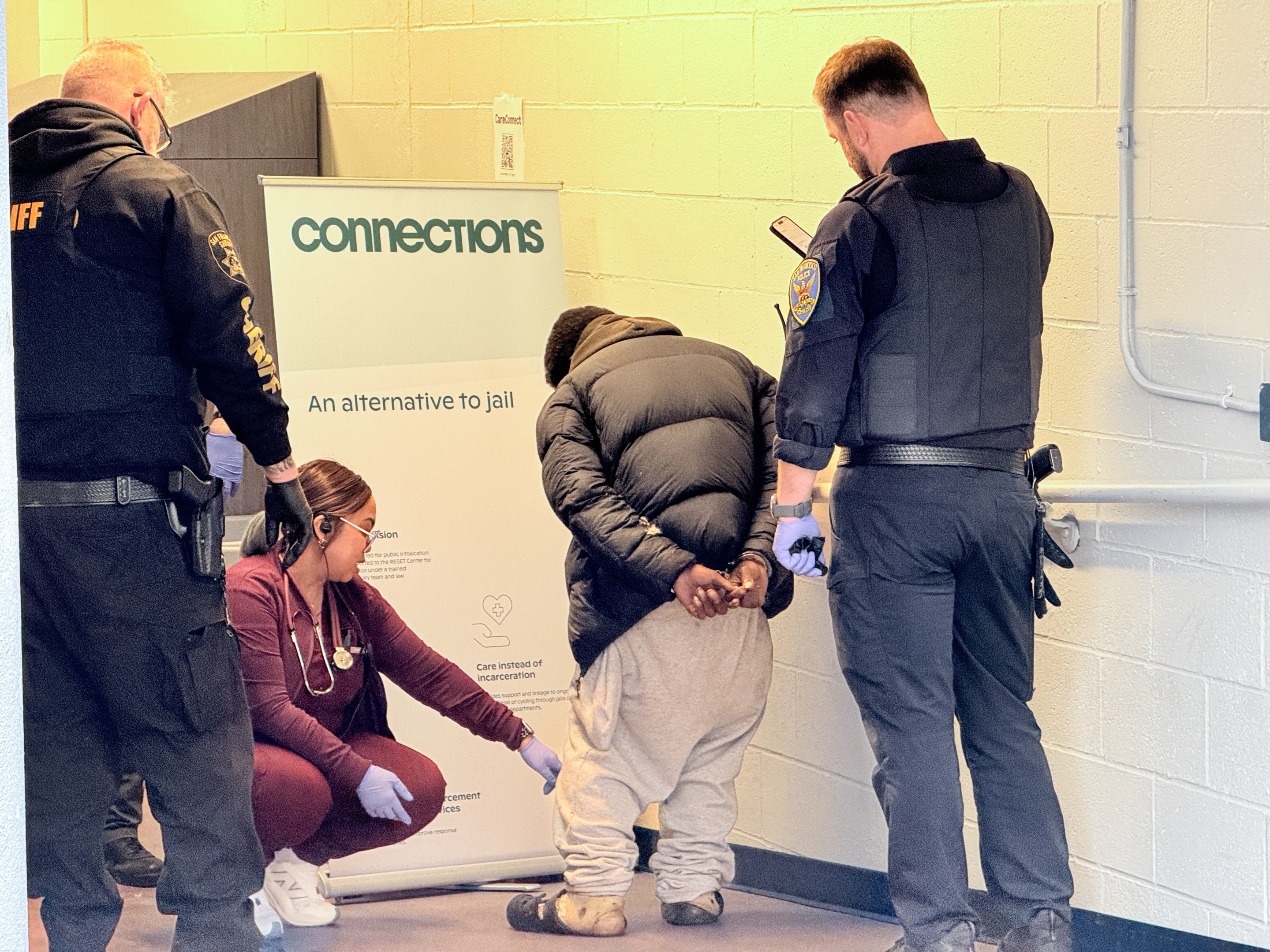
On one recent visit to the facility at 444 Sixth St., I watched and photographed a man being admitted at 6:45 a.m. But more often, I witnessed no patients being taken in, the entrance largely unused and guarded by sheriff’s deputies. Inside the center’s biggest room, it’s rare to see more than two or three visitors.
Though only in its third week, RESET isn’t lacking candidates for treatment. On any day or night in the last two weeks, a walk up the four blocks of Sixth Street from RESET to Market Street revealed clusters of people openly using drugs, hunched over or curled up on the sidewalk, a common reaction to fentanyl.
On a recent Monday evening, a man clearly in need of help was out cold on the sidewalk about ten yards from RESET’s front door. On Tuesday morning, another man just a few yards further away from the center was also laying on the ground. He remained there late into the afternoon.
Speaking to Gazetteer on background, San Francisco police officers continue to describe being overwhelmed by the city’s drug problem. An officer working Sixth Street, who spoke on condition of anonymity because they’re not authorized to speak for the SFPD, said they’d just resolved a confrontation involving a man blocking a car. The man, whom the officer said they knew from previous encounters, had recently left RESET, where, he told the cop, he had a good experience. The man was wearing a sleep mask on top of his head and carried a plastic bag with his personal belongings, a telltale sign of his RESET visit, the officer explained.
Asked about the continued open drug use in the area, and why people weren’t being arrested and taken to RESET, the officer said they were. For every drug user arrested and taken from the street, the officer said, a new user takes up their spot, some of them from RESET.
The officer said that RESET was often full.
Yet, just minutes earlier, per first-hand observation, at least half of the center’s chairs were empty.
Editor’s Note: This story has been updated with specific RESET patient numbers, and a clarification that the center has been open two and a half weeks, not three.