
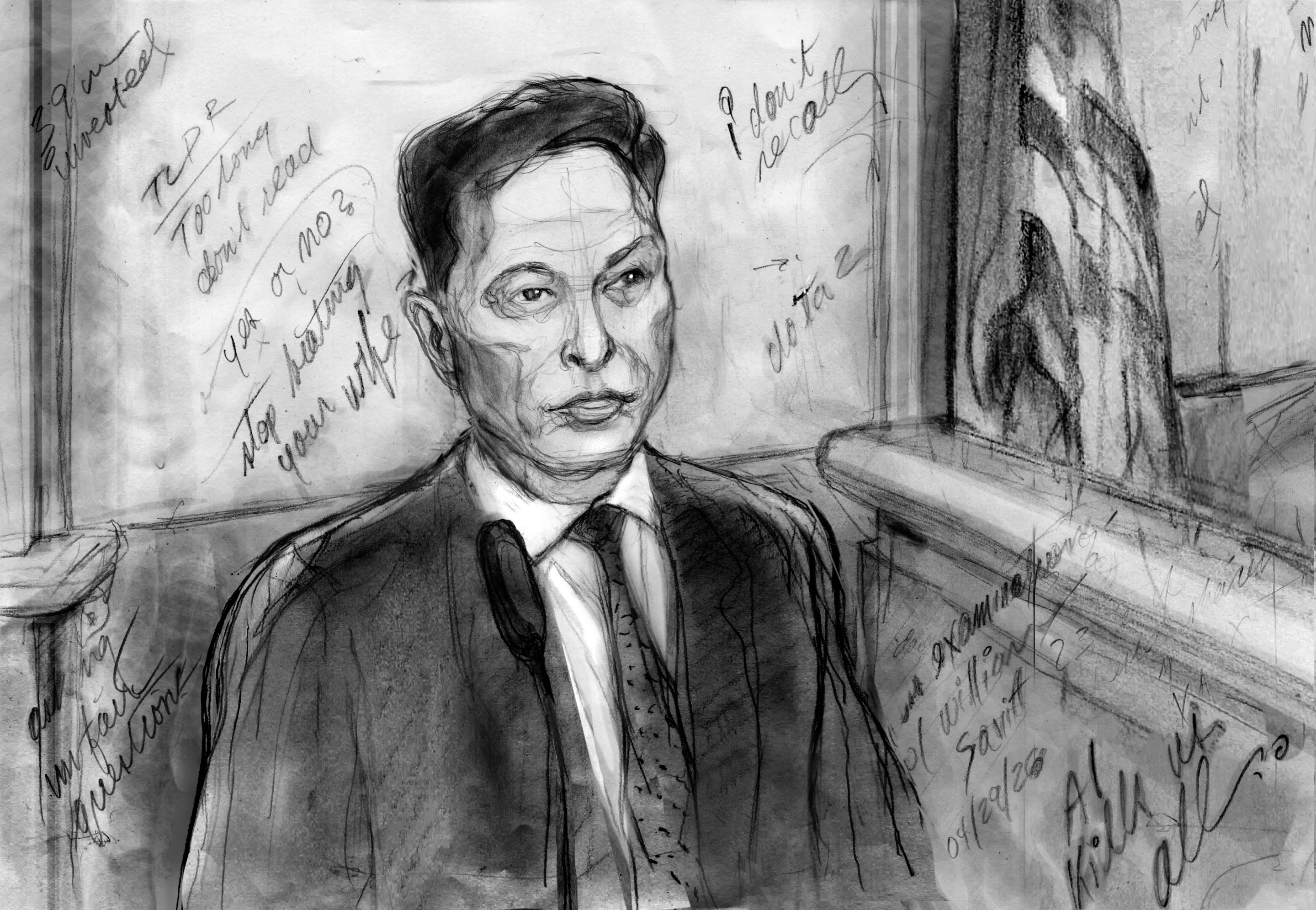

Elon Musk was on the stand, clenching his jaw as he waited to be cross-examined by Sam Altman’s lawyers. In the back of the courtroom, Lance Jackson watched with a No. 2 pencil in his hand, and thought about corpses.
Jackson is a courtroom artist, one of many who showed up to capture the scene inside the Ronald V. Dellums Federal Building courthouse in Oakland at the trial techheads and reporters insisted would be the legal showdown of the AI age.
Musk v. Altman, and particularly its verdict, turned out to be a snoozefest, unfolding with few surprises. In the end, the jury deliberated for less than two hours before rejecting Musk’s claim on a technicality: He filed the suit too late.
The most interesting part about the trial was the fact that these two men were simply there, in person, for anyone who braved the long lines and circus-like atmosphere to see. For weeks, flocks of protestors, journalists, lawyers, startup founders, and students descended upon downtown Oakland to get a first-hand look at the tech titans, whose characters are so omnipresent that they’ve become cartoonish. Sure, they have billions upon billions of dollars and outrageous influence on politics, culture, and the global economy, but what were they really like, in all their fleshy humanity?
“Musk has this jarring, strong face. His eyebrows twist sometimes,” Jackson said. But what really caught the artist’s eye were Musk’s lips. “While he’s waiting to talk, he’ll purse his lips. It’s funny to see him twisting those lips all around, like he just couldn’t remain silent. I had to figure out how to convey the twisting, sort of percolating part of the face there, between the lips and under the nose, up through the jaw.”
To do this, Jackson relied on his early lessons in anatomy: In college, he used to sneak into the medical school to watch students slice up cadavers. “There’s this bank of muscles there around the lips that I found I could pull back,” Jackson said of capturing the tension in Musk’s face on the stand. “I think I got it.”
Courtroom art is a form of graphic journalism. Photography is prohibited in most courtrooms, so the images that artists create must be interesting but, more importantly, accurate. In the case of Musk v. Altman, that meant capturing the buzzing energy of the courtroom, which on most days was so full of media and other spectators that the audience spilled into an overflow room to watch a livestream of the testimonies.
San Francisco-based illustrator Dan Bransfield found himself shunted to the livestream room on the second day of Musk’s testimony, wondering how he could produce a decent sketch from a subprime seat.
“I’m just like, ‘What can I do now?’ Here I am, sitting in these folding chairs in front of a small TV with a bunch of other journalists with their laptops out and chargers and extension cords and cables and stuff,” Bransfield said. “Then I’m like, well, maybe I can make it about the coverage of Musk, rather than just a depiction of Musk on the stand with the microphone and the flag. So I thought that lended itself to a unique opportunity.”
That day, Bransfield was on a freelance assignment from the San Francisco Standard to produce a few sketches to accompany a story about the trial. While Jackson produces dynamic, almost dreamlike sketches with regular graphite pencils and a pad of translucent vellum paper, Bransfield uses pens and watercolor paints to create bright, clean drawings that are layered with depth. (This style has attracted some big gigs over the years, including an outdoor local shopping campaign for SFMTA and an animated activation that played on the screens atop Salesforce Tower.)
Within the throngs of spectators at the courthouse, there were always a handful of artists. Among them, Vicki Ellen Behringer is probably the most well-known.
For almost 40 years, the Sacramento-based artist has covered high-profile trials throughout Northern California: The Unabomber trial in 1998; Elizabeth Holmes’ fraud trial in 2021; Apple v. Samsung in 2012, 2013, 2014, and 2018. These days, she often has a standing front-row seat waiting for her in most courtrooms.
“I’ve been around for 36 years. Everyone knows me,” Behringer said. “I work with the media, and the courts are being accommodating to the media to make sure they get what they need.” (For Musk v. Altman, she was contracted by Reuters and ABC7.)
Behringer works in watercolor. She’s known for her striking pink-purple backgrounds, a style she picked up 30 years ago, when she needed a way to break up the many browns and tans in one courtroom scene. Aside from her watercolor palette, Behringer’s courtroom supplies also include a lap desk, a seat cushion, and a pair of binoculars to make sure she can see every last microexpression.
“Altman’s got very expressive eyebrows, and he’s got distinctive features. His lips are full, and his hair is very fun to sketch,” Behringer said. (Jackson said something similar, referring to the way Altman’s hair flips up at the front as a “banana haircut.”)
At times, the OpenAI chief was also so physically demure that Behringer said it took her a few minutes to notice he was even in the room if he wasn’t on the stand. “There were just so many people. I’d be sketching and look over and go, ‘Oh my goodness, Sam’s here. I need to put him in the sketch.’”
All three artists said they tried not to let the public personas of Musk or Altman influence how they portrayed them. The trial’s subject matter, however, did influence their approaches to the art.
“I wanted to embrace as much tactile quality as possible,” Bransfield said of his choice to forgo using his iPad. “I know the iPad is not AI, but everything is so digital. I wanted a real gritty texture you could feel with these drawings.”
To Jackson, who grew up in Detroit during the automaker era, AI is not a sufficient replacement for his own understanding of the physical mechanics behind facial expressions and body language. Learning for oneself how something, or someone, works, in order to pare them down into a basic sketch, is the whole point.
“You watch these people thinking in real time,” Jackson said. “The skillset they have as a CEO, as a person in control, the language props they use… It’s so interesting, just studying that skillset. It’s fascinating to watch.”