

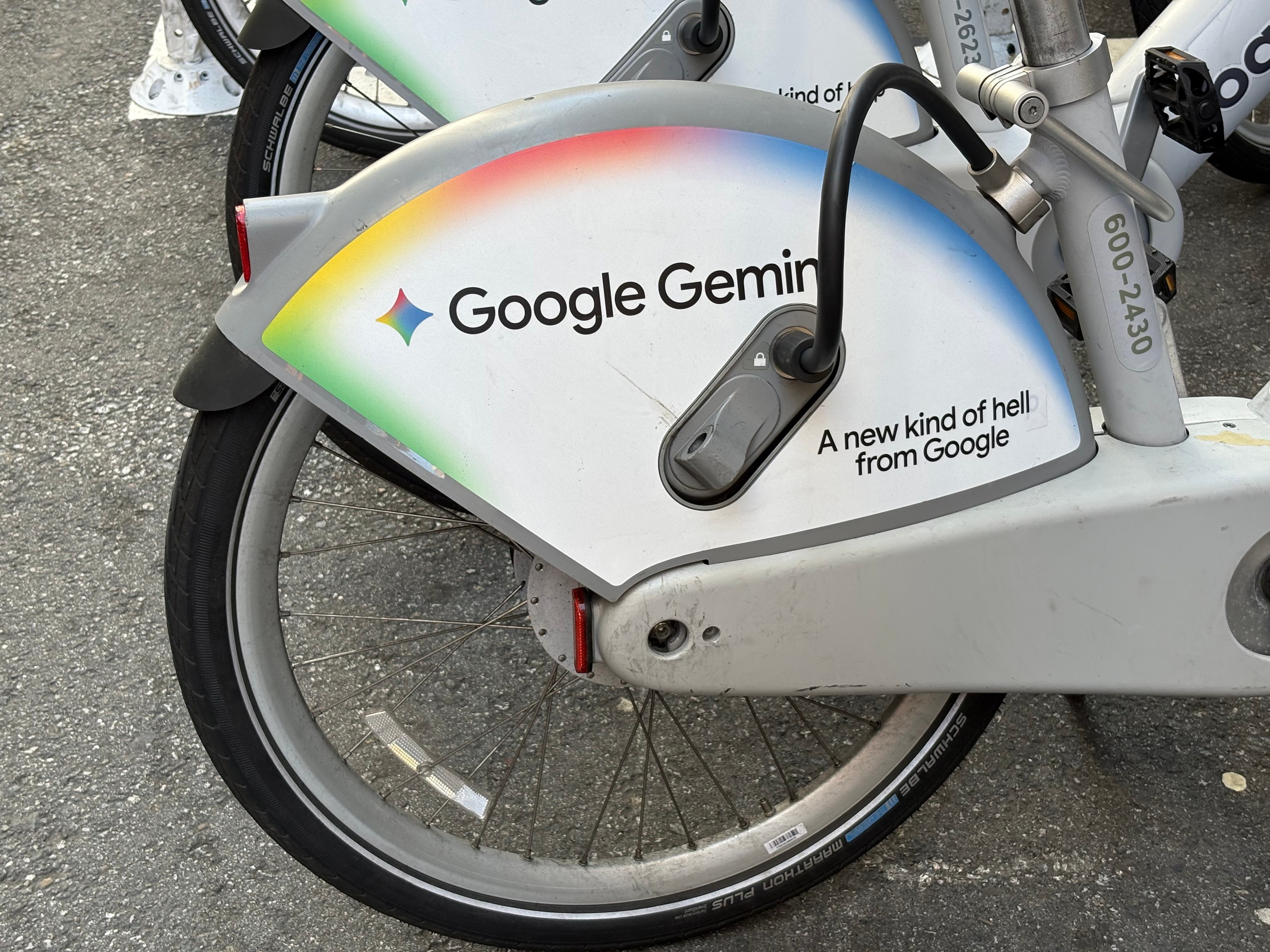
Among the thousands of Google Gemini-branded Lyft bikes whizzing around San Francisco right now, some are carrying a message for the AI industry: Gemini is “a new kind of hell from Google.”
The actual ads for the AI assistant read “A new kind of help from Google,” but someone — or many someones, since no one has copped to the mischief just yet — clearly thought “help” was too generous a word.
Luckily, it only takes a tiny sticker that changes the “p” to an “l” to make that point.
It’s unclear exactly how many bikes are carrying the anti-ads. On Wednesday at the Bay Wheels bike share station at Montgomery and Sutter streets, ten of the 30-some Lyft bikes available at the dock had had their “p”s stickered over. A handful more also appeared to have had stickers recently peeled off, presumably by the Lyft maintenance team in charge of Bay Wheels.
When asked for comment, Lyft spokesperson CJ Macklin did not speak directly to the stickers, but said, “When we identify bikes that have been altered, whether through stickers or other modifications, our operations team works to restore them to their intended appearance as quickly as possible.”
Google did not respond to Gazetteer SF’s request for comment.
Whoever they are, the hellions appear to have been stickering the ads for nearly a month now, when photos of the anti-ads started showing up on local subreddits. The guerilla campaign is one of the latest instances of what’s known as culture jamming, or the modification and subversion of mainstream media and advertising, usually as a form of protest against consumerism and corporate power.
Like so many countercultural practices, culture jamming has roots in San Francisco, and in an aversion to the tech industry: The term was coined in 1984 by the Bay Area-based techno-Dada rock band Negativland to “describe billboard alteration and other underground art that seeks to shed light on the dark side of the computer age,” wrote cultural critic Mark Dery, who popularized the term in a 1990 New York Times feature and, later, a chapbook on the subject.
San Francisco has always been a great mecca of culture jamming, bearing subversive street art groups like the San Francisco Mime Troupe and anti-corporate bands of “brandalists,” to borrow another Dery term, like the Billboard Liberation Front. Now as AI companies plaster public spaces with inane, self-aggrandizing, and downright hostile ads for the same technology that’s fueling sweeping layoffs, breaking the job market, and rapidly advancing a new sort of mass psychosis, startups and corporations are also providing pranksters with a lot of jammable real estate that’s proving too tempting to pass up.
But how tempting is too tempting? In the past few decades, advertising has become extremely sophisticated, moving far beyond just co-opting the countercultural symbols for corporate gain and becoming fluent in ragebait, memes, and manufactured virality.
In the case of the Gemini ads, some people online have wondered if marketers at Google actually anticipated the subversion and wrote their tagline to help people tell AI to go to hell.
“Oh they fully expected somebody to do this and share it on social media so they’d get millions of engagements for free. mission accomplished,” one user posted.
On the same forum, another added: “I, a person living in Vietnam, would have never seen this ad otherwise.”