

Market Match, a statewide food security program that provides a dollar-for-dollar match for recipients of CalFresh and other food benefit programs to spend at local farmers markets, was not included in the state’s 2026-2027 budget following announcements from Governor Gavin Newsom’s office on Thursday. This would drastically limit recipients’ access to fresh food in the state and impact farmers’ earnings.
Christine Farren, the executive director of Foodwise, a San Francisco nonprofit that oversees farmers markets, and Martin Bourque, executive director of the Ecology Center, which administers the Market Match program statewide, were part of a coalition scrambling to secure funding for the program on Thursday. Assemblymember Damon Connolly and State Sen. Josh Becker were also working with the coalition to direct funding to the program.
The effort to save Market Match comes at a tense time for those working in food security: CalFresh is facing the largest funding cut in the program’s history, impacting 665,000 Californians beginning in June alone, according to the California Association of Food Banks. Many food banks, which are the next resource for food insecure households when SNAP benefits are insufficient or cut entirely, are already facing high demand and are facing their own funding crises.
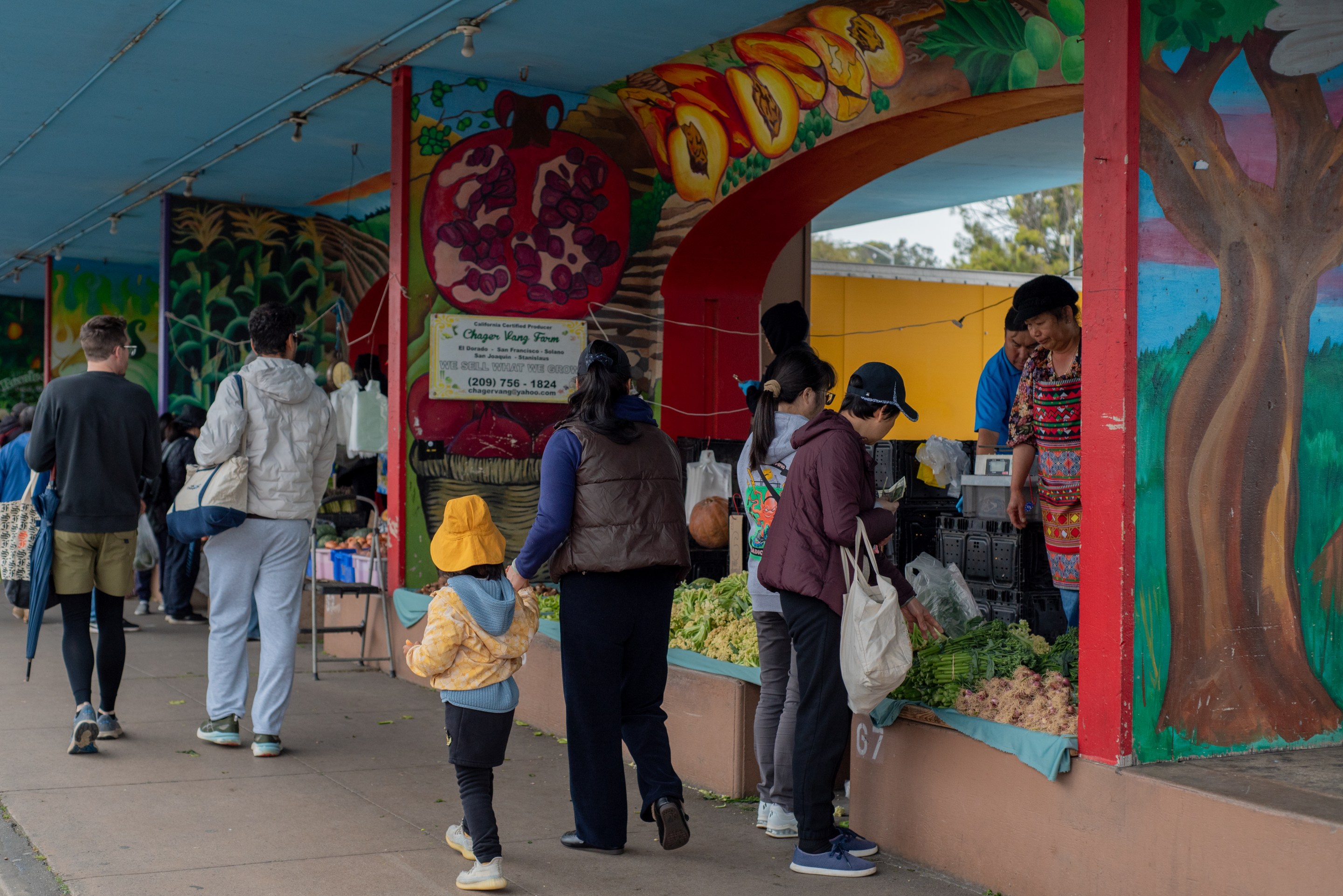
Recipients of CalFresh food benefits can receive tokens to spend at farmers markets across the state. For participating Market Match markets such as the Ferry Plaza, Clement Street, and Mission Community markets, CalFresh recipients receive $1 of EBT credit and $1 of Market Match credit up to $15 to spend exclusively on fruits and vegetables. That turns $10 of CalFresh benefits into $20 worth of produce.
More than 650,000 people statewide used the program last year to access nearly 50 million servings of fresh produce, according to the Ecology Center. Market Match accounted for $25 million in fresh food sales statewide, nearly $6 million of which was spent in San Francisco alone, where some 112,000 people receive CalFresh food assistance.
The coalition trying to save Market Match says the program has previously received bipartisan support because it addresses the needs of both urban and rural residents. Market Match, in addition to expanding access to locally-grown food, has bolstered income for small farmers. For every $1 in Market Match spent at farmers markets, $3 is generated in the local economy as farmers reinvest in their operations, according data from the coalition.
Farmers’ takeaway is higher with person-to-person sales: More than 95 percent of every dollar spent at farmers markets goes directly to small farmers, compared to just 15.9 cents per dollar at supermarkets. At the Ferry Plaza Farmers Market and Mission Community Market (both managed by Foodwise) Market Match and CalFresh directed $300,000 to small farmers last year, Foodwise said.
“There are a number of farms that 25 percent of their revenue comes from the people who shop with their food benefits,” said Farren. “It’s nutrient dense, super fresh, really delicious food and the person you're buying it from is getting this income stream that’s really important to them. The irony is that some farmers and their employees are actually eligible for food stamps themselves.”
Market Match began in 2009 and was later lumped under the California Nutrition Incentive Program (CNIP) after it was formed in 2015. In addition to state general funds, CNIP receives federal funding through Gus Schumacher Nutrition Incentive Program grants, which matches state funding, as well as private donations. In 2024, after a similarly difficult push, the state allocated $35 million to CNIP, which is set to run out early 2027.
Throughout the program’s history, there has been no permanent or ongoing General Fund appropriations, meaning that Market Match is subject to fluctuations in — or denial of — funding every two-year budget cycle.
With this year’s budget deadline approaching, the risk to food insecure Californians could be dire.
Earlier this year, the Market Match line at Civic Center’s Heart of the City farmers market — where CalFresh recipients trade their dollars for farmers market and Market Match tokens — was hourslong every Wednesday and Saturday. (Videos of the line went viral.) To stretch its funds throughout the year, the market reduced its match limit to $30 per benefit-holder per month.
Newsom in his final budget presentation on Thursday revealed a lean spending plan to stave off a long-term deficit in the future. The governor is not proposing new spending to backfill gaps created by federal reductions in programs such as Medicaid or SNAP passed in H.R. 1, also known as the One Big Beautiful Bill Act, despite an injection of tax revenue.
The absolute latest the state’s budget can be finalized is midnight on June 15. Program advocates were hoping to see a lifeline for the program in the governor’s May Revise budget announcement, which was published Wednesday morning without mention of Market Match.
Bourque drove out to Sacramento shortly after the budget revision was published to bring his argument directly to the governor’s office.
In addition to Newsom’s office, the coalition will be campaigning their needs to State Sen. John Laird, the state senate budget chair, and State Sen. Melissa Hurtado, the chair of the subcommittee that oversees CNIP funding. On the state assembly side, they are directing their concerns to Assemblymember Jesse Gabriel, the budget chair, and Assemblymember Steve Bennet, the chair of the subcommittee that oversees any CDFA funding. Until June 15, the Capitol is going to see very intensive budget hearings as the legislative bodies and the governor’s office battle for their priorities.
“It is the 11th hour for sure,” Bourque said. “If there isn't state funding, then we lose out on the federal match. So, there's a dollar for dollar federal match that the state has been successful at landing in the past. And those are the two sources that could support this size of the program over time.”