


The retail space at 680 Valencia St. is as foreboding as it is famous. Those familiar with the cavernous storefront near the corner of 18th Street remember it as the once-bustling Hawker Fare before its post-pandemic closure. In the years since, 680 Valencia, despite its twinkly-lit surroundings and no shortage of money-spending pedestrians, has been shrouded in what appeared to be a curse.
While the origins of this curse remain veiled, its effects were evident: No business could survive. In 2025, the barbecue restaurant Smokey Joe closed after just six months. In 2024, a Petra Mediterranean, with a Mitchell’s ice cream pop-up and belly dancing, couldn’t survive. 2023 saw the demise of The Kickback breakfast restaurant and bar.
Each new restaurant concept was darker and dingier than the last, as if already resigned to its fate — that is, until now.
When the paper was finally torn from the large glass windows of Mandi House’s facade six months ago, hope poured from within the palace-style banquet hall. After opening its doors in June, the restaurant, which serves traditional Yemeni food from 11 a.m. to 1 a.m. daily, has welcomed a steady stream of customers no matter the day or hour. Named after the Yemeni dish made from rice and tender, slow-cooked meat such as lamb or chicken, Mandi House had already amassed a following at its first location in Los Angeles before expanding to San Francisco.
At the risk of jinxing this new spot, it seems Mandi House owner, Faris Alqabass, has employed several spells and defenses to rid 680 Valencia of its curse.
Firstly, it undertook a grand makeover: Mandi House’s massive, glistening interior alone is a visual feast, and one very distinct from typical low-ceilinged and short-of-seating San Francisco restaurants. (It feels like you’ve been transported to Southern California, or Houston, where square footage grows naturally in abundance.) The sprawling hall beyond features white and grey faux marble aglow beneath a bright lofty ceiling. On the walls, there are large illuminated signs, including an outline of the nation of Yemen and replicas of qamariyahs, traditional Yemeni stained glass. Large screens play Yemeni cultural and historical videos. A special dining zone under a canopy is the most desired seat in the house, putting diners on display to passersby through large windows. And then there’s also an entire second floor.
Another defense against the curse is Mandi House’s ability to accommodate large groups: Along one entire wall, traditional majlis booths easily fit groups of eight to ten, complete with their own shoe racks (as the cushion seating is traditionally shoes-off), pillows and and moveable arm cushions. There are also tables in the center of the room that can be pushed together to fit anywhere from four to 20. Few restaurants in San Francisco will happily host walk-ins on a Friday night at peak dinner time, let alone eight of them. (Hello Mission Chinese, we love you.) However, at Mandi House, where reservations are nil and darkness is nigh, the manager Omar met our sheepish request for a big table with excitement.
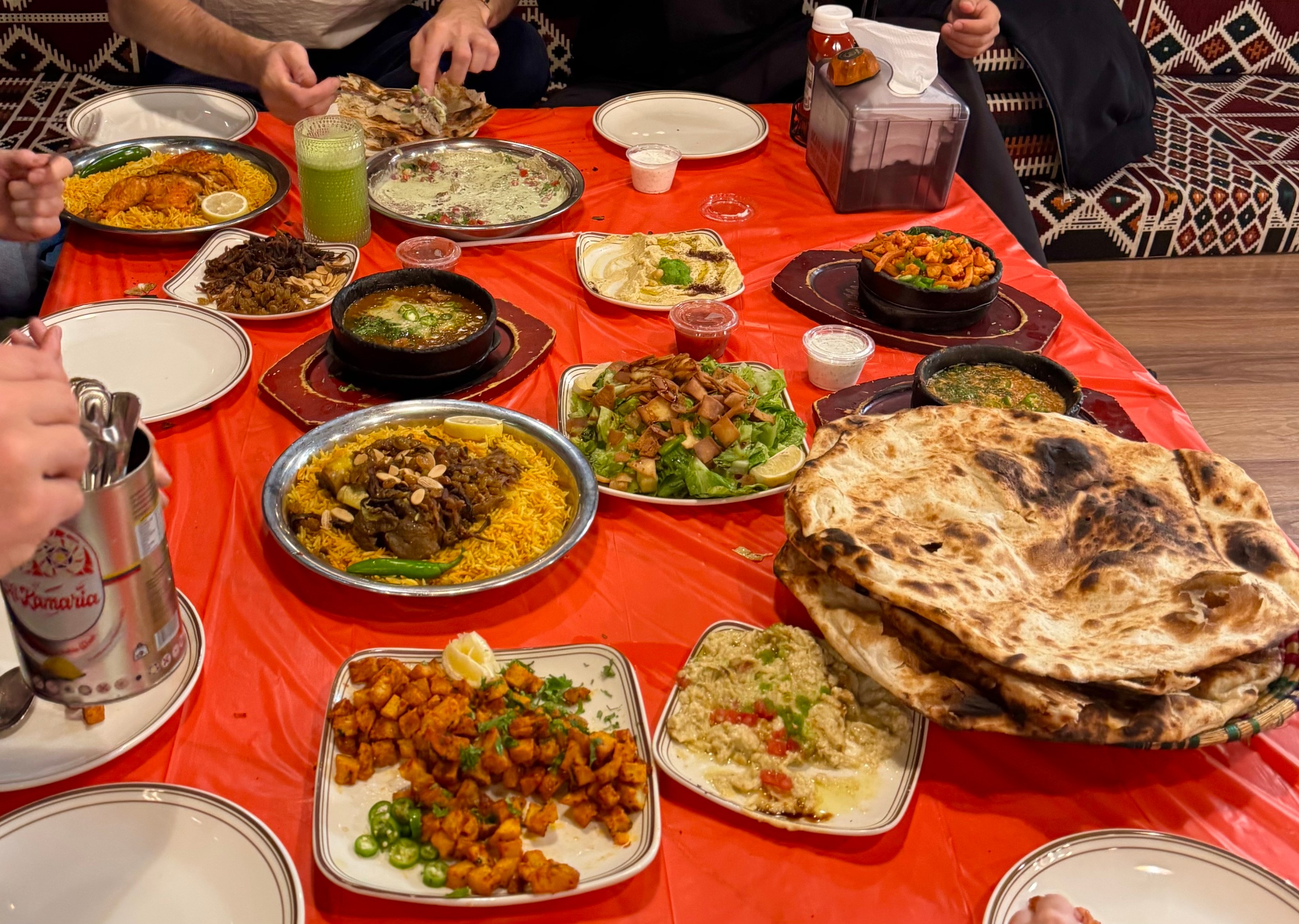
Of course, you can’t break a curse by simply baiting customers with smoke and mirrors: Food is the most necessary ingredient. Mandi House’s several-page menu, which includes breakfast, lunch, and dinner dishes, is available all day. Appetizers include favorites: hummus, muttabal (a roasted eggplant dip), fattoush, shafoot, and spicy potatoes. The dips, among other dishes, are accompanied by large (like, 15-inch diameter) pieces of warm, stretchy tandoor bread.
A wandering eye will notice steaming cauldrons on every table: These are hradas, stone pots in which stews and meats are cooked and served. Mandi House offers hradas of seltah, the national dish of Yemen, consisting of a bubbling-hot meat, fish, or vegetable stew. Entrees include the eponymous mandi chicken or lamb, or lamb madhbi, grilled over hot stones instead of slow-cooked. Mandi House also offers large sharable dishes, such as lamb haneeth and mandi chicken that range from $80 to $180.
The appetizers alone, with massive rips of bread, are reason enough to justify a visit.
Pots of karak tea, a spiced milk tea, are available, as is freshly-squeezed lemon juice with mint (not lemonade). And just when you think you’ve had enough and the bill is paid, outside, there is sometimes a table selling hot, fresh kunafa, a dessert made from layers of shredded pastry dough and a melty unsalted cheese and topped with a sweet sugar syrup and pistachios. One is more than shareable — especially after that meal you’d’ve just had — but much like everything else at Mandi House, the offering of kunafa has a “When in Rome” charm that’s difficult, and pointless, to resist.
Yemeni cafes, such as Delah Cafe and Heyma Cafe, are booming in popularity in San Francisco right now, though restaurants serving Yemeni cuisine are still few and far between in the Bay Area. Not only is this a much-needed outpost for folks craving Yemeni food, but it’s one of the few restaurants on Valencia Street (aside from Panchitas and the weird but trusty AI-ified pizzeria) that will feed you past 10 p.m. Perhaps this is partly how Mandi House has beaten the curse: by satisfying a couple specific wants in a neighborhood that already has everything you could ever need.
Mandi House did not respond to Gazetteer SF ahead of press time, so we’re unsure whether they knew, or cared, about 680 Valencia’s curse. All we do know is that the curse appears to be broken and now, we’re all under Mandi House’s spell.