
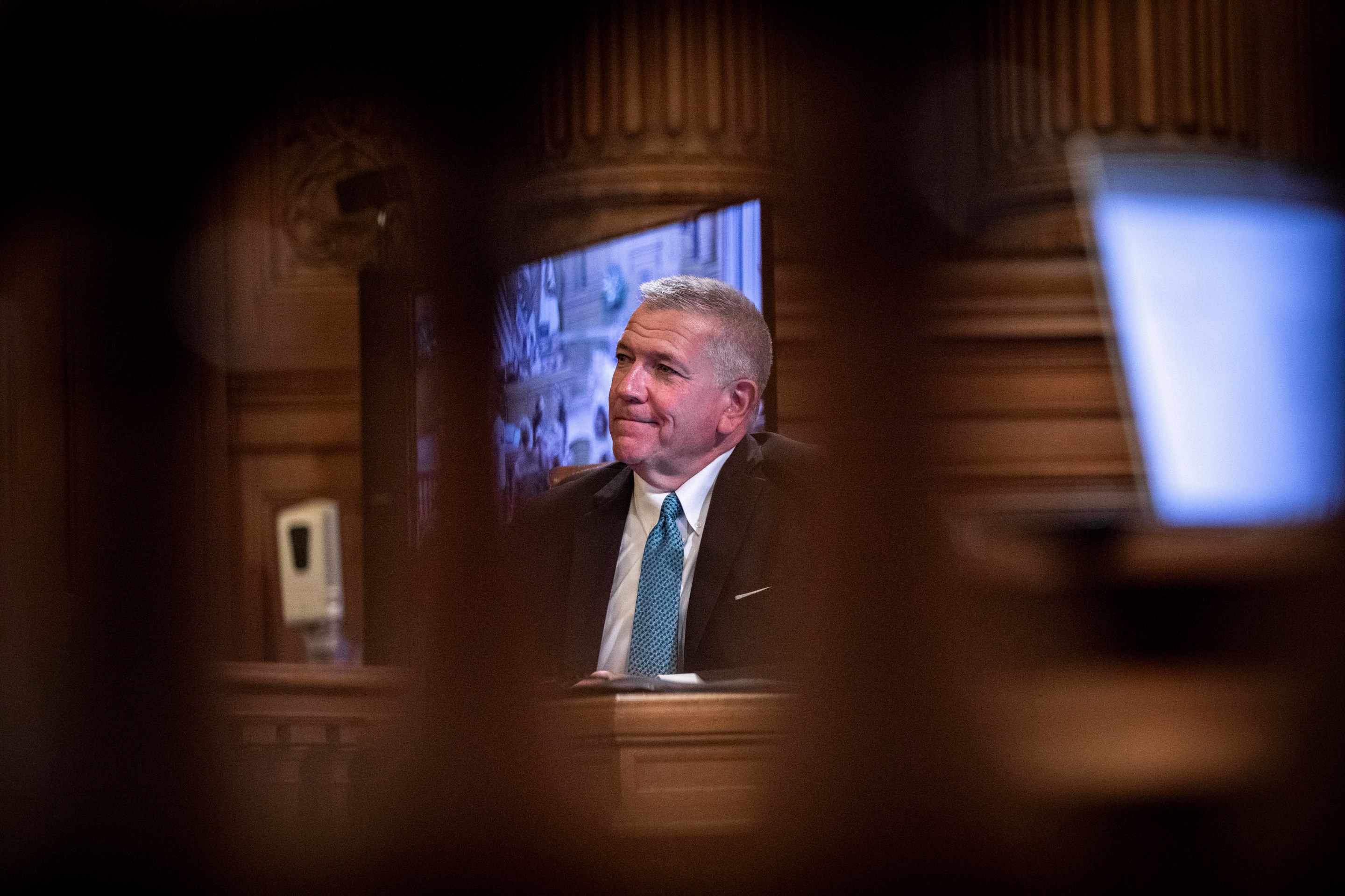

District 6 Supervisor Dorsey was glued to Mayor Daniel Lurie’s side at City Hall Feb. 17. That morning, the mayor signed legislation formally creating the city’s new RESET center, a controversial development in the supervisor’s district, which Dorsey acknowledges is home to a disproportionate number of homeless shelters and drug treatment centers.
After Lurie spoke for just a few minutes, Dorsey took the podium.
“Anybody coming to San Francisco needs to know that there are now three new options: Get sober, get arrested, or get out,” he said at the signing ceremony. “But the party is over.”
Now scheduled to open in May, RESET stands for Rapid Enforcement, Support, Evaluation, and Triage. The center’s distinguishing feature is that it is involuntary, meaning visitors are first arrested for drug use, and taken there by law enforcement officers. RESET is the “single most important policy shift in San Francisco since the advent of the fentanyl crisis,” Dorsey said at the ceremony.
It was an awkward statement, and, at the same time, pure Dorsey. A recovering addict, Dorsey knows better than most that fentanyl is no party drug. His PR-inflected delivery felt stiff, and like something Dorsey might’ve produced in his previous incarnation as a spokesperson for the San Francisco Police Department. Above all, in his words and presentation, Dorsey seemed eager to align himself with Lurie and the mayor’s push to arrest drug users.
Which isn’t to say he doesn’t believe in it. In multiple interviews with Gazetteer SF, the supervisor described drug policy as both a passion and a means of political survival. Dorsey is on a quest to loosen fentanyl’s deadly grip on the stretch of Sixth Street in the South of Market neighborhood of his district and citywide. Fentanyl is a preview of what Dorsey referred to in an interview as the “synthetic drug era, when drugs are more potently addictive, more profitable, more deadly, and resulting in the sort of street-level disorder beyond what we have seen in years past.”
Manufacturing synthetic drugs is simpler, Dorsey said, and restricting access to their precursor chemicals, and flow from other countries, more difficult. Supply-side interventions that might’ve curbed heroin have diminishing returns, according to Dorsey: “I think we need better, more life-saving interventions on the demand side, and that’s what the RESET center is all about,” he said.
Not everyone in Dorsey’s district shares his enthusiasm. A voice of opposition is Leah Edwards, co-founder of the SOMA West Neighborhood Association, who argues RESET violates the One City Shelter Act (OCSA). Passed last year, the ordinance aims to spread shelters and treatment facilities more evenly throughout the city, and prohibits their approval in neighborhoods that have a disproportionate concentration of them.
According to materials provided to the Board of Supervisors as they deliberated OCSA, District 6 has one-third of the city’s shelter beds, where more than 1,200 people sleep on any given night. The SOMA West Community Benefit District has published a map illustrating the distribution of shelters and treatment facilities citywide.
“We’re not saying, ‘not in our backyard,’ we’re saying, all of it is already in our backyard,” Edwards said. Continued open drug use on Sixth Street makes street conditions difficult, reduces foot traffic, and causes businesses to struggle, she said. The neighborhood hasn’t received adequate law enforcement or street cleaning services, she added. “We want some of that to be alleviated before adding more [supportive services],” she said.
RESET will attempt to connect visitors to longer-term care. That’s optional, however, meaning once patients are sober, they are free to leave. SoMa residents are skeptical about its location on Sixth Street, between Bryant and Harrison. It’s unrealistic to expect a freshly sober drug user to walk out of the center and resist dealers plying Sixth Street, Edwards said.
“I just don’t think that's fair to either the folks in the programs, or those outside of them,” Edwards said.
The biggest shock to Dorsey’s constituents was how they learned about RESET. They had received assurances from the mayor’s office, and the supervisor, that after the passage of the OCSA, the city wouldn’t approve more supportive services in SoMa, Edwards said. Then came a Nov. 12 Chronicle story, citing Lurie’s office as its source, and quoting the mayor, announcing RESET and its location at 444 Sixth Street, squarely in District 6. Many in the neighborhood felt betrayed.
“I caught hell,” Dorsey said, describing the reaction from his constituents. “There was some anger about how it was rolled out.” The messaging wasn’t “optimal,” he added. “And I say that as somebody who spent a lot of my career doing communications work, we didn’t really have this buttoned up.”
Dorsey said he had no say in where RESET was located. Curiously, Dorsey maintains that he was blindsided by the Chronicle story, not the Lurie administration — even though he also learned of the RESET announcement from the news story, and not the mayor’s office. His response, intentionally or not, gives the Lurie administration cover for the center’s botched rollout, for which he, so far, has paid the highest price with constituents.
The day after the Chronicle story ran, Dorsey and city officials, including Kunal Modi from the mayor’s office, got on a Zoom call with SoMa residents, who were told that RESET is an exception to OCSA because drug users are taken there involuntarily, a position that Dorsey maintains in interviews with Gazetteer SF.
“The frustration with Supervisor Dorsey has been that he is the point person to be managing things like this for the neighborhood,” Edwards said.
Dorsey has supported two other shelters since OCSA was passed, she said. The first, on 11th Street, didn’t move forward. A second, Jo Ruffin Place, at 333 7th Street, did. Dorsey’s position on RESET and the other shelters “is at odds with what the neighbors in SOMA West have been advocating for,” Edwards said.
Dorsey’s support for RESET is rooted in its “custodial intervention.” While he doesn’t yet fully reject supervised drug consumption, given what he’s learned about synthetic drugs his support increasingly leans towards drug-free facilities, including James Baldwin Place, the Salvation Army’s Harbor Light rehabilitation program and Hope House, where he said he volunteers every Saturday.
The supervisor said he is a three-time graduate of drug rehabilitation programs similar to that at Jo Ruffin Place, which closed during Covid, and will be reactivated.
“I am about nothing if I’m not about this,” Dorsey said. “I’ve had to say to some residents that there’s no scenario where I'm going to be opposing drug treatment – and no hard feelings if you’re not going to support me for that. But that’s why I asked for this job.”