

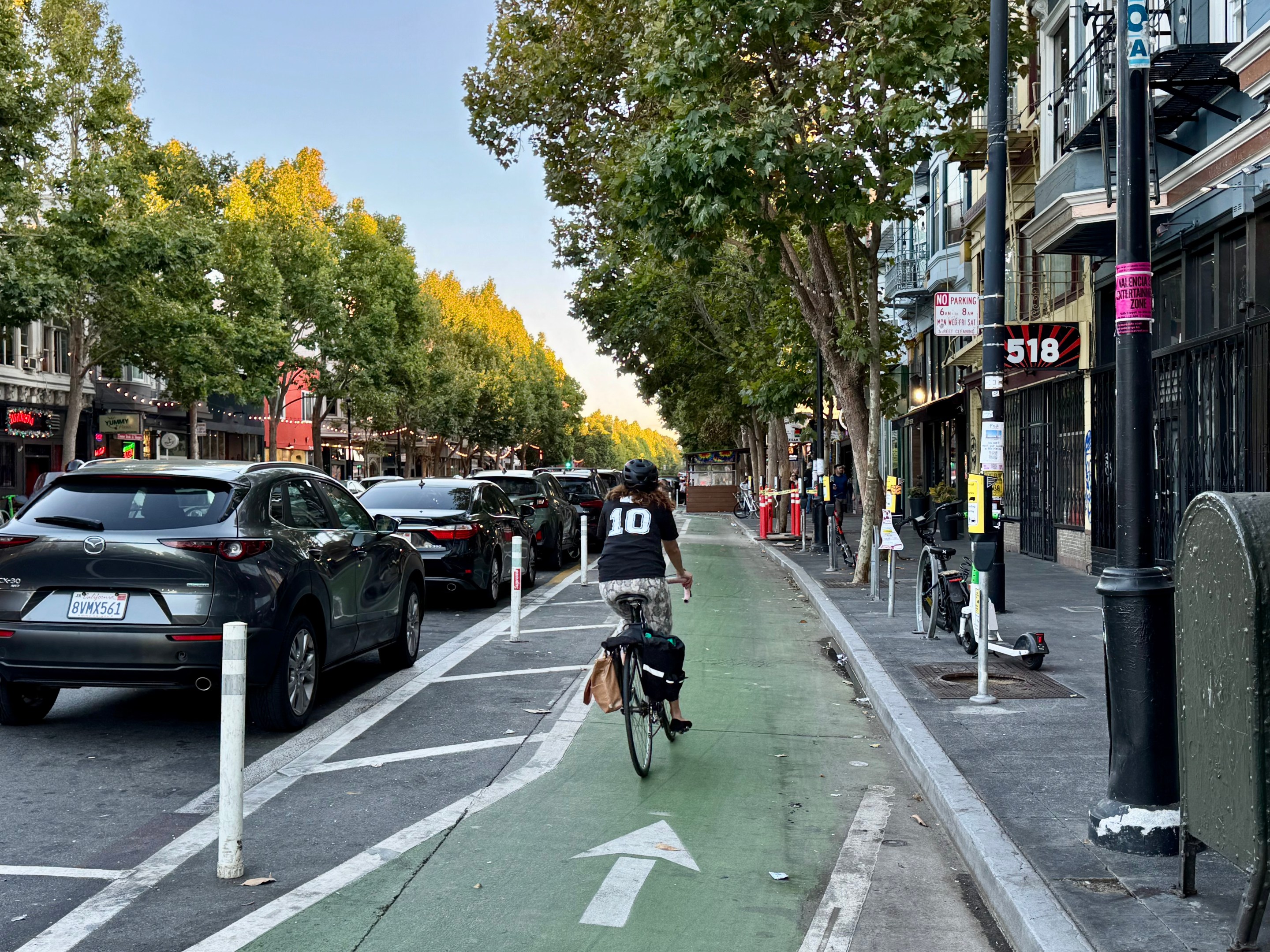
The nation’s supposed longest stretch of independent businesses pulses on a warm San Francisco summer evening. Unprotected lefts clog up bass-blasting cars; hordes of chatty pedestrians float along the sidewalk and sometimes, with comical ease, directly across the bike lane; delivery drivers on motorbikes zoom up and down the corridor, every lane their oyster, distributing the flavors of Valencia’s many restaurants across the city; analog- and e-bikers try, harrowingly, to avoid all of them.
Valencia Street is a sight to behold.
The different modes of traffic, despite the chaos, are a welcome sign of a neighborhood in economic recovery. And for many business owners, the one-time third rail — that is, the center bike lane — can finally be put to rest.
It’s been roughly three months since construction on the side-running bike lanes on Valencia was completed, to the delight of many of the businesses up and down the street. The city first installed a two-way center-running bike lane in the summer of 2023, the design of which won attention and awards within the transportation industry. But businesses weren’t happy: Some complained that the bike lane disrupted car traffic, worsening parking for potential patrons. Businesses and cyclists argued that the design was unsafe and confusing, discouraging customers. The owner of now-shuttered Yasmin, Eiad Eltawil, even embarked on a hunger strike to stand against the bike lane.
At the whim of the angry mob, SFMTA opted to redesign the bike lane and make it side-running, this time as two semi-protected lanes between the parking spots and parklets. While this satisfied many business owners along the street, a group of merchants called VAMANOS appealed the side-running project’s approval, demanding a full environmental impact report.
“I was not a fan of the center-running bike lane. And I'm coming at this as a pedestrian, a cyclist, a driver, and a business owner,” said Eileen Rinaldi, the owner of Ritual Coffee Roasters and the president of the Valencia Corridor Merchant’s Association.
“As a merchant, what I saw was that the center-running bike lane created a lot of confusion and constriction for people. So I think that people just started avoiding Valencia Street because they felt like they didn't know how to navigate it or they felt like it was just too constricted for the flow of traffic,” she said.
With the center bike lane, drivers could not navigate around cars reversing into spots, right-turners, double-parked delivery drivers, emergency vehicles, and accidents. This could clog up a block of Valencia for up to an hour, some business owners claimed. Now, the side-running lanes allow for cars to pass one another over the yellow line. Newcomers and the less observant are sometimes confused about where to put their car, given that parking spots are not against the curb. But on a street trying to accommodate so many different kinds of business and transportation, it’s a worthy trade-off, in the eyes of many proprietors.
“It's a lot better than the older one, which was absurd,” said Pablo Romano, the owner of Venga Empanadas. Venga has been on Valencia Street for 15 years. “But you know, it's never going to please everybody. I mean, I think it's good enough.”
Valencia Street hosts two bike lanes, metered parking spots, motorcycle parking, parklets, commercial loading zones, and two lanes of traffic on a roughly 60-foot-wide street. Romano, who currently has a parklet and motorcycle parking outside of his business, says SFMTA’s focus has been on commuters and shoppers more than business owners.
“SFMTA has this, you know, utopian thing that everybody goes on a bike and works on a computer and makes 300 grand a year. That's not the real world,” he said. “I have to schlep a bunch of flour sacks and bags of potatoes and onions.”
Generally, businesses told me the side-running lanes are better for general customer traffic, even if it leads to the occasional close call between pedestrians and cyclists in the bike lane. The proximity to businesses and pedestrians has led to more engagement of shops by cyclists, instead of keeping riders siloed in the middle of the road.
Side-running bike lanes are “the tried and true and proven best practice from around the world including on merchant corridors,” said Luke Bornheimer, founder and executive director of sustainable transportation advocacy group Streets Forward. “Curbside protected bike lanes increase the number of people who use bikes along a street, and people who ride bikes spend more money at local businesses than people who drive or use cars.”
There are a small handful of center-running bike lanes around the world, Bornheimer said. Most, such as the now decade-old one on Pennsylvania Avenue in Washington DC, are intended to be used as bike highways that funnel cyclists to bridges or downtown areas, for example, rather than for casual riding.
To Rinaldi, the center lane was “difficult to get on and off of it, so it almost created a bike freeway where people could be shuttled from Bernal Heights towards Market Street, right? Just to get downtown quickly,” she explained. “Now that we have the side-running protected bike lanes, it's easy to hop off your bike even just to say hi to a friend or to stop into a business or to pick something up.”
Starting in August 2023, businesses on Valencia Street experienced declines in transactions, which can be representative of foot traffic. Sales tanked as low as 12 percent in October of that year, according to data provided to Gazetteer SF from point-of-sales service Square. Overall, from August 2023 to July 2024, (during which the center lane and its backlash were in full swing), business on Valencia St. experienced a 1 percent decline in sales. Square interprets this period as a missed opportunity for growth, compared to years prior (August 2021 to July 2023) when sellers generally experienced a 10 percent growth in transaction volume.
Now, the good kind of traffic has been on the rise on Valencia. In the past year, August 2024 to August 2025, Valencia businesses saw an 11 percent increase in transactions. This trend is consistent in other American cities: In New York City, for example, protected side-running bike lanes on 9th Ave. resulted in a 49 percent increase in retail sales, compared to just a 3 percent increase elsewhere in Manhattan.
With sales on the rise and contentions between merchants simmering down after the latest bike lane edits, things on Valencia feel generally hopeful.
“It feels like a completely different street and merchants are feeling optimistic,” said Rinaldi. “We had a good summer with lots of traffic so it feels like a new era on Valencia Street to me.”