

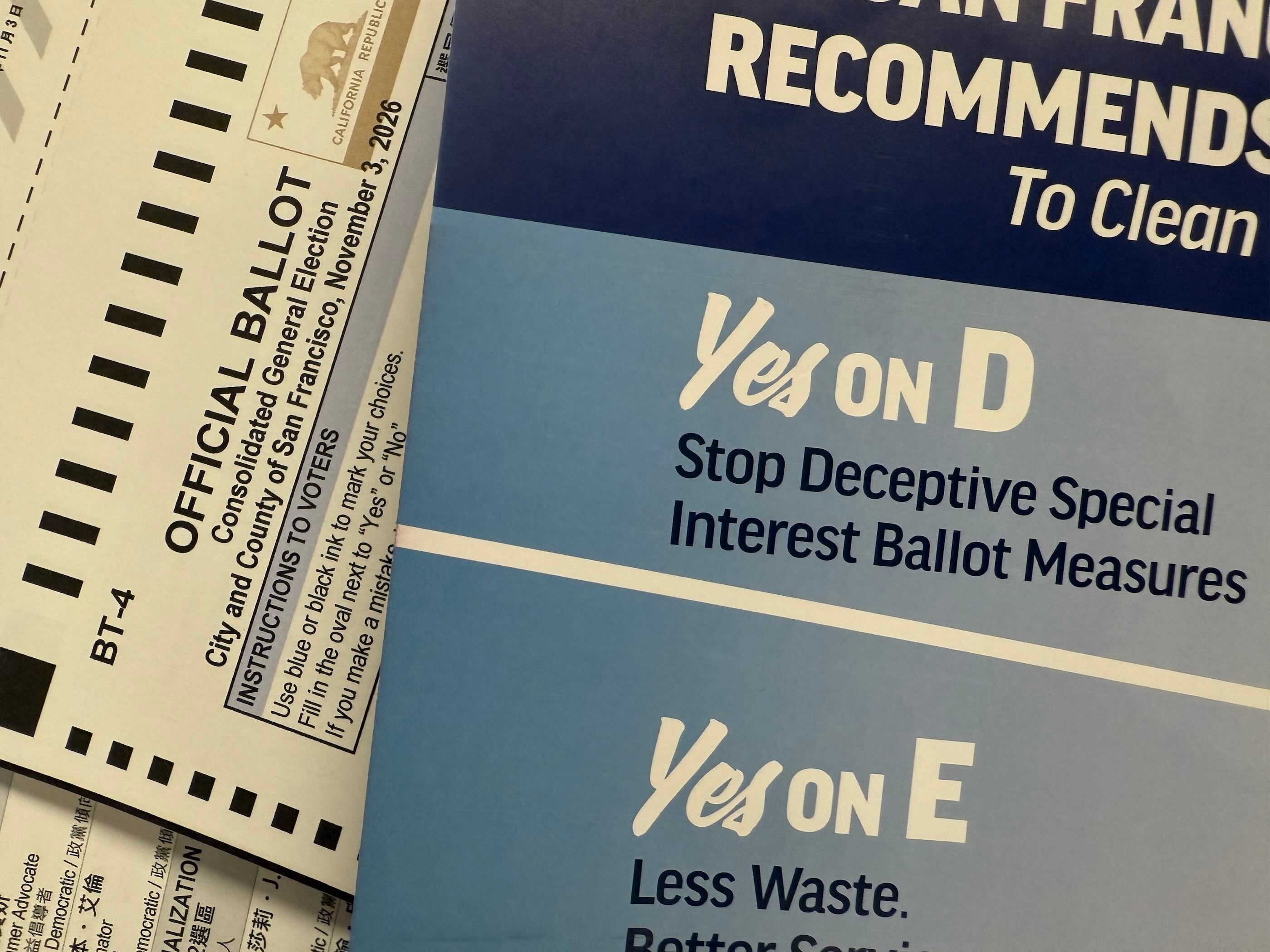

To the San Francisco chapter of the League of Women Voters, Mayor Daniel Lurie’s Proposition D represents nothing less than a threat to democracy.
The measure aims to reduce the number of propositions that make it on the ballot by quadrupling the number of signatures required to get them there, to about 42,500. That represents an increase from two percent to eight percent of the city’s registered voters, driving up the cost of collecting those signatures to more than $1 million, opponents of Prop. D argue.
“This one is really problematic for us,” said Lauren Girardin, a spokesperson for the San Francisco League of Women Voters, which is nonpartisan and does not support or oppose candidates.
That doesn’t mean the group is apolitical. As Girardin explained, if Prop. D passes, “it’s going to be a lot easier for only wealthy interests to get what they want on the ballot, and for regular folks, it’s going to be that much harder. And to us, that’s just not democratic,” Girardin said. “That’s not good government. That’s a threat to democracy.”
With five days left until the Nov. 3 election, Mayor Lurie’s Yes on D, E & F Committee has collected $13.8 million for the trifecta of propositions, averaging almost $3.5 million for each. The No on D campaign has collected about $500,000, mostly from unions. While there are differences among opponents of Lurie’s various measures about how to allocate resources, there is a general resistance to Prop. D that includes Girardin’s group, the San Francisco Labor Council, the Community Tenants Association, and Coleman Advocates for Children and Youth.
The measure has galvanized organizations on both sides of the proposed reform.
“It is the most consequential measure on the ballot, honestly, because it affects all future ballot measures,” said Daniel Anderson, a progressive political consultant and spokesperson for the No on D campaign.
According to Anderson, Prop. D represents a threat to citizen-driven initiatives that depend primarily on volunteer-based signature gathering more than the well-funded propositions that rely heavily on paid signature collectors. “There’s no way you can do that at a 42,000 signature level,” Anderson said. “It’s totally impossible.
Another key feature of Prop. D is that it would eliminate Lurie’s unilateral power as mayor to put a measure on the ballot. It would also require a six-member majority of the Board of Supervisors to submit a measure. Currently, a measure can get to the ballot with the support of four supervisors.
Prop. D, as well as propositions E and F, originated in a report published last year by the San Francisco Bay Area Planning and Urban Research Association (SPUR), according to Sean Elsbernd, SPUR’s president. Elsbernd said Lurie grabbed six of ten recommendations in the report, and converted them into the three ballot measures. (SPUR also considers itself nonpartisan.)
According to Elsbernd, Prop. D only makes it more expensive for organizations to get measures on the ballot if the propositions don’t have grassroots support.
“If you have the grassroots support for your measure, you don't have to hire anybody. You can go collect the signatures,” Elsbernd said. “I do not think 42,000 signatures is practically too difficult for a measure that has significant grassroots support. That can be done,” he said. Alternatively, under Prop. D, with the requisite grassroots support, advocates can get six supervisors to place a measure on the ballot, which Elsbernd says occurs regularly.
San Francisco is the only city in California that allows propositions to make it on a ballot with the support of just two percent of its voters, Elsbernd noted, producing a bewildering number of measures every election. Prop. D would eliminate that outcome by forcing elected officials — the Board of Supervisors, and the mayor — to legislate policy “and stop kicking issues to the electorate,” Elsbernd argues. The natural extension of the argument is that if voters don’t like the policies their elected officials make, they will vote them out of office.
As Lurie’s political team drew up Propositions D, E and F, it recruited Jason McDaniel, a professor of political science at San Francisco State University, as an official proponent of the measures. McDaniel, who said he has independently studied such reforms for more than a decade, called Prop. D’s requirement that the mayor forfeit unilateral ability to put measures on the ballot a “big deal.” Requiring six supervisors instead of four to submit a measure, which McDaniel said is a reversion to an earlier version of the city’s charter of about a decade ago, aligned with his own thinking. (McDaniel said he wasn’t paid by Lurie’s campaign, and would’ve been put off by any offer for payment.)
McDaniel argues that opponents of Prop. D have conflated the vast sums behind it —from Lurie’s committee, GrowSF, and tech billionaires like Michael Moritz and Chris Larsen — with the merits of its policy arguments. “I think this is a good government reform that will rebalance the system,” he said.
The San Francisco Labor Council has so far contributed $20,000 to the No on D campaign. The group’s membership of more than 150 unions didn’t arrive at the required consensus to take positions on Propositions E and F. There was little disagreement about Prop. D, according to Kim Tavaglione, the group’s executive director. “Taking away voters’ rights in any shape or form is just bad taste in this Trump era,” Tavaglione said.