

While the normies were resting, I was mainlining tech discourse all weekend to bring you the latest trends, rumors, fights, and innovations from the sweatiest corners of the internet. This week: Musk vs. Altman begins, Sam Altman attempts a rebrand, and Canva is accused of anti-Palenstine censorship.
This is Manic Monday.
The OpenAI trial begins in Oakland...
Musk v. Altman, the much-anticipated (by no one) showdown between the AI world’s two most controversial figures, began today at a federal courthouse in Oakland. Elon Musk, a co-founder of OpenAI along with Sam Altman, is seeking up to $134 billion in “wrongful gains” due to Altman and OpenAI’s president Greg Brockman’s decision to turn nonprofit AI lab into a for-profit corporation. Jury selection began earlier this morning to immediate hurdles: Wired reporter Max Zeff posted on X that the “first few potential jurors have flagged that it will be hard to be unbiased and fair, because of their negative views about Elon Musk and AI more broadly.”
...while the court of public opinion convenes on X
While the trial is underway IRL, some users on the Elon Musk-owned social network have begun to point out that Musk may be attempting to sway public opinion in his favor by manipulating the timeline and resurfacing critical reporting on Altman. Musk appears to have boosted posts linking to The New Yorker’s investigation into Altman’s history of lying at OpenAI; other users have also noticed their feeds are suddenly full of accounts talking about the legal particulars of nonprofits, conveniently making the case Musk is currently trying to make in court.
Meanwhile, Sama is sillymaxxing
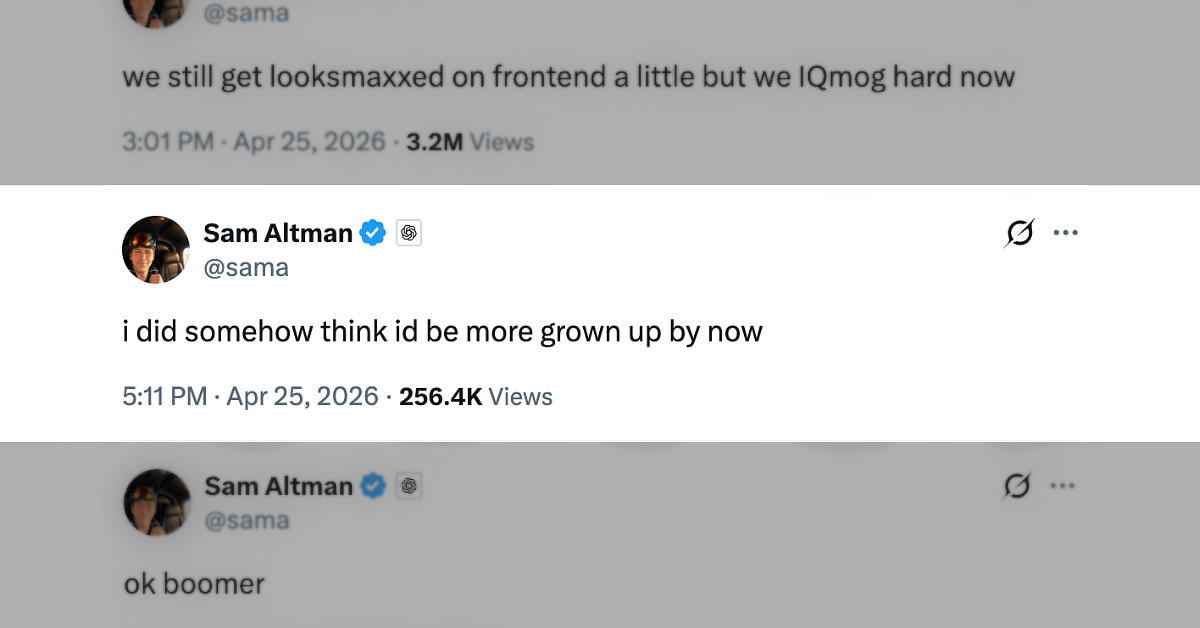
In light of the trial as well as the two attacks on his Russian Hill home that appeared to be motivated by anti-AI sentiment, Sam Altman — or Sama, the online handle by which his acolytes refer to him — appears to be attempting to rehabilitate his image by being cutesy online. For about a week now, Altman has been tweeting drunk typos, fumbled attempts at internet slang, and confessions that he still feews wike a wittle kid too. Perhaps the humanity Altman is expressing is genuine, but this attempt at a rebrand looks pretty calculated.
Unsuccessful shooters all around
Internet sleuths have discovered that Cole Tomas Allen, the man who allegedly attempted to assassinate Trump and several high-ranking government officials at last weekend’s White House Correspondents’ Dinner in Washington DC, was not only a teacher and a CalTech graduate but also an indie games developer. Kotaku reported that Allen released his only title, a chemistry-inspired game called Bohrdom, in 2018 to little fanfare. On the games distribution platform Steam, Bohrdom’s description reads, in a way, similar to his shooter’s manifesto, which is to say passionate but unfocused and tonally confused: The game is described as at once “non-violent” and a “bullet hell,” a subgenre of the Space Invaders-style games known as “shoot ‘em ups.” The game has only three reviews, all from 2021 or earlier, but users have recently added the tags “Assassin” and “Political” to its listing.
Canva gets canceled (Canvaceled?)
Canva was accused of politically-motivated censorship Sunday night, after a user named @ros_ie9 posted on X demonstrating how the design platform’s new AI-powered Magic Layers feature automatically replaced the word “Palestine” with “Ukraine.” The Sydney-based company, which has been heavily pushing its AI capabilities in recent months, moved quickly to quash the controversy, apologizing in a statement to The Verge and noting the “issue” with the Magic Layers feature has since been resolved. Still, people online are now searching for less biased Canva alternatives, and many are recommending an open-source design platform called avnac (Canva backwards), which was conveniently launched earlier last week.
The week ahead: Sam Altman posts several montages of his own baby photos set to Green Day’s “Good Riddance (Time of Your Life).”