

The San Francisco Board of Supervisors’ Land Use and Transportation Committee on Monday again moved to postpone a vote on the proposed smoking ban.
The ordinance, first brought forth by District 7 Supervisor Myrna Melgar in April, would prohibit smoking at outdoor bar patios. It would also catch the city up to California law by doing away with “preempted exceptions” that allow smoking indoors at certain owner-operated bars, as well as in a small share of hotel rooms, in San Francisco.
The proposed ban has sparked heated discussions among bar owners, who claim the patio smoking ban would be another blow to their bottom line amid rising rent costs, inflation, and pandemic-related losses. A petition against the ban, spearheaded by Zeitgeist owner Lara Burmeister, has garnered roughly 3,000 signatures. The city’s Small Business Commission unanimously voted to oppose the proposal in April.
A different petition in support of the bill, organized by Joseph Hayden, a project manager based in Vallejo who collaborates with a slate of Bay Area anti-smoking nonprofits, has garnered about 2,000 physical and online signatures.
The land use committee, which consists of Melgar as chair, District 11 Supervisor Chyanne Chen as vice chair, and District 5 Supervisor Bilal Mahmood, had initially delayed the vote on May 19 to this week.
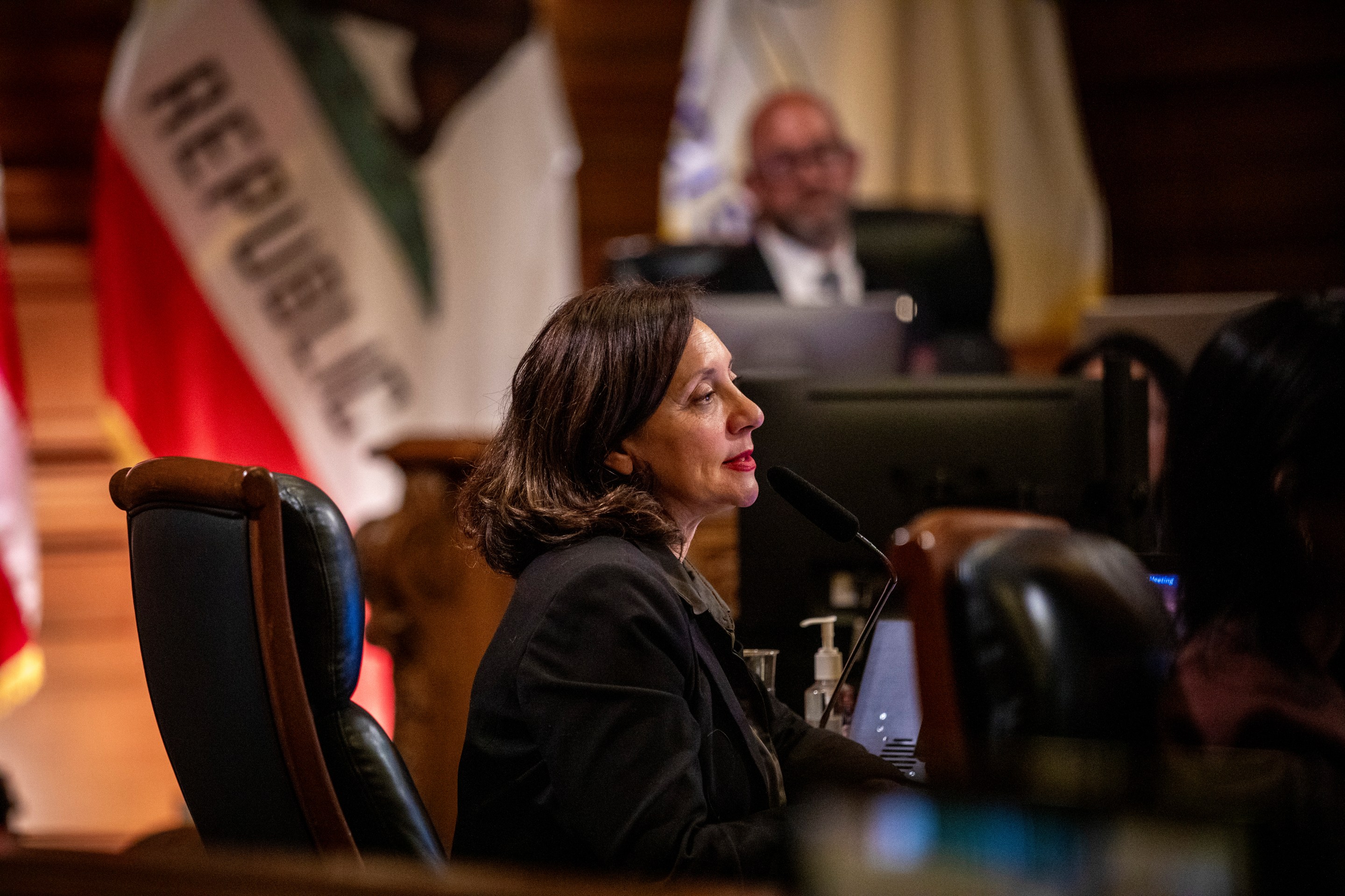
On Monday, Melgar announced that they would continue discussions on the item on a later date. In order to advance the proposed ordinance to the Board of Supervisors, Melgar would need a majority vote from her committee; she suggested that she still lacks the support on her committee and in the Board of Supervisors to get the ordinance passed.
“It’s clear that we need to do a little more work,” said Melgar. “I’ve accepted the recommendations from a couple of my colleagues and the mayor to help with some amendments.”
Mayor Daniel Lurie recently hosted Melgar, the Small Business Commission, and bar owners to discuss potential amendments to the ordinance. Melgar offered a slow implementation of one to two years and up to five years, which was rejected. The ordinance currently puts the burden of enforcement on businesses or face financial penalty; bar owners said this puts employees in a frustrating position and also poses an economic and existential threat to businesses.
“Often, when there is a complaining neighbor, whether it's about noise or some other thing that's going on, the complainer often uses multiple things to try to make life difficult for the bar,” said Christin Evans, the owner of Alembic and Booksmith on Haight Street. “And so this would create a potential situation where, even if they had no-smoking signs up, there would be the opportunity for that neighbor to take photos of people smoking on the patio and then get the bar owner in trouble.”
Evans is one of the founders of Small Business Forward, who was at the committee meeting to comment on the smoking ban and an affordable housing item discussed just before. “Even the bars that have non-smoking patios said that they have their signage up but people do sometimes ignore the signage. That's kind of the reality of people enjoying a drink at night.”
Several people in opposition of the ordinance arrived to comment at the committee meeting, including bar owners, nightlife workers, and other folks from Small Business Forward. Posts on social media urged folks to come and oppose the bill.
While the vote was again postponed, Melgar said that people were still welcome to comment on the ordinance. The smoking ban proposal was scheduled last on Monday’s agenda; commenters endured more than four hours of agenda items before being able to stand before the committee. Some grew visibly bored and restless, leaving without addressing the committee after sitting in the legislative chamber all afternoon.
Evans was among the few that made it to the bitter end. Addressing the committee and a practically empty room, she brought attention to the lack of outreach and collaboration with business owners.
“I don't think you ever came up with a total number of businesses that were going to be impacted,” she told Melgar. “We very much care about our patrons and care about our employees and our opposition to this legislation is primarily regarding how the legislation was brought forward.” Evans said. “We would like to see partnership going forward.”
Four people arrived at the nearly-empty room right as the committee got to the smoking ban ordinance. Three of them were volunteers for different smoke-free advocacy organizations who spoke in favor of the ordinance. One commenter, Brian Davis, co-chair of the San Francisco Tobacco-Free Coalition, asked that the ordinance not be swayed by businesses’ concerns.
“The air on the patios will be healthy. People who currently smoke will be motivated to quit. And bars will gain new customers, making more money, or breaking even at worst,” he said. Another commenter, Liz Williams, from American Nonsmokers’ Rights Foundation, supported patrons smoking on the sidewalk. The fourth commenter in favor of the ordinance lives in Berkeley. While they spoke, Melgar stared at them intently, nodding and smiling.
Editor’s Note: This story has been updated to remove a reference to Joseph Hayden attending the Board of Supervisors committee meeting. He was not in attendance on this date.