

San Francisco Mayor Daniel Lurie released a $16.9 billion proposed budget Monday that, he said, “strengthens our social safety” in the face of federal funding cuts. To community leaders who have spent months rallying in opposition to anticipated cuts, Lurie’s description was an attempt to mask a gutting of social services that confirmed many of their worst fears.
As advocates for the city’s least powerful constituencies pored over the 347-page document, they said the proposed budget leaves them with just over three weeks to press the Board of Supervisors to restore the mayor’s cuts before a critical vote cements the city’s spending for the next two years. To bolster that campaign, a labor union representing most of the city’s workers has its hopes pinned to the passage of Proposition D, otherwise known as the “Overpaid CEO Tax,” in Tuesday’s election that would bring in much-needed funds.
Lurie presented the budget at the city’s Human Services Agency in the Mission because, he said, it’s where hundreds of San Franciscans come every day for health care, food assistance, and to find work. “This budget protects legal services for immigrant families,” the mayor said. “It continues critical support for LGBTQ+ and trans residents.”
Lurie made his case that the city must close a $642.8 million two-year deficit that he has repeatedly warned will balloon to $1 billion in five years if he fails to intervene. He plans to reduce $130 million on city personnel by slowing hiring, and save another $80 million through reorganization and attrition. The mayor wants to eliminate 550 city jobs, a number that includes 127 previously announced layoffs, and the elimination of vacant positions.
“Pretty much all, if not all, of the cuts that we feared are moving forward in this budget,” said Anya Worley-Ziegmann, the coordinator at the San Francisco People’s Budget Coalition. Worley-Zeigmann said she found Lurie’s positive spin on the budget “bizarre,” especially compared to last year when he took an appropriately somber approach and acknowledged “painful” cuts.
Worley-Ziegmann pointed to cuts in health-equity and HIV services, case management and housing support at the mayor’s Housing and Community Development, Free City, the program that provides free tuition to the City College of San Francisco, and the Department of Disability and Aging Services as areas heavily targeted for cuts.
She also took direct aim at Lurie’s claim that he’s protecting immigrant services, noting that the San Francisco Immigrant Legal and Education Network (SFILEN) and Rapid Response Network will see their budgets reduced, according to Worley-Zeigmann. Both got supplemental funding in December to expand their services.
The groups have “been spending down that money, and hired attorneys and staff with the hope that they would be able to continue it, because the need just gets greater all the time,” she said. “In reality, he’s only continuing to fund a little more than half of it, so half of that money is going away.”
For months, SEIU 1021 has marshaled its members and supporters at massive rallies in an effort to spare three health clinics for youth and the elderly from Lurie’s cuts. The union said in an emailed statement that it was “relieved” Lurie’s budget didn’t include any additional layoffs beyond those that were previously announced. Sophia Padilla, a union member and therapist at one of the facilities, the Michael Baxter Larkin Street Youth Clinic, said the Department of Public Health (DPH) has extended the Larkin Street clinic’s closure date from August to October.
“I want to believe an extension is a win, but with our future still unclear, it’s hard not to think they’re just throwing us a bone before they shut us down anyway,” Padilla wrote in a text.
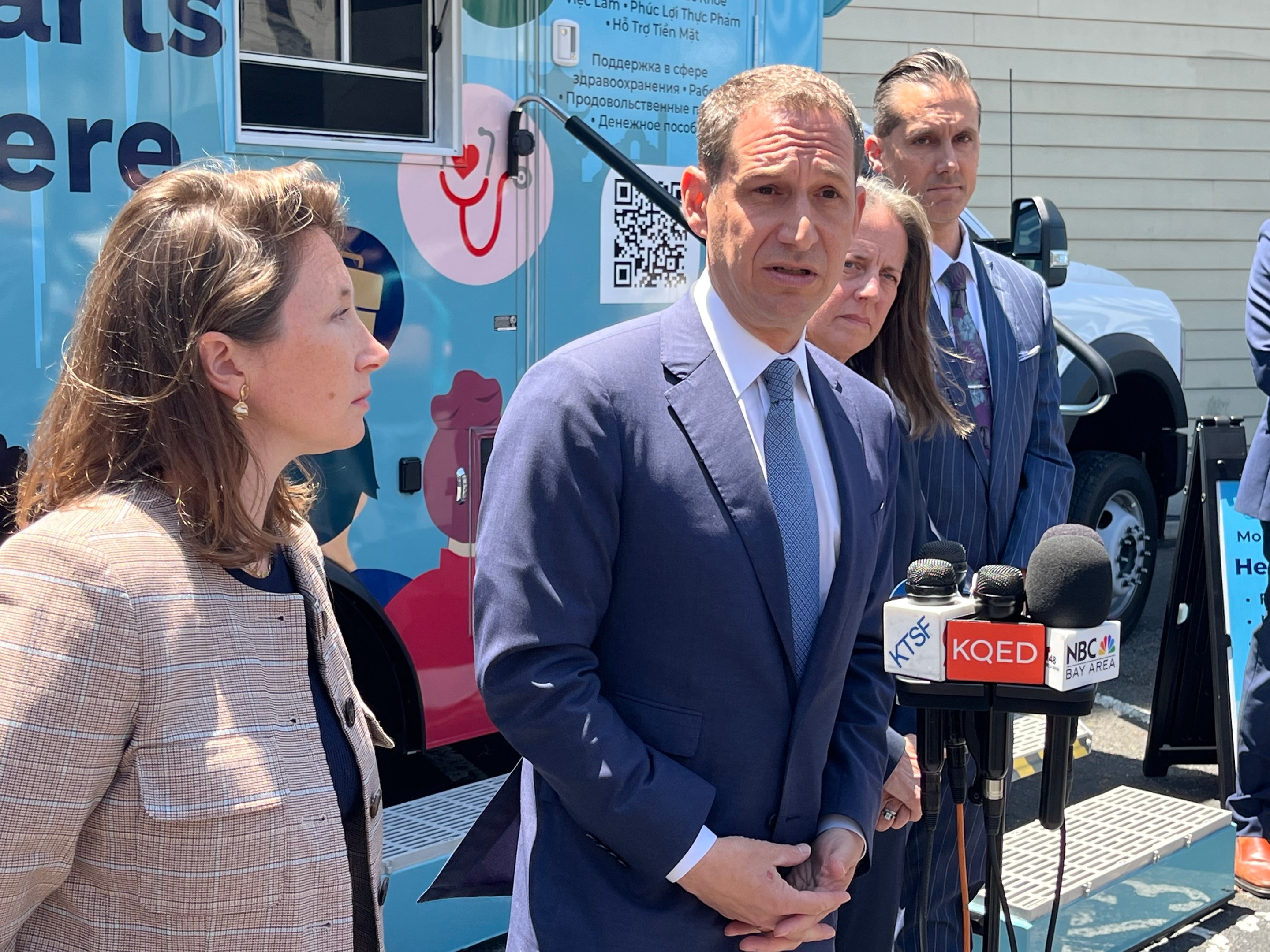
After presenting his budget at HSA, Lurie took questions from reporters in a parking lot across the street. Asked about the clinics, the mayor confirmed to Gazetteer SF that the city has extended its contract with the Larkin Street Clinic “for another couple of months.” The mayor repeated a previous explanation from DPH that patients at the clinics will still have access to care.
He didn’t say so directly, but the clear implication was that all three clinics will be closed.
“Every single day I’m out on the street, there are people telling me about how these cuts impact them, and I hear them,” Lurie said. “I know that this has real impacts on people throughout the city, not just city workers, but also the people that benefit, and I hope what you’re hearing from me today is that we are focused on working families, we’re focused on young people that need the help of the city. We’re going to take care of them to the best of our abilities, but we have a budget. We have to live within that budget, and we are looking out for the social safety net in the best way we possibly can.”
Jennie Smith-Camejo, a spokesperson for SEIU 1021, said the union is “laser-focused” on the passage of Proposition D, which she said will generate as much as $300 million for the city. The union and the People’s Budget Coalition believe the added revenue from the measure will give them the leverage they need to persuade Supervisors, and ultimately Lurie, that the mayor’s cuts should be restored.
At the press conference, Lurie, who has aggressively campaigned to defeat Proposition D, was asked how its passage might impact the budget. If it were to pass, he said, the city wouldn’t see any money from the measure for 18 months.
“We have to be fiscally disciplined now,” Lurie said. “We can’t wait another year and a half. That’s what's gotten us into trouble: spending money that we don’t have. So we’re going to be a city that spends what it has, and not, you know, on future potential ballot measures.”
The next key date is June 25, when the city’s Budget and Appropriations Committee votes on the budget, sending it to the Board of Supervisors for a final vote.