
It’s easy to imagine that the passionate evangelists for AI were grown in a lab or sent here by some extraterrestrial force to feed what is left of humankind’s artistry, ingenuity, and creativity into the all-consuming maw of a Large Language Model designed to replace all that is good and holy for purposes unknown. Imagining the carbon-based ambassadors for our slop-drenched future as somehow alien is pleasurable, but it does not explain who goes AI and why.
Portraying the CEOs, VCs, vibe coders, prompters, and social sharers as Other is (irony alert) dehumanizing. It elides or erases the choices they make, the hopes they hold dear, the sadnesses they, like all of us, seek to ameliorate with whatever is within reach or just on the horizon.
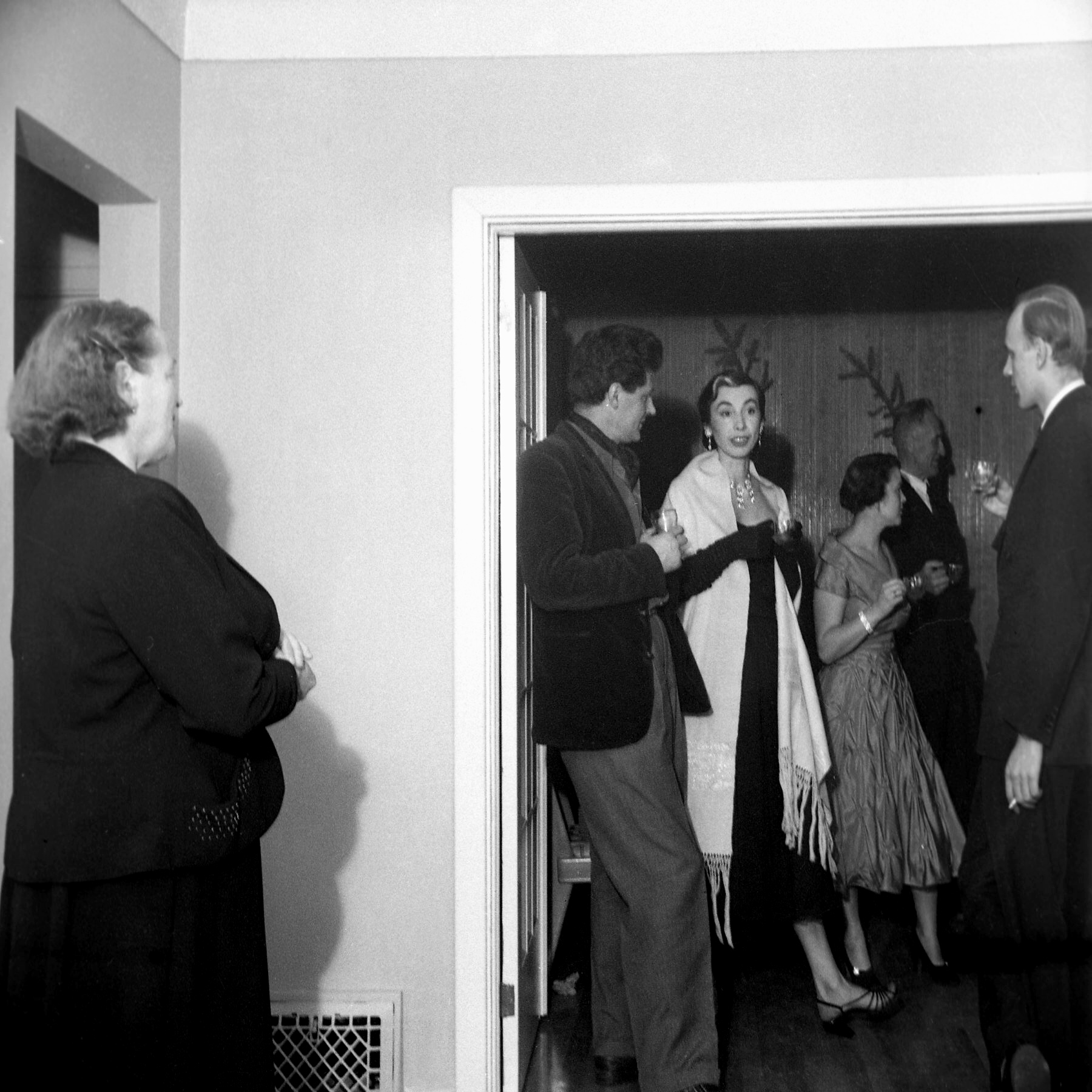
And so, with a nod to Dorothy Thompson, let us enter this big, boisterous party, circulate about these stately rooms sipping a drink and chatting with acquaintances old and new and ask ourselves as we do: Who goes AI?
There is no one type of person who succumbs to AI, no ethnicity or social class uniquely susceptible to its promises. AI speaks to people of all ages and educational backgrounds, people who have fallen deeply in love with technologies in the past and others who have been skeptical to the point of suspicion.
Yet here they are at this party, talking animatedly, showing their phones, wishing they were alone with their chatbot of choice, or merely nodding along as someone unspools a well-rehearsed elevator pitch.
Standing by the mantle with a seltzer water is a luminous presence, an actor whose early promise was squandered. In middle age, they won back audiences thanks to their charisma and talent, dormant for so many dark decades. How happy they are to be living out a comedy of remarriage with their career. With the specter of AI films looming, they have chosen to open that marriage to include generative artificial intelligence. While their peers fight to clarify digital replica clauses in their contracts, the actor, hoping to stay forever in the spotlight and share their charisma and talent in perpetuity even as mortality makes its endgame, embraces AI filmmaking. Will this provide the role of a lifetime? Multiple lifetimes? Only time and exigencies of the algorithm know.
The actor should walk over to the pool where the middleaged enfant terrible auteur is smoking, ash dusting their stained Members Only jacket. Their hair is greasy; their skin greying. The middleaged enfant terrible auteur has not made a film that has seen wide release since the Bush era, and yet they are stroked and cossetted by a small, fierce fan community online. The middle aged enfant terrible auteur once fancied themself in the lineage of European art house directors, but lately their work has been sliced and diced into single panel memes and oft-repeated catchphrases. Where once they found writers at alt-weeklies and adjunct lecturers gathering tenure-bait essays in film journals who’d praise their use of dirt-cheap, analog media to make their noncommercial fare, when the middle-aged enfant terrible auteur speaks to the paunchy, middle-aged writers who still remember them, they now rhapsodize about AI like a late-life convert spreading the Good News. AI isn’t killing movies; it’s saving them! AI doesn’t replace craft; it supercharges it! The middle-aged enfant terrible auteur can now make movies without expensive location shoots, without unions, or, indeed, without actors, especially ones who may complain about on-set behavior by certain middleaged enfants terrible auteurs. Yes, this is the real and true auteur theory cinema has been working toward, lo, these many years: No producers, no script supervisors, no studio notes, no marketing department, nothing to come between the middle aged enfant terrible auteur and their adoring, diminishing audience.
Huddled together by the hors d'oeuvres (a reflex from their leaner days), two former magazine editors are nibbling canapés and trying to look like they fit in. These print refugees want to appear as though they’re not too impressed by this house (bigger than any they’ve been in) or this crowd (more famous than most) and yet, there is a fetching flush to their cheeks, an undeniable giddiness to their uptalk. Perhaps they are so excited because they survived the fiery plane crash of their former industry, the one thing they aspired to do since reading so many fashion and rock ‘n’ roll magazines in their youth, tearing out pictures to hang on their walls, and feeling for one heady, too fleeting moment that they were interpreters of the zeitgeist, gatekeepers of the culture. In the years since then, they’ve dabbled in marketing, technology, technology marketing, and marketing technology only to see so many people less experienced than them, less interesting than them, get so, so much richer than them. And so, here they are, running their hands blindly on the rough beast of AI, groping to define the shape of things to come. Just as their highest aspiration was to break a band, mint an it girl, or conjure the hot new neighborhood, they now want to herald the arrival of this impossible-to-define thing: Is AI a medium? A platform? A worldview? An evolutionary step? Nothing quite comes close other than, maybe, Agape. The former magazine editors hope their faith in AI proves their place in heaven while also providing for their heirs for generations to come.
In the corner, their eyes casting about, their mouth pursed in pinched disdain is the disruptor. The disruptor is not enjoying the curry roasted shrimp being passed around by servers, the signature drinks mixed with care, or the company of so many chattering, nodding idiots. In fact, the disruptor rarely enjoys anything so much as breaking things and replacing them with something else entirely. The disruptor has no formal job title but their LinkedIn profile describes them as a consultant, a founder, a coach, or a strategic advisor. Passive income somehow accrues as they sleep; their consulting or coaching or strategic advising appears to involve attending conferences, living in white-washed Airbnbs, or standing on beaches in well-cut swimsuits, their sinews tight. The disruptor disdains AI (as they disdained NFTs, crypto, social gaming, VR, AR, and MR before it), is doubtful of its purpose or usefulness, yet they disdain its critics more. They are at this party to be seen on the right side — or is it the wrong side, the switchbacks and boomerangs of the discourse so confusing these days — of history. If AI makes so many people so irrationally angry, it must be doing something right. If the inclusion of two vowels side-by-side in one’s summit bio can spark so much intrigue and potential income, how bad can it be? And even if it’s bad, that’s good, too.
Tickling the keys of the piano as a few of their junior employees look on as they sneak swipes at their phones is the publisher. They have been so many things for so very long: innovator, pivoter, retrencher, lifer. The publisher has survived advertiser flight, digital predation, reader abandonment, and industrywide ossification to prove to the world (especially their father, who made them the self-made person they are by gifting them a small publishing concern the way other parents might put $20 into their elementary school aged child’s first savings account) that the sun shall never set on their empire, even if that empire continues to shrink and that sun grows hotter every day. With AI, the publisher can lower costs, multiply output, translate, grow into untapped markets, and collect small fractions of revenue while telling themself they’re still in the game, even if that game is rigged. The publisher’s audience, of course, is now largely made up of bots, so it stands to reason that the publisher’s team should be too. Only a bot knows exactly how to please a bot. One day, the employees barely bothering to clap at the publisher’s nimble recitation of Chopin will be replaced by bots as well, and AI’s much-debated “sycophancy” will be understood as not a bug, but a key feature.
Off to the back in a room that has been given a once-over by an advance team and overseen by earpiece-wearing agents is the politician holding court among the people who matter most: lobbyists. Never one for market testing or useless polling, the politician prides themself on operating by instinct, taking on all challenges with a sound mind, open heart, and clear eyes just as their hardworking parents in their close-knit small town taught them to do. The politician knows that AI is not a tool for making pornography, assisting suicides, or creating fan fiction based on preexisting IP. AI means a level playing field, prosperity, jobs, innovation, the American dream, a chicken in every pot. AI is the future and all who stand in its way are aligned with the past, a past that is both a shame on this great nation and the foundation upon which it stands. Recently, a voter in the politician’s district approached them at a hardware store — or maybe it was a local diner or watering hole — and said, “I am afraid of artificial intelligence and what it might mean for my job at my place of work.” The politician could feel their pain. “AI is made by good people, creative people,” the politician told them. “People who love this country.” That those people are also possible donors (unverifiable thanks to Citizens United vs. FEC, 2010), doesn’t matter. AI is the last and greatest hope for this great nation, which is itself the last and greatest of human dreams. We hold these truths to be self-evident, that had our forefathers had AI, they would’ve used it to craft our founding documents to be more legible, understandable, and scalable.
As you wait for the valet to bring your car around, feeling the fresh air on your skin and imagining your bed fondly, you may finally understand that the people who go AI are not bad people. Like you, they are human beings. Are they scared? Selfish? Yes, but so are you. Are their motives venal? At times. Are they arrogant? Singleminded? Yes and yes.
Like anyone, they just want to survive and will attach themself to anything they think will help them do so. This may explain why they went AI. Guessing who is an amusing game. Try it at the next party you go to.