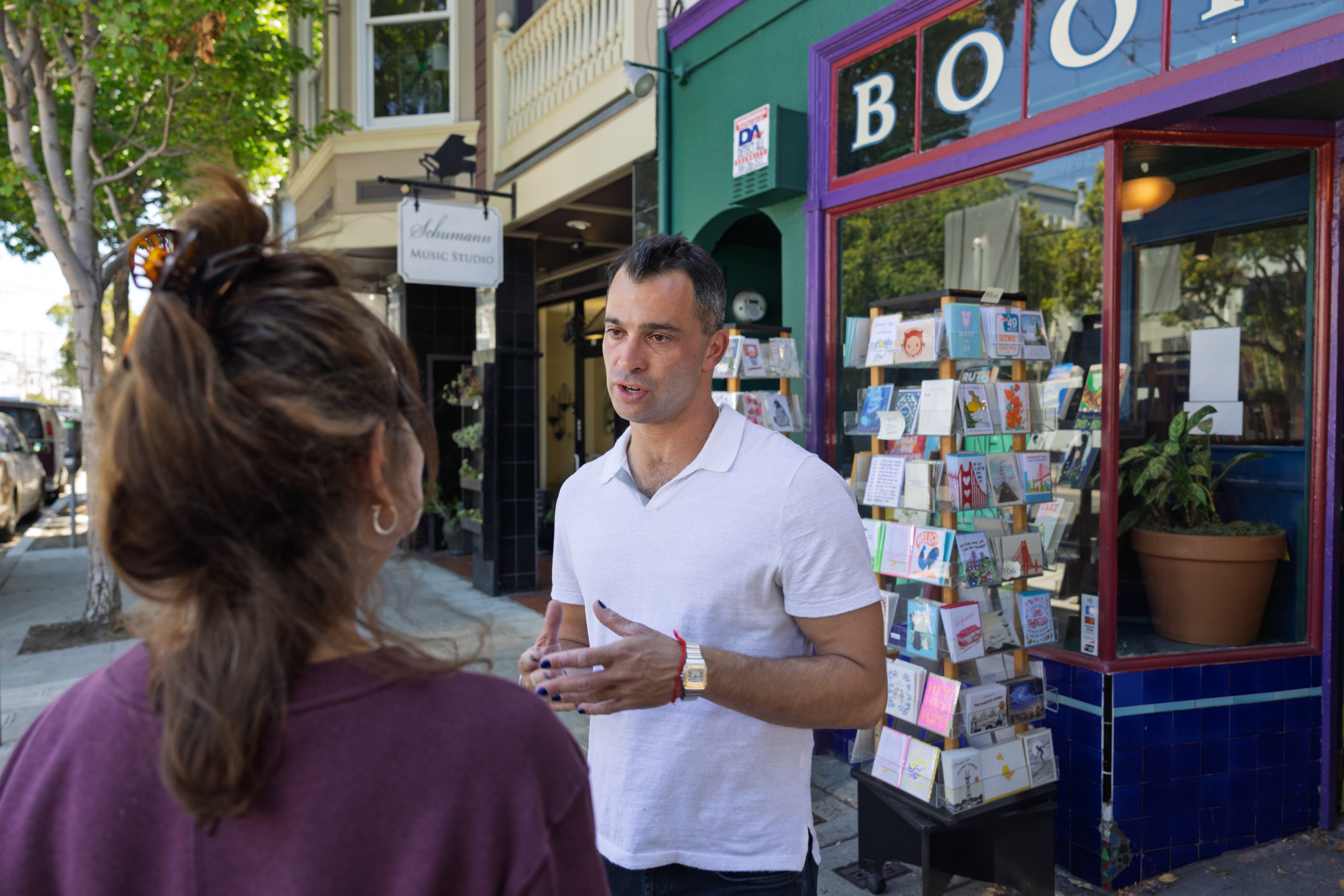


Clifford Yee’s family moved to the Richmond District in the 1960s. Yee grew up on 12th Avenue in the Inner Richmond and attended Argonne Elementary. As a kid, he played basketball at Mountain Lake Park and arcade games at 7-Eleven on Clement Street and 10th Avenue. If his family left the Richmond at all, it might be for a Metreon visit downtown.
A social worker who now works in development, Yee still lives in the neighborhood, which he always thought of as more a suburb than part of the city. Russians, Jews, Irish, and, most numerically, Chinese emigres like Yee’s parents settled in the Richmond throughout the 20th century. Per census data released in early 2026, the combined inner and outer neighborhoods are now the third-most populous in the city.
Yee sits on the board of the Richmond Neighborhood Center as its chief strategy officer and has witnessed a lot of changes up close. Many of the families he knew growing up have sold their homes, some getting a million over asking thanks to the city’s ultra competitive real estate market. He also sees a lot of continuity: He takes his two daughters to Little Henry’s off Balboa Street and Dragon River on Geary and 14th, the same places he went to as a kid. (The 7-Eleven on Clement, alas, has been boarded up for years.)
Looking at it today, the neighborhood is full of cool cafes, boutiques, and the new outpost of Berkeley-based Rose Pizzeria, which the New York Times dubbed one of the best pizza places in the country in 2024. Opened on Arguello and Clement Streets, the line outside of Rose spills onto the corner every night.
Soon enough, Bi-Rite will be moving into a long-defunct space at 6001 California St. for its fourth location, a sign of gentrification to some and an answer to others’ prayers.
In 2020, restaurateurs Lily and Lucy Lieu brought chef Robert Lam to Clement Street to open Lily. Lam definitely recognizes the neighborhood changing, and is frank about the financial pressures he and other operators are under and how that impacts their customers. “There are no more mom-and-pop shops,” Lam told Gazetteer SF. “You’re charging $12 for a fucking dessert. There has to be a relief on cost of goods.”
In May Zendaya strolled into this ongoing conversation about the neighborhood when she spent the day in the Richmond and made headlines around the world. The Oakland-raised A-list mononym actress went into Pasta Supply Co. at 236 Clement St. and browsed the original Green Apple Books at 506 Clement St., prompting people to wonder, could the Richmond be any hotter right now?
Then again, it may be proving too hot for some. In a San Francisco Standard article that went viral in June, a couple in the Outer Richmond learned their landlord was increasing their rent by 90 percent. Ashley and Zachary Waldmans’ two-bedroom condo listed for $3,500 a month in 2021. Whoever moves in after them will rent the same place for $7,000 a month.
While the Waldmans’ story drew headlines, tens of thousands of people across the city have faced such evictions. Some longtime residents have been quietly priced not just out of their homes, but California. Data presented in the 2021 book Counterpoints: A Bay Area Atlas of Displacement & Resistance paints a bleak portrait of how the Richmond district is changing.
In a visualization in the book, Finley Coyl of the Anti-Eviction Mapping Project (AEMP) shows that the Richmond (both Outer and Inner) ranked high in Ellis Act evictions, a divisive state law that allows landlords to “go out of business” and evict all their tenants. From 1994 to 2017, the Inner Richmond ranked fifth-highest in the city with 110 buildings evicted. The Outer Richmond saw 96.
Charlie Lower has a unique vantage point from which to observe the Richmond in this moment of change. Lower, who uses they/them pronouns, moved from the Sunset to 16th Avenue and Balboa Street in 2024 and has worked as a front of house manager at cafe and bakery Breadbelly at 1408 Clement St. for about a year. With its New York Times writeup, James Beard Award nomination, and two citations as a top 10 restaurant in the Bay Area by the San Francisco Chronicle, Breadbelly could be seen as precisely the kind of place that might signal a once homey neighborhood’s glow up, and yet, Lower in their own way is as committed as longtime residents like Yee to keeping the neighborhood livable and affordable.
Contrary to the popular narrative of service workers needing to commute into San Francisco from cheaper cities nearby, Lower lives five blocks from Breadbelly. Many of their coworkers also live in and near the Richmond, creating a sense of connection with the place they work and the customers they serve. “I feel this is rarer and rarer,” Lower said.
Working at the shop, they encounter “a true, random demographic of people who happen to live in this neighborhood,” introducing them to “all the people I wouldn’t have met otherwise. It feels like a privilege to me.”
But looking around, it is without question a changing neighborhood. In late January, the Richmond Neighborhood Center’s community food market, which provides free food to members of the community in the Inner Richmond, relocated to the Outer Richmond.
The reason for this move was shifting from the 94118 zip code to the 94121. According to Yee, their service areas were based on a poverty rate equal to or higher than the citywide average of 20 percent. The Inner Richmond no longer qualified. “It wasn’t our decision,” Yee says, “but that’s what the data’s saying.”
When talking about this, Yee doesn’t speak about gentrification necessarily, but an ongoing evolution of his neighborhood that’s been happening since before he was born. As a parent, he talks to his kids about these changes, but also what it means to give back to the place that gives them so much.
“We have to take care of ourselves,” Yee says. “This is what it means to be a part of the community.”
A version of this story first ran in print in Gazetteer San Francisco Issue 4.