


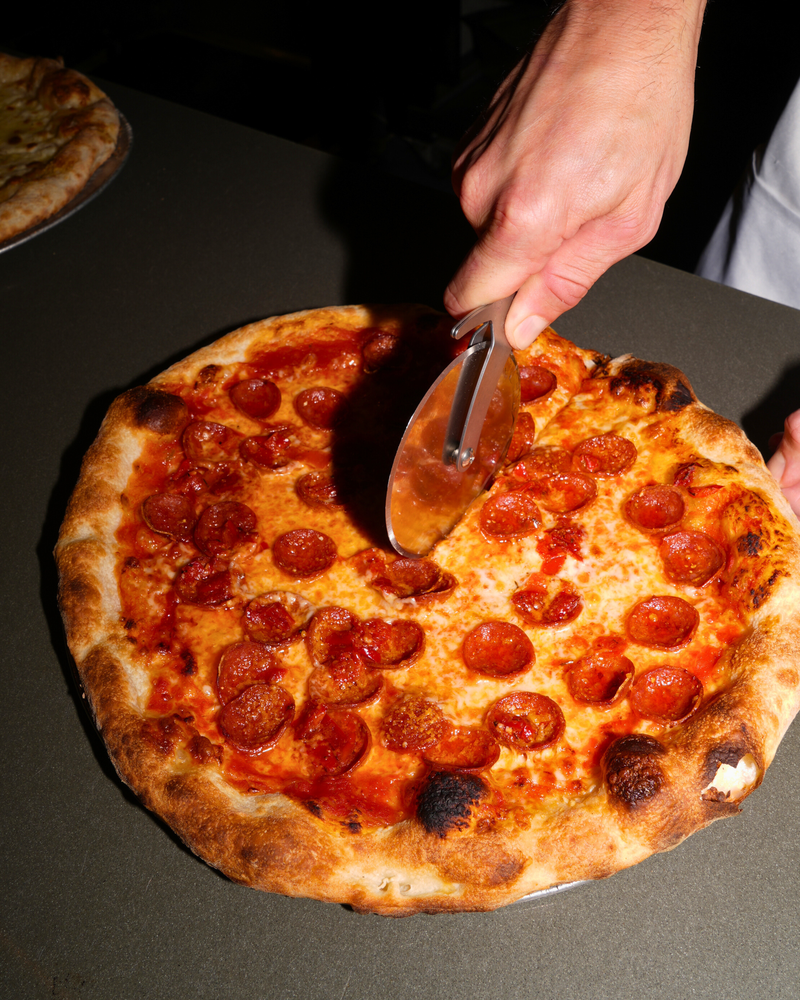
If my mother had a dollar for every pizza cutter she threw out with the box, she’d have $78. Hopefully you’ll remember this once you drop $78 on a new pizza cutter collaboration from the folks at Bernal Cutlery and Flour + Water, which they insist is a cut above the rest.
Conceived by Flour + Water chef Ryan Pollnow and Bernal Cutlery co-owners Kelly Kozak and Josh Donald, it started as an idea to make high-end pasta cutters, but that market has been tapped for centuries. Instead, they turned to an overlooked, simpler product.
“Generally speaking, the tools used in the pizza world, especially cutting tools, are cheap garbage,” said Pollnow. “That's when I think the lightbulb moment happened. Like, pasta tools have been solved. Let's figure out what we can do in the pizza world.”
Here’s what they came up with: a heat-treated and precision-ground 10-centimeter-diameter double-beveled blade at the end of a sleek, hollow handle made of stamped steel. It’s the result of 18 months of research and development and was manufactured overseas by a company called Prince in the Tsubame Sanjo region of Japan. About two hours north of Tokyo, the area has been famous for its metalworking since the Edo period.
The pizza cutter is sleek and sharp, to say the least. It looks like it belongs in the kitchen drawer of a Bond villain’s lair or in the Louvre robbers’ toolbox.
Bernal sent Sachie Uchimaru, the shop’s cultural liaison and a native Japanese speaker, to Prince’s facilities twice during the R&D process. Specs such as the wheel diameter, handle weight, and ergonomic shape were iterated by designers. But the most practical feedback came from the Flour + Water kitchen during a trial by wood-fire.
“Prince had made the best, sharpest pizza cutter ever that was also the most dangerous pizza cutter ever,” said Pollnow. The first design did not include two wings at the base of the handle to serve as guards, which they later added to protect quick, greasy hands from sliding into the blade.
The pizza cutter’s second release might be a more industry-facing tool, with a silicon slip to add more grip to the handle. Different color silicon can be used to mark which cutters are used for what pies. (Flour + Water’s pizzeria uses six different cutters per night.)
Overall, they’re hoping this attention to detail and quality will set their pizza cutter apart from the aforementioned cheap garbage in both performance and longevity and justify the high price.
“I think the ultimate goal was to have something really good quality with a good edge and that we could avoid it going in the trash,” said Donald. “I'd rather buy something high quality once than buy something cheap and replace it many times.”
A market for specialty and craft kitchenware has always existed in San Francisco, but the artisanal wheel is hitting shelves at an interesting time. On one hand, the increased popularity of home pizza ovens and the new school of pandemic-born hobby chefs (many here with tech salaries) have created some potential customers.
But on the other hand, tariffs have hit specialty small businesses that source from artisans around the world, like Bernal, especially hard. On top of the 15% blanket tariff on any imported goods, they’re navigating a 50% tariff on steel and aluminum alone. In response, Bernal has imposed a 4.4% price increase across all goods to offset the aggressive tariffs on some of their products and will not host their annual sale events. Many businesses are stuck between losing money or losing customers that can’t meet the tariff-adjusted costs. “We definitely have a lot of gray hair from this year,” Kozak said.
Pollnow asserts a pizza cutter isn’t a single-use tool. It can be (and already has been) used for cutting pasta, pie crust, and pastry in restaurants and home settings. Or for that simple shredded cheese and tortilla stovetop quesadilla, he says, which you could turn to to save a few bucks.