
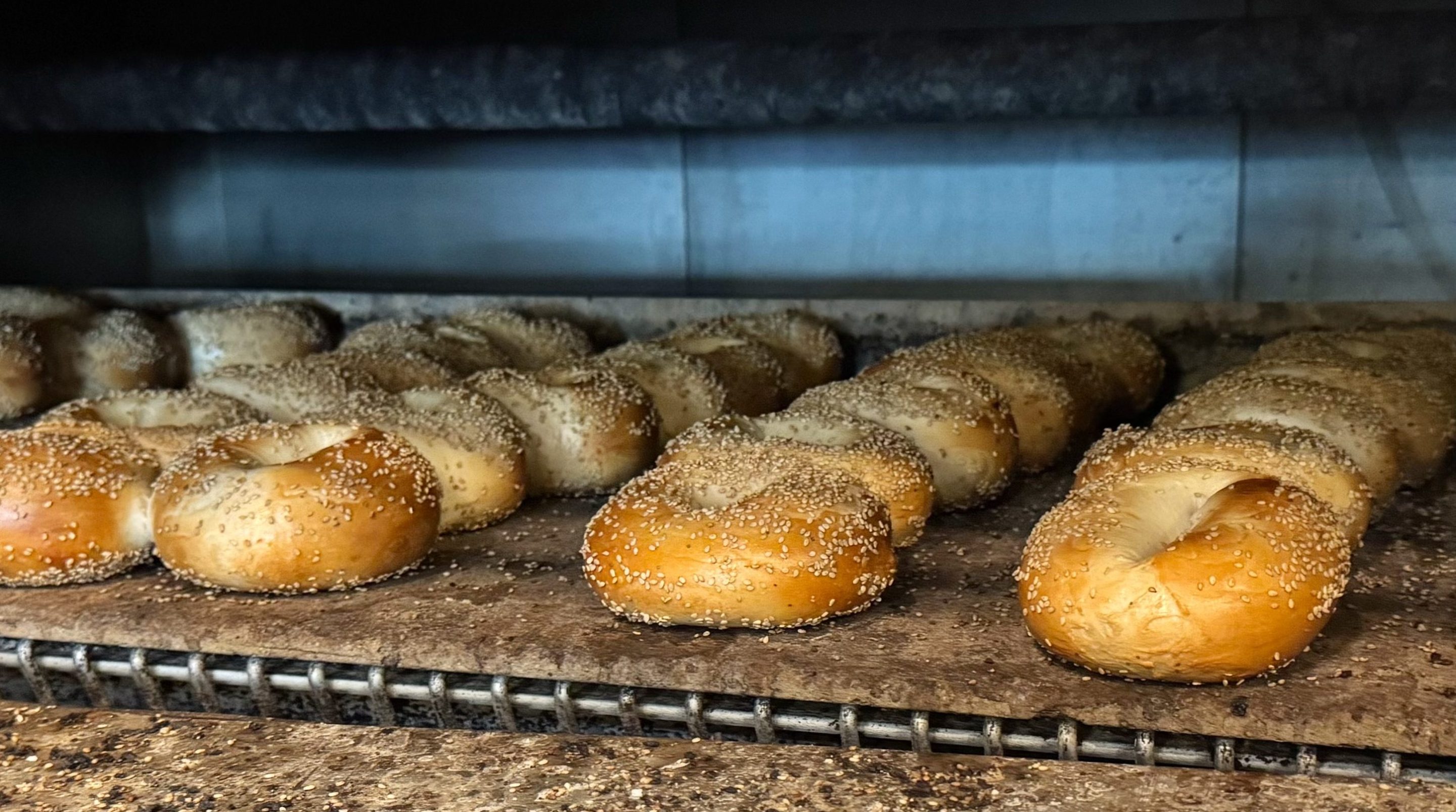

Bagelmakers across New York are staring down the barrel of a big change to their dough recipes. A ban on bromated flour, widely regarded as a quintessential ingredient for bagel and pizza dough, is currently sitting on the governor's desk. In California, that change is even more imminent: Our ban goes into effect on January 1, 2027.
Luckily for us, some of the buzziest San Francisco bagel establishments already work without it.
Bromated flour makes dough stretchy, springy, and consistent. It’s known to give bagels that perfect balance of lift and chew. It’s also one of several chemical additives that have been used in bakery flours to eliminate some of the guesswork involved with proofing, as it makes dough less susceptible to changes in temperature and humidity.
James Lok, co-founder of Schlok’s, calls bromated flour “the ultimate cheat code,” but doesn’t use it in his NoPa or FiDi shops. Using it “objectively reduces the error rate and the personnel training time.” Despite being made from “such a simple recipe,” bagels can be challenging “with so many technical elements.”
“There’s so much to think about,” he said.
The California Food Safety Act (also known as the “Skittles Act”), signed in 2023, put into place a total ban on potassium bromate, the additive in bromated flour. In studies dating as far back to the 1980s, potassium bromate has been linked to kidney and thyroid cancer in rats. It’s because of these studies that the additive has been eliminated from much of the world’s food supply, including total bans in Canada, the United Kingdom, the European Union, China, India, and many other countries.
The Associated Press reports that it’s currently used in an estimated 80 percent of commercial bakeries in New York. However, in California, that number seems significantly smaller thanks to Proposition 65, which mandates that businesses disclose their use of products that may expose customers to chemicals linked to cancer or reproductive harm.
“Ultimately, it was a conscious decision to not use [bromated flour] once we understood the legislation and California,” said Schlok’s co-founder Zack Schwab. “Will people buy bagels with a cancer warning? Because that's the philosophical question here, even if they taste better, or the texture and the rise are better?”
Many of SF’s top-rated and long-lined bagel businesses have shied away from bromated flour. Even SF’s longest-running bagel shop, House of Bagels, doesn’t use bromated flour.
Berkeley-based Boichik Bagels, which were ranked the best in the US by The New York Times, have never used bromated flour in their bagels. Founder and CEO Emily Winston uses organic flour from Central Milling, which does not contain potassium bromate.
“I'm a Berkeley foodie and I was fully planning on having fancy ingredients because it made sense to me. So I never actually looked into using other flour,” she said. “I didn't come from the professional baking world, so I really had no idea. I just was like, ‘This flour is delicious’ and it kind of checked all the boxes for me.”
The Outer Richmond’s The Laundromat also uses organic, un-bromated flour from Central Milling for their bagels and pizza. Co-owner Kevin Rodgers worked at an organic farm before opening his restaurant: “That was definitely the foundation for using food responsibly and using ingredients responsibly, and making sure that no chemicals and anything like that are involved,” he said.
“It's also just a very different methodology and philosophy in California, where ingredients are paramount,” Rodgers continued. “Especially San Francisco, there are some really great restaurants whose big focal point is sourcing everything responsibly.”
Unbromated craft flours are typically sold at a higher price point, which may be why SF’s boiled dough rings are notably more expensive than New York City’s. (Though Rodgers, who is from New York, just returned from a trip east and said bagels in Manhattan will run you $2.50 these days.) That being said, while New Yorkers are bracing for higher bagel prices should the potassium bromate ban go into effect, SF’s scene will be virtually unimpacted.
“It definitely is more expensive than a standard, un-organic flour. One of my mentors owns a bagel shop in Wisconsin and when I told him what I was paying for a sack of flour, he just about fell over,” said Jersey-born Winston. “But it makes a fantastic bagel.”
The New York State legislature voted this year to pass the Food Safety and Chemical Disclosure Act, which is currently awaiting Governor Kathy Hochul’s signature. If passed, businesses would have a one-year period to comply, as well as some additional time to work through unexpired stock. A similar bill has been introduced in New Jersey. (Disclosure: My family owns a bagel shop on the Jersey Shore called Bageleddi’s.)
Whether Albany and Trenton push a ban forward is still up in the air, though consumer awareness is growing.
The American Bakers Association, the largest trade organization for commercial bakers, in January launched a voluntary industry pledge to phase out potassium bromate by the end of this year. More people online are inquiring what flour brands do not contain potassium bromate, and where in their cities they can find bagels and pizza without a side of the purported carcinogen.
“In the Bay Area, we're probably not going to see a change,” said Boichik’s Winston. “But I think it's going to be interesting elsewhere.”