
Last month in Las Vegas, Los Angeles-based adult performer Siri Dahl sat in an auditorium just off the Strip, watching a presentation at the AVN Adult Entertainment Expo, the world’s largest porn industry convention. Somewhere between speakers, an advertisement for the erotic roleplay chatbot company Joi AI played on the big screen. Immediately after the ad finished, Dahl told Gazetteer SF, the entire crowd erupted into boos.
“I was surprised,” Dahl said of the response.
Not because she didn’t agree — she does, vehemently — but because she didn’t realize such strong anti-AI sentiment was so widespread among her peers. There must have been thousands of people in the audience, including performers, producers, businesspeople, and fans. “It was a pretty unanimous boo.”
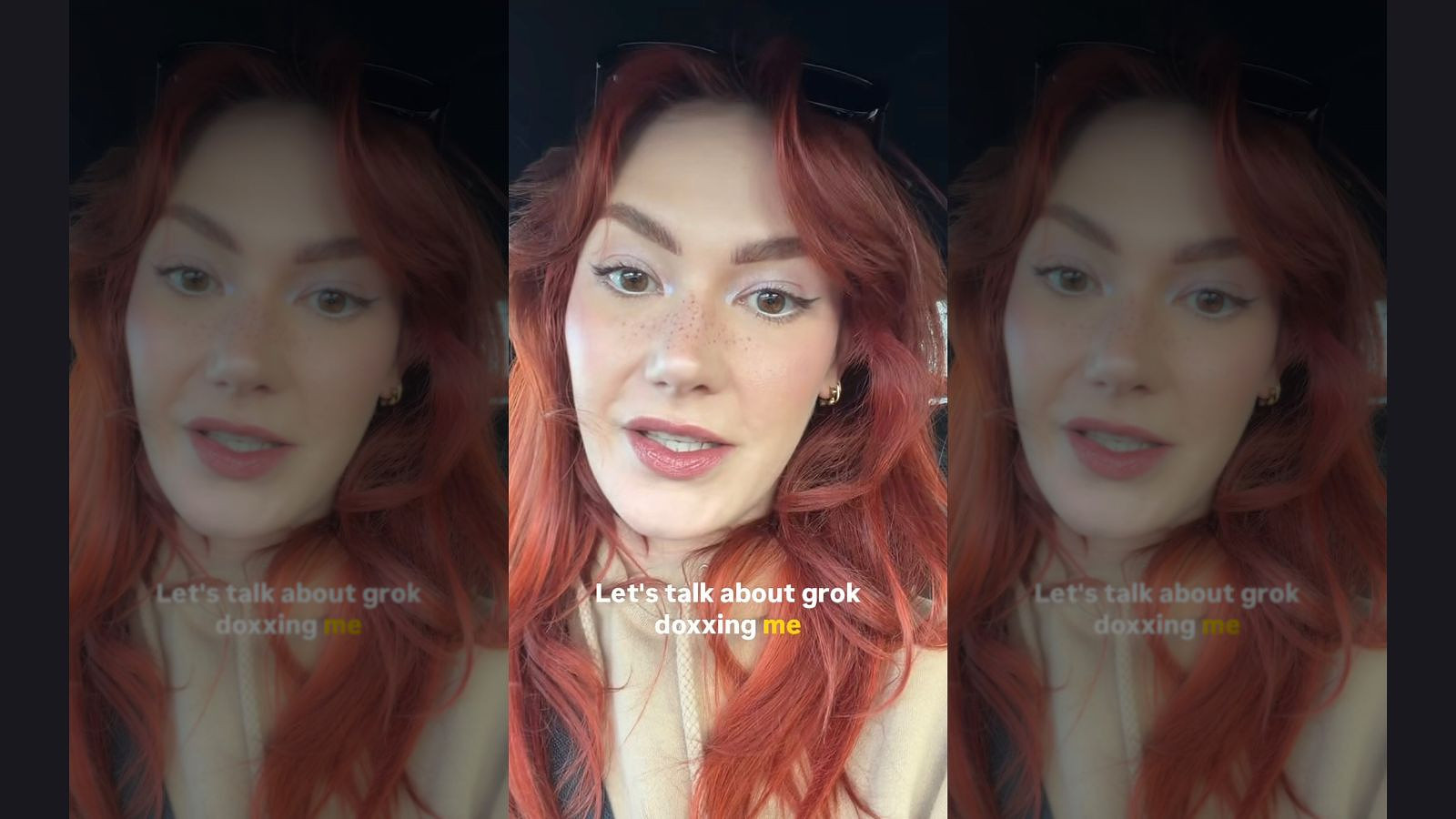
Dahl has even more of a reason than most to condemn the technology: Earlier this month, xAI’s Grok chatbot publicly exposed her full legal name and birthday to an X user who wanted to identify her from a clip posted to the platform, as 404 Media reported last week. Since then, fake accounts using her real name and content stolen from her official channels have popped up on Facebook and OnlyFans; she worries that Grok will inevitably expose even more dangerous personal information, like her address, soon enough.
But even beyond doxxing performers, Dahl can point to several reasons people in the industry feel “hostile,” as she put it, toward the many applications of AI, which has been creeping into the industry from all angles for the last few years.
The booing incident at AVN came amid a flurry of headlines about Grok flooding X and the Grok app with AI-generated images of “undressed” women and children in violent, abusive scenarios, which Dahl said has put an unfair spotlight on the legal porn industry. Meanwhile, trade conventions like AVN and XBIZ are swarmed by what Dahl called AI “pitch bros,” many of whom “are, like, freshly 22” and have zero experience in the business, but are nonetheless armed with venture capital and hyperreal sex bots ready to colonize the industry.
AI companion services like Joi or the highly controversial Character.AI threaten to eat into audiences who might otherwise pay to watch and interact with a human performer, whose product, however parasocial, is still a two-way human relationship. On the creator side, platforms like Fanvue are elbowing their way into the subscription market, selling themselves as a kind of AI-powered OnlyFans.
“But their whole shtick, really, is that they’re trying to convince creators to use primarily generative AI content,” Dahl said. The only “creators” she’s ever seen with Fanvue links in their social media bios are models and performers generated by AI.
Dahl works with porn studios and collaborates with other creators, but she makes most of her income on OnlyFans. She admits generative AI could benefit performers, virtually all of whom are independent business owners or contractors who could use AI to create new content if they’re sick or injured, for example. She uses Meta’s Instagram chatbot to auto-respond to direct messages from fans, but she spent a long time training it to respond the way she wanted it to: nonsexually, clear that it was a bot and not Siri herself, and to never, under any circumstances, reveal her personal information.
Gazetteer spoke a few weeks before Dahl found out Grok had exposed her real name. At that point, Dahl considered something like the Meta chatbot, which she sees essentially as a conversational point-of-sale interface, the only helpful application of AI for her business. (For now, she’s leaving it enabled.) But even then, any introduction of AI into her work gave her a bad feeling. When asked if she thought human porn performers and AI could live in a balance, she said, “I would not trust it to coexist, honestly.”
So far, the emergence of AI porn has not spurred any serious economic shifts in the industry. Outside of the conventions like AVN, AI platforms like Fanvue and Joi are still pretty niche. Fanvue, which was launched in 2020, raised $22 million in Series A funding and claims 17 million active users — an impressive number, but still nowhere close to the some 377 million user accounts on OnlyFans, where Dahl and many other content creators earn most of their income. Under “AI” tabs on tube sites like Pornhub, users will mostly find fantastical festish content — like, say, dick-loving fairies or busty double-headed twins. Dahl hasn’t yet noticed a shift in the average porn taste, and her fans aren’t unsubscribing from her OnlyFans in favor of pornbots en masse.
“Not that many people pay for porn, period,” said Jiz Lee, a performer and producer at the San Francisco-based queer porn studio Pink & White Productions. Tube sites that host often pirated content have dominated the industry for at least the past two decades. “So if you saturate the tube sites with AI porn slop, [the people who would watch it] weren’t going to pay for porn anyway.”
But AI porn slop is influencing the industry through political channels, advancing a new moral panic about online pornography, human-made and otherwise, and spurring a wave of legislation that unfairly clamps down on the legal porn industry and puts performers like Dahl and Lee at legal and financial risk.
Mike Stabile is the director of public policy at the Free Speech Coalition, a San Fernando Valley-based advocacy organization for the adult entertainment industry. When the sort of sexual abuse material like the kind produced by Grok — which he and Lee agreed should not be considered “porn” — surfaces in the mainstream, he says the legal porn industry is always the first to get scapegoated on the basis of “protecting the children.”
“We are in the middle of a sex and tech panic on multiple fronts,” Stabile said. “When we’re in such a heightened moment like this, regulation gets drafted and passed that isn’t always all that well thought through.”
Just around the time ChatGPT came on the scene, so did a wave of age verification laws that require users to upload a government ID to visit adult sites. In 2022, Louisiana was the first to codify the state’s right to sue adult sites — meaning websites whose content is more than one-third “harmful to minors,” aka sexual in nature — that do not require its visitors to upload their ID.
Since then, 24 other states have passed age verification laws; within those, five are also pushing new ones with even more stringent rules, like one in South Carolina that requires cable and internet service providers to block adult content by default, Stabile said. Fifteen more states have legislation pending. That leaves only seven states, including California, where you can visit an adult website without scanning your government ID.
“It’s had a destabilizing effect on the industry,” Stabile said. “95 percent of people who go to an adult site do not want to scan their ID to do so, right? It’s tremendously sensitive content.”
Ironically, this pushes US-based consumers to sites operating outside the country, which have less strict policies on illegal or AI-generated content. “They may allow deepfakes or CSAM [child sexual abuse material] or revenge porn or pirated content,” Stabile said.
The restrictions also make potentially harmful AI content more attractive to consumers, pushing them to sites like Grok and X, which are able to skirt the regulations because they are composed of less than one-third adult content.
Dahl said that this feedback loop — harmful AI content creates a moral panic, which spurs restrictive legislation, which pushes audiences to seek out more harmful AI content — is hurting her business. She said she’s seen a steady loss of revenue in the past few years, which she attributes to the age verification laws.
“It’s also hard for me to square with generative AI and things like Joi,” Dahl said of being subject to age verification policies. “What are the policies for these websites?”
The characters promoted on Joi’s homepage run the gamut of fetishes, and most seem generally unproblematic. (“Dark Empathetic Diva,” for one, looks like a middle-aged woman, and “Supportive Stag” is a buff cartoon deer.) But some, like the quite young-looking “Submissive Farmer,” set off alarm bells for Dahl. “There’s no way of knowing that the images that were used to create these models were of people over the age of 18.”
Representatives from Joi did not respond to Gazetteer’s request for comment.
Even before Grok doxxed her, Dahl was outspoken about her views on tech and politics. She hosts marathon livestreams to raise money for sex worker mutual aid funds and awareness about threats to free speech. On social media, she’s posted about fighting sex trafficking and defunding ICE, and she tries to teach her 454,000 followers AI literacy: when she comes across sexy Instagram models that are clearly AI-generated, she reshares them to warn her fans that if they subscribe at the Fanvue link in bio, they won’t be paying the hot girl on their screens but probably some scammer who’s good at writing prompts.
“They might very well clock it as AI, though, and just don’t care,” Dahl said.
With all these forces at play, Dahl also worries that what’s fringe now could go mainstream soon.
“I do worry that if enough fans get used to interacting with AI models and chatbots, fans’ expectations about what I’m able to offer them on platforms like OnlyFans will shift,” Dahl said. How accessible she is expected to be, Dahl said, is one of her main concerns. For basic health and safety, Dahl needs things like sleep and privacy; AI performers do not.
“Three years down the line,” she wondered, “am I going to get an inflow of toxic fans who want me to behave like a sycophantic chatbot?”