
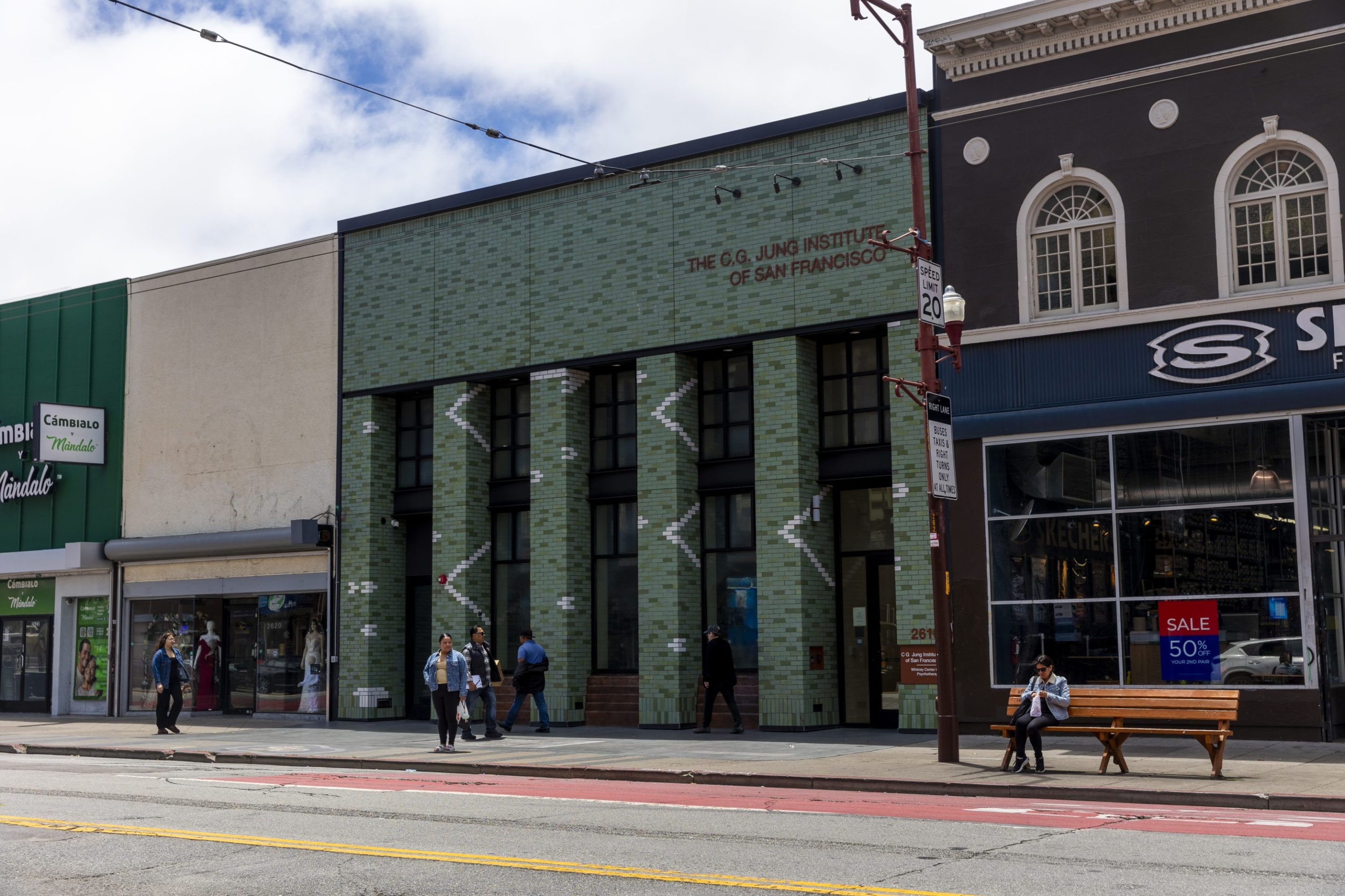

The C.G. Jung Institute of San Francisco appears like something out of a dream. Occupying a former Anna’s Linens store on a bustling section of Mission Street near the corner of 22nd Street, its exterior reveals the building’s purpose, and the secrets it contains, discreetly. It certainly isn’t hiding, with its unusual columned facade of textured, glazed brick tile in hues of terre vert, but then it’s also holding something back, asking for passersby to look again — and closer.
A pattern of slight, white arrows running through the green draws you inside. Enter and you will find practitioners and clients of analytical psychology rooted in the teachings of Carl Gustav Jung (1875–1961). A Swiss psychologist who started as a protégé to Sigmund Freud, Jung went on to develop his own pathways to understanding the self. Whether you know it or not, our speech is rich with words and ideas first postulated by Jung or popularized by his adherents: introvert, extrovert, synchronicity, and the idea of the collective unconscious all trace back to his writing.
The Institute’s facade was designed by visual artist Amy Trachtenberg in consultation with analysts at the Institute. She used a combination of high-gloss and matte brick tiles manufactured by Fireclay Tile, based in Salinas, California. At Trachtenberg’s direction, the company agreed to apply varying amounts of glaze to reflect different degrees of light and color.
Trachtenberg titled the facade Verdigris, after the green pigment resulting from copper oxidation. As Trachtenberg describes the process, it’s a metamorphosis. “The Jungians were very interested in both the idea of metamorphosis for their own practice, and the fact that green is widely considered a healing tone,” she said.
Her design also met a more practical requirement: spray paint easily washes off the tiles. The C.G. Jung Institute may be dedicated to plumbing the depths of human consciousness, but it lives next to a Skechers store.
The nonprofit Jung Institute of San Francisco grew out of San Francisco’s Medical Society for Analytical Psychology, founded in 1943, and was originally located in a mansion at 2040 Gough Street, at the top of Pacific Heights. In 2018, the organization purchased and completely renovated the building at 2610 Mission Street for about $16 million.
To buy it, the Institute took out a loan, raised money from donors and its member analysts, and sold the Gough Street mansion for about $6 million to pay off the debt, according to Steve Hargis-Bullen, the Institute’s administrative director. He declined to name the Institute’s donors, saying they wish to remain anonymous. The Institute runs on an endowment fed by donors large and small. A few years ago, Hargis-Bullen said, one such donor was so impressed by members’ writings that he left the Institute millions of dollars.
The Institute’s Mission location, which opened in 2022, also serves the purpose of offering more affordable therapy to a broader demographic.
“When we bought the building here, we were aware that we were moving from Eurocentric, millionaired Pacific Heights,” Hargis-Bullen said. Member analysts see clients at their own offices, while clinicians-in-training offer therapy at the Institute on a sliding scale, depending on financial need, from $35 to $120 for a 50-minute session once per week.
Entering the Institute from the rush of Mission Street, the interior feels spacious and spare. Its tan-painted walls, evocative of giant canvases or sea-washed beach sand, make it feel even bigger.
Visitors are greeted by a framed photograph of Jung from 1955. His balding head is tilted slightly downward, his bespectacled eyes looking directly at the viewer in what can only be described as a Kubrick stare. His expression is placid, yet his forehead is etched with worry lines. Gazing into it, it’s not hard to feel it gazing into you.
This sentry hangs at the start of a two-story curving wall constructed as a tribute to Bollingen Tower, the stone structure Jung built on the shore of Lake Zurich in 1923. On the other side of the wall is a cavernous seminar room.
David Trachtenberg, the architect who oversaw the renovation and a longtime collaborator with his sister, Amy, said his biggest challenge was creating a source of natural light. The curved wall draws visitors to his solution: a three-story light well. As David explained, it “keeps revealing itself to you as you walk into the building.”
On one of my half-dozen visits to the Institute, I met Gale Lipsyte, who oversees the clinicians-in-training. Lipsyte, who has been a practicing therapist for 40 years, led me down two flights of stairs to an atrium on the basement level, where giant leaves of monstera deliciosa, philodendron gloriosum, and schefflera plants, surrounded at their bases by round stones, reach for the skylight two levels above.
I followed Lipsyte as she disappeared behind a plain, tan-colored curtain into one of six nearly identical soundproof rooms, where the clinicians-in-training see clients five days a week, from 9am to 7pm. Each room resembles a decent-sized study.
Lipsyte carefully adjusted the lights to a level that was calming but not too dark.
As we sat across from each other in comfortable tan leather chairs, I couldn’t help but feel like a client. Next to me, I was surprised to find shelves containing hundreds of figurines: fairies, soldiers, an assortment of animals, and archetypal figures like Buddha and Batman.
When I asked Lypsyte to explain what takes place in the rooms, she asked me if anything stood out. It was a playful, open-ended inquiry, but I was the one who was supposed to be asking the questions. I played along, noting the hundreds of extraordinary figures.
She quickly hit me with a follow-up: “Do you alight on any? Are you drawn to any particular figure?”
I didn’t immediately say so, but her question triggered a deep-seated unease stemming from my childhood. My mom, a now-retired psychotherapist who studied Jung, was particularly drawn to his practice of dream analysis. When I was young, she once asked me about my dreams. It was a line of questioning I found invasive and improper, and I told her so. Even if I wasn’t sure what my dreams meant, I sure as hell didn’t want my mom interpreting them for me.
With this connection coursing through my consciousness, I worried what Lipsyte might surmise from my choice. I told her I liked the figures of the big cats, pointing to one that looked like a mountain lion. Which was true enough, but also felt like a safe pick.
Lipsyte assured me that she wasn’t trying to psychoanalyze me, but, rather, wanted to give me a glimpse of the process. When I asked, half-seriously, if she had any helpful analysis as to why I picked the mountain lion she again turned the tables, asking me what it was about the cat that I found appealing. With some reticence, I noted the animal’s qualities of power, stealth, craftiness.
Yes… she said, pausing, apparently wanting more detail.
Athleticism, speed, secrecy, I offered.
“Are those qualities that you sort of…” Lipsyte began to ask.
“Value?” I said, finishing her question.
“Yes,” she said, laughing.
As I thought about it, I told her, the qualities I identified are useful to a journalist. When she asked if I ever dreamed about mountain lions, I said, truthfully, that I didn’t recall. I went on to explain my mom’s Jungian background, and her interest in my dreams. I asked Lipsyte if she thought it was inappropriate that my mom had inquired about my dreams.
“I don’t think it’s inappropriate, but I think it’s incredibly healthy that you might want to say, ‘Hey, I’m not sure I want to divulge this, I want something for myself here,’” she said.
Lipsyte went on to say it was understandable that I’d want to maintain my distance from my mom, and “grow and individuate in my own space,” like a cat, she added: powerful, stealthy, “a little bit wary.”
My attention turned to another unusual feature in the room: a tray of fine, clean sand, which I somehow didn’t previously notice. Lipsyte pushed some aside to reveal a light blue bottom of the tray, creating the impression of a pond or lake. Lipsyte explained that the archetypal figurines occupy the top shelf. (Shiva, Shakti, and Jesus were up there with Buddha and Batman). In descending order, each shelf represented humans, animals, and invertebrates. Clients, if they’re interested, place the figurines in the sand to “make a little world, and dynamically move it around,” she explained.
Sandplay therapy, I learned, is not strictly Jungian. Instead, it is one of a number of ways in which Jungian therapists have used his concepts to create new therapeutic approaches to get beneath the rational thinking we use in our daily lives.
The goal, Lipsyte explained, is for people to uncover their potential and pursue a richer, more spacious, and meaningful life. By learning to not react in “such a difficult and constricted way,” she explained, clients can learn to be more responsive in relationships and better able to contextualize their lives. “Instead of perfection, we’re really sort of looking for wholeness,” she said.
An important tenant of Jungian analysis is learning to hold the “tension of opposites,” Lipsyte added.
“So instead of the sort of the black and white, and polarity thinking — do I do this, do I do that, do I make a list of pros and cons, and how do I go about doing that — we really want people to learn to be able to hold uncertainty, and not knowing,” Lipsyte said. “Out of that may come generative possibilities you might never have thought about.”
The Institute is also home to the Archive for Research in Archetypal Symbolism, which contains tens of thousands of curated, historical images from around the world. A separate specialized library is situated in the other half of the building’s bottom floor. On multiple visits, I found it to be perfectly quiet, except for the occasional deep hum of BART trains racing underneath Mission Street.
The library’s books are divided into sections devoted to analytical, or Jungian, psychology, and general psychology, as well as subjects that were important to Jung: mythology, folklore, philosophy, religion, alchemy, shamanism, astrology, and divination. It has decks of tarot cards, and copies of the I Ching.
Miranda Lindelow, the Institute’s library manager, showed me a copy of The Red Book, Jung’s series of meditations and artwork that detail an often tortured, 16-year odyssey of his soul. The controversial tome was fiercely guarded by Jung’s family, and remained locked in a Swiss vault for 23 years before it was finally reprinted in 2009.
Before my visit, Lindelow told me the Institute has handwritten letters from Jung that I was keen to examine. As I interviewed people at the Institute, and unearthed their dedication to Jung’s teachings, I wanted to see the man’s own handwriting, wondering if his missives might transmit even a morsel of the knowledge generations of therapists, shamans, and searchers have sought.
In her office, Lindelow unlocked a door to a long room that runs behind one of the library walls and contains rare and precious writings kept separate from the traditional books. At the end of it was a giant black safe where Jung’s letters are stored. On this particular day, however, Lindelow couldn’t open the safe. The code wasn’t working. She pressed the numbers on the unresponsive keypad to show me. Whatever knowledge the letters contained would have to wait.
“With the letters, people always assume that they’re going to find a secret, or an answer to some really interesting question, kind of like a dive into his mind,” Lindelow told me. “But it’s more like, ‘Hi, can you pick up my dry cleaning?’ Everyday things.” In one letter, she said, Jung wrote to a member of a previous iteration of the Institute to politely decline her offer of a dog she wanted to send him.
Lindelow assured me that they were far from the most interesting documents in the room, including some “very rich” volumes of the diaries of Joe Henderson (1903-2007). One of the Institute’s founding members, and an analyst, Henderson traveled to Zurich in the 1920s to undergo psychoanalysis with Jung himself. Because Henderson lived and worked so long (he died at 104), his writings serve as a portrait of the Institute.
The archive also contains neatly organized boxes of thousands of photographs. Lindelow grew still and quiet as she leafed through them, as if she was looking at a family album. “I kind of know all of them, through the archive, in a weird way,” she said of the people in the photos.
Lindelow paused on an image of a woman standing next to a helicopter, whom she identified as Jane Hollister Wheelwright (1905-2004), an heir to the Hollister Ranch, which at one point covered more than 200,000 acres along the California coast. Wheelwright also traveled to Switzerland to undergo analysis with Jung and also became an analyst herself, co-founding the organization that would become the Jung Institute of San Francisco. I surmised the helicopter was likely the same one described in a Los Angeles Times obituary. A ride in it overlooking the ranch convinced Wheelwright to sell her family’s property.
Back in the main library, Lindelow and I ran into Michael Grubb, who was doing research as part of his goal to get certified as a Jungian analyst.
Grubb had maintained a private psychotherapy practice in the city for 17 years before he set foot inside the Institute. The Institute’s training isn’t expensive relative to many degrees (it costs about $25,000) but generally takes around eight years of seminars, case work, consultation with an analyst, and study to complete.
I asked Grubb why, if he already had an established practice, he wanted to get certified as a Jungian analyst.
“It’s not just about being good at something, it’s about being really as deep as possible with people,” Grubb said. “I’ve experienced it myself, right, being in Jungian analysis myself. There’s a personal transformation that’s possible, to be most fully who you really are, and who you really can be. That’s what this is about.”
During his career and after his death, Jung was frequently branded an occultist, a charlatan, and a con artist. I asked Grubb about the reverence for Jung at this institute bearing his name. Is there a risk that all of this was bordering on cult of personality or idolatry? Jung is not regarded by anyone at the Institute as a guru, Grubb said. He distinguished himself from some analysts, who he jokingly referred to as “fundamentalists,” who prefer to stick to a close reading of Jung’s writings. (It was those members who advocated for the picture of Jung at the building’s entry.)
Nonetheless, Grubb said, there is a mysticism to Jung’s work. Freud’s accusation that Jung was a mystic — an accusation that led to the two men’s falling out — was actually a characterization that Jung didn’t shy away from, according to Grubb.
“There are things that can’t be fully understood,” Grubb explained. “Jung wanted to go toward those things.”
“Everything doesn’t have to be rational,” he said. “There’s a lot that’s really valuable in life that’s not.”
A version of this story first ran in print in Gazetteer San Francisco Issue 4.