

I love San Francisco, but sometimes I’m not sure it loves me back. I moved here from Santa Cruz almost 15 years ago to study at the San Francisco Art Institute, lured by the promise of a city that I thought cared about art and culture.
Even in my relatively short time here (though, compared to some folks my age, positively epic), I’ve seen that city change thanks to waves of gentrification and retrenchment I couldn’t have imagined. The jazz club I worked at for years became a hip brunch spot; SFMOMA and Yerba Buena Center for the Arts cut their public film programs that were a major part of my aesthetic education. SFAI closed after more than 150 years.
I’ve somehow managed to carve out a place for myself as an art critic and culture reporter here, but every day it seems like there’s less art and culture to engage with — and fewer readers interested in criticism.
As 2026 begins, I’m proud to say that I’m still here, trying to remember the San Francisco I fell in love with. I feel lucky on the days when I’m able to catch a glimpse of it behind boarded up office buildings and billboards boasting AI’s ability to replace human beings. I feel less despondent when I remember that mine is only the most recent generation of San Francisco artists and writers to feel the squeeze of Big Tech.
25 years later, the issues Solnit and Schwartzenberg addressed are as relevant as ever.
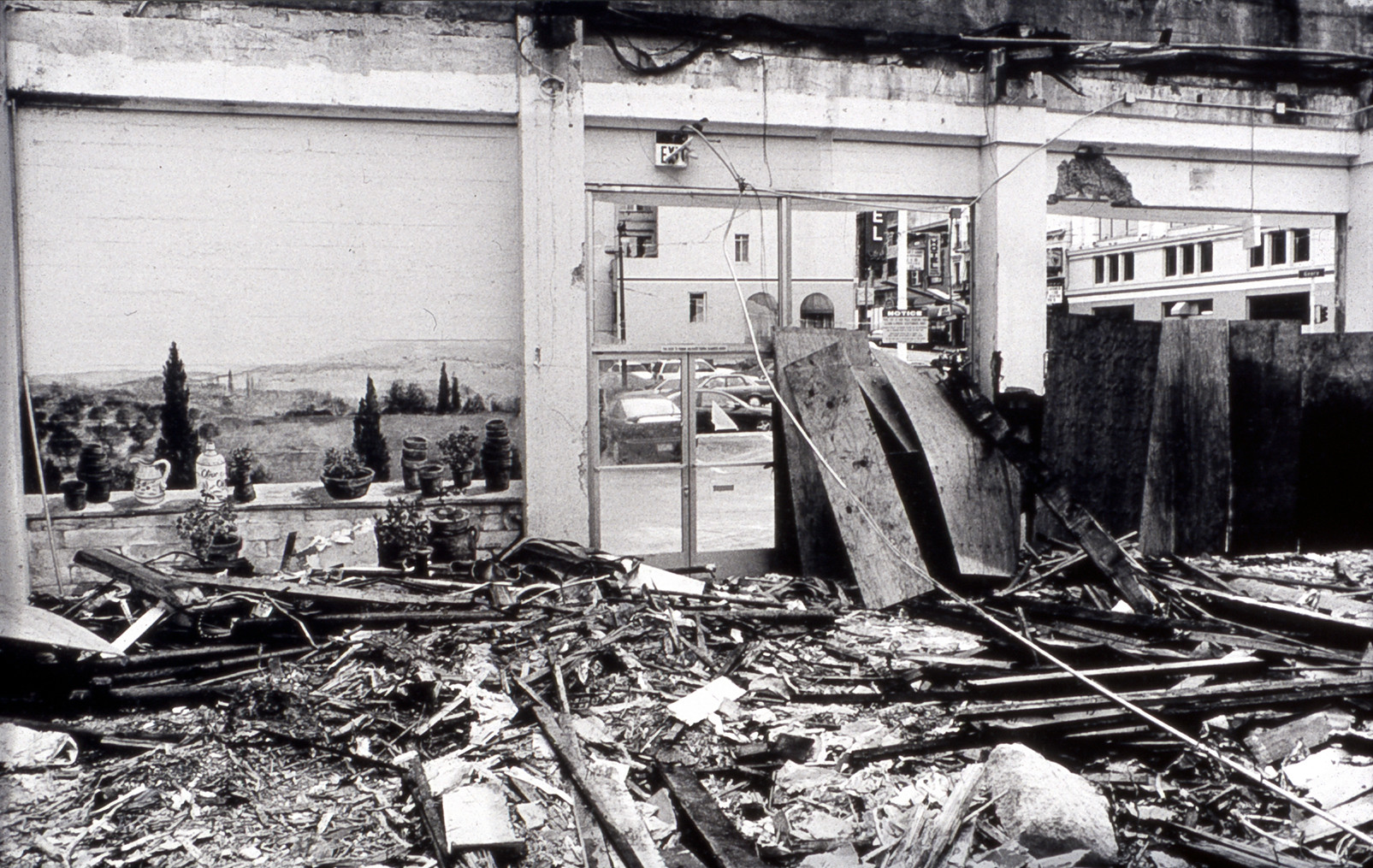
Published in 2000, Hollow City: The Siege of San Francisco and the Crisis of American Urbanism, painted a picture of what was then a rapidly vanishing San Francisco. In it, essayist Rebecca Solnit and photographer Susan Schwartzenberg responded almost in real-time to the rapid gentrification of San Francisco during the dot-com boom of the late 1990s and the threat it posed to the city’s artistic community.
25 years later, the issues Solnit and Schwartzenberg addressed are as relevant as ever.
The project grew out of a 1998 essay Solnit published in Harvard Design Magazine and an earlier photo project Schwartzenberg had done with the San Francisco Arts Commission on urban change. The writer and the artist joined forces to respond to the urgency of the moment, Schwartzenberg shooting new images for the book, as well as curating selections of archival images by other photographers and Solnit bringing her signature blend of activism and elegy.
Since the book’s release, Solnit has become, in many ways, the conscience of San Francisco. Her essays on everything from gentrification to the wealth gap, her 2010 book Infinite City: A San Francisco Atlas and her 2020 memoir about her early days in the city put into words some of San Francisco’s most ineffable qualities, making her something of an institution. She should be, having lived here since 1981, seeing the city change multiple times over. “I’ve lived in 10 places called San Francisco,” Solnit recently told KQED’s Alexis Madrigal.
Schwartzenberg echoed this sentiment. “I carry an archive in my head,” she told Gazetteer SF. “I remember what happened on this or that street corner; the gallery I used to go to. I remember the row of Victorians that were here, the kids who used to play in that parking lot.”
While many of those things are gone, Schwartzenberg, a Staff Artist at the Exploratorium, has maintained a life in San Francisco.
“I started thinking of myself as an artist in the art world and realized it was important to be a little more hybrid than that,” Schwartzenberg said. “To also be a curator, to start a whole new project, to bring a sense of that to the Exploratorium. It’s important that people retain a sense of this place.”
By 2000, Solnit argues, the Internet had replaced tourism as SF’s main economic driver. The city’s’s rush to remake itself for the new population of tech workers left the creative class behind as rents skyrocketed and landlords evicted tenants without mercy. Solnit estimated that 35% of the venture capital in the country was in the Bay Area in 2000. Now, that number is closer to 50%. Rents have continued to rise, with the average 1BR listing hovering around $3,000 per month.
“All kinds of businesses started that weren’t really businesses,” Schwartzenberg said. “They seemed bogus, but all kinds of VC flooded the city. It was a complete influx of money and business and transformation that has really changed the structure of the city.”
At its best, art complicates things rather than smooths them over.
Among the many signs of gentrification that Solnit bemoaned in 2000 was “valet parking suddenly appearing where lowriders once cruised Mission Street.” Valet parking seems quaint compared to Waymos making airport runs or DoorDash hoping to use drones to deliver food in the Mission. At the time, though, it was a harbinger of the convenience culture that has since taken over much of our lives.
Solnit posits that art is antagonistic to bourgeois standards. At its best, art complicates things rather than smooths them over like delivery apps and frictionless transactions. Messy and thoughtful, art confronts reality rather than hiding from it. A boisterous, thriving art scene doesn’t fit neatly into a city striving to emulate suburban comforts.
Solnit quotes then-local curator Larry Rinder predicting that by 2020, San Francisco will become “a city of presentation without creation … small- and medium-sized arts organizations will have folded unless they retool to cater to segments of the tourist community.”
25 years later, Rinder’s prophecy has largely come true with a few unforeseen caveats. The city’s major museums are devoting their most prominent gallery spaces to courting tourists, with major exhibitions devoted to Manga (de Young) and KAWS (SFMOMA) serving as prime examples of shows that are high in attendance and low on art-historical merit.
Rinder’s prediction could not, of course, have accounted for the pandemic, which briefly shut down the city (and the world) and complicated San Francisco’s relationship to tourism. And while 2025 saw visitor numbers closer to 2019, the city still hasn’t made a full recovery. In the last three months alone, five San Francisco art galleries have closed, including Altman Siegel and Rena Bransten, as the national art market contracts.
It isn’t only a lack of tourists hurting our cultural institutions, but the long-tail effect of the shift Solnit described in her book: the move toward corporate privatization that has only escalated in recent years. With the rise of companies like Alphabet, Meta, Salesforce, and OpenAI and the smaller companies that attach themselves like barnacles on a whale, more of the city feels hidden behind fob-access points and security protocols. There are more private clubs, members-only coworking spaces, and businesses that telegraph exclusivity over serendipity.
Despite this, artists remain present in the City, some of them making art without a means for presentation, others presenting their work at smaller, community-oriented galleries.
“The wealthy class here has an interest in art, but it’s more New York work,” Schwartzenberg told me, “or things like the Bay Bridge lights and the atrocious thing happening along the Embarcadero with Burning Man art. People with money get to say what happens. But I also think San Francisco, and the thing I love about Rebecca’s research, is that even in the early 20th century, artists were creating their own spaces to work and developing their own galleries.”
Still other artists have day jobs in tech, finance or law –– careers that afford them a life in art –– a dynamic further complicated by the fact that tech workers have themselves been demoted to something of a middle class in the Bay Area as tech ownership accumulates net worths in the billions.
In Hollow City, Solnit draws a parallel between the gentrification of the late 90s and the urban renewal project of the 1950s that wiped out the Black-inhabited Fillmore to make way for redevelopment. Here, she includes photographs by David Johnson, the first Black student in SFAI’s photography department.
Johnson’s photos show a vibrant community that included artists and musicians who were disappeared by greedy developers. While urban renewal targeted one neighborhood in the mid century, the gutting of San Francisco’s art community in the 2000s was citywide.
At one point in the book, Solnit extrapolates the term “delivered vacant” — often found on apartment listings — to apply to SF as a whole. “All of San Francisco is being delivered vacant to the brave new technology economy,” she writes. The rise of tech culture, Solnit said, would leave the city “a Disneyland of urbanism,” which isn’t a bad way to describe a place littered with whimsical statues of dragons, giraffes, robots, and aliens that wouldn’t be out of place in a preschool playground.
“There aren’t leftover spaces like there were in the ’70s and ’80s. Still, young people try to find places in the cracks where art can happen.’
Susan Schwartzenberg
Solnit wonders if artists can, in part, be blamed for gentrification, making areas “so attractive the affluent follow them.” Artists can’t really be blamed, but they can let themselves be taken advantage of and willfully aid the very machinations that make existing here difficult for them. While a true integration with the arts community doesn’t seem appealing to the affluent, what is appealing, at least to developers, is leveraging art to drive up real estate prices. Art-washing initiatives like Vacant to Vibrant — which places pop-ups in empty Downtown storefronts — offer artists and galleries subsidized rent and then evicts them when a higher-paying tenant comes along.
“There aren’t leftover spaces like there were in the ’70s and ’80s,” Schwartzenberg said. “Still, young people try to find places in the cracks where art can happen.”
This is an optimistic view compared to Solnit’s prediction from 2000.
“The circumstances for generating future generations of … artists and activists here look bleak,” she wrote.
In an an essay she penned for the London Review of Books last year, Solnit painted a dystopian vision of the bleak future she predicted in 2000, a city that has become a power center for right wing tech oligarchs to influence global politics while profiteering off of the data they collect through the surveillance network the Internet has become.
“I used to be proud of being from the San Francisco Bay Area,” Solnit wrote. “I thought of this place in terms of liberation and protection; we were where the environmental movement was born; we were the land of experimental poetry and anti-war marches, of Harvey Milk and gay rights, of the occupation of Alcatraz Island that galvanised a nationwide Indigenous rights movement as well as Cesar Chavez’s farmworkers’ movement in San Jose and the Black Panthers in Oakland.” Now, she writes, “we’re a global power centre” from which “a new super-elite shapes the world in increasingly disturbing ways.”
But maybe that’s what San Francisco has always wanted to become. What’s striking about all of the movements Solnit mentions here is that each one grew out of a necessary resistance to the conservative direction the City and country took at various times in the past. What San Francisco lacks today is not so much culture as counter culture. And it’s not coincidental that the ruling class would be interested in expunging that counter culture or sanitizing what little of it remains. What we need now, more than ever, is for San Francisco’s artists to take a stand.