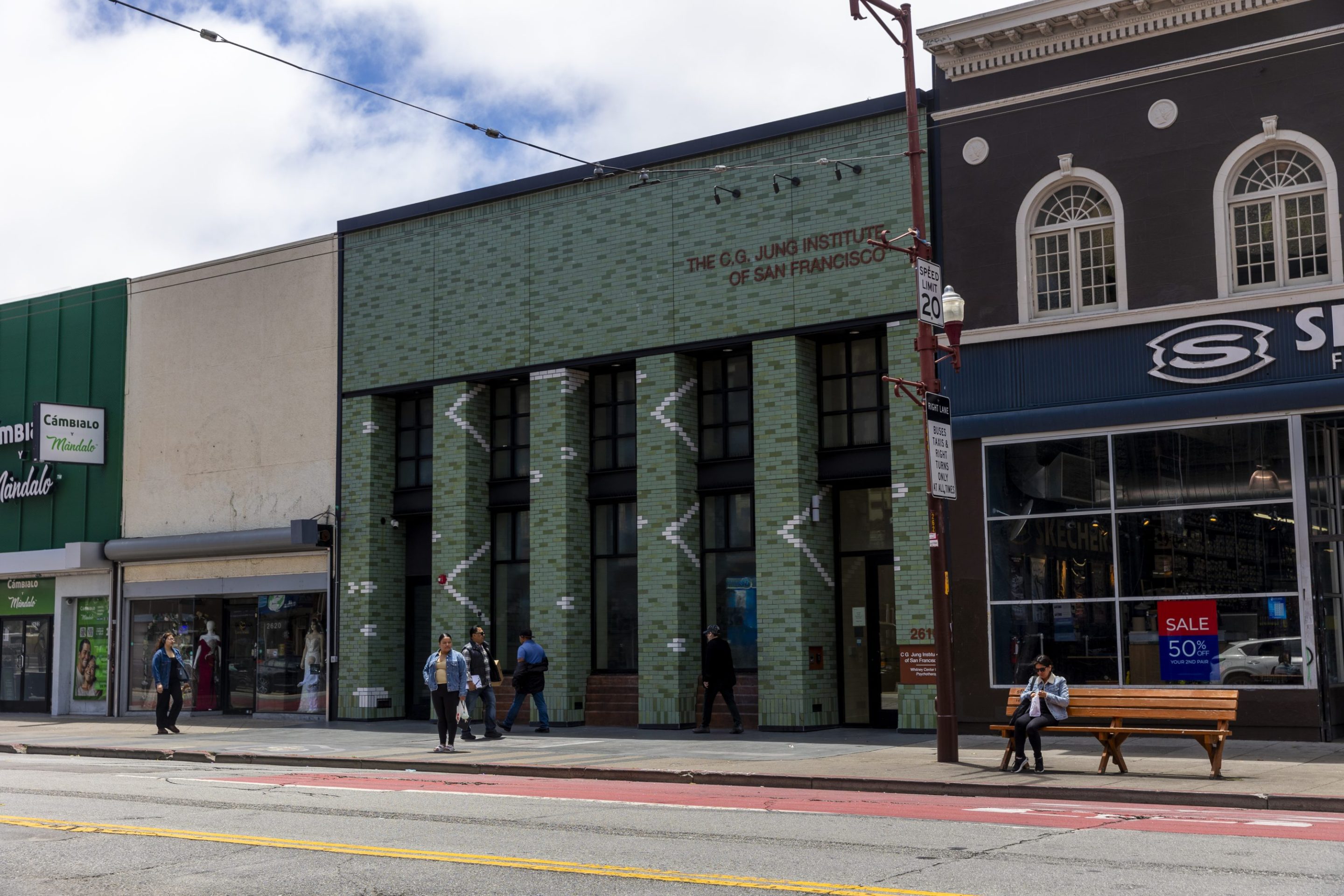

In December, Temple of Soma, a storefront psychedelic church, opened its doors on Kearny Street. Located between an L&L and a corner store, it attracts adherents seeking mushroom sacraments encased in capsules, chocolate, and Mylar bags.
Soma’s white, minimalist storefront calls to mind less a temple than a shop where you might get your iPhone screen fixed, but its operators describe it as a site of worship for those who practice Entheoism, a multifaith tradition inspired by the psychedelic rituals of several religions: Baha’i, Buddhism, Christianity, Confucianism, Hinduism, Islam, Jainism, Judaism, Shinto, Sikhism, Taoism, and Zoroastrianism.
Long before the word was associated with the neighborhood south of Market, soma was known as a sacred plant or elixir believed to unlock spiritual intuition and communion with the divine. Scholars have long believed it to be in reference to a psychoactive mushroom or different entheogenic plant that could induce an altered state of consciousness. In the Vedic tradition, Soma is also a god.
The founders of Temple of Soma say they worship this god by taking psilocybin, a naturally-occurring psychedelic compound found in over 200 mushroom species.
Visitors of the Temple of Soma enter to a lobby resembling that of an eyebrow waxer, furnished with a white laminate desk and some chairs. There, your sacrament advisor checks your ID and records your information. Membership is free, and donations for the sacrament can be made with either card or cash.
The advisor begins by asking some questions to help guide your experience: Have you participated before? Will you be participating alone or with friends? Do you know what kind of experience you’re looking for? What setting will you be in? Are you currently on SSRIs?
“I pick your brain to guide you to the right products and experiences and sacraments that we think will be best for you,” said Trevor, a volunteer sacrament advisor who did not share their last name. Trevor says they use their own personal experience, a deep understanding of the products, and psychic intuition to help members select the right strains and doses.
“For example, if someone says they want to be, like, walking through the forest, I’m going to be careful with their dose because they’re out in public. They're on a trail by themselves. I’m picking up what you’re laying down carefully,” they said.
Some members don’t want a walk in the woods, but come to Temple of Soma seeking more intense spiritual experiences or have ideas about the dose they want based on their own experience, understanding of the products, and, maybe, psychic intuition. While it’s the sacrament advisor’s role to educate on worship methods such as pacing doses in small, 30-minute increments to ensure partakers don’t overdo it, “None of our products are dangerous at all. It just might be a little bit spooky for a couple hours if you don’t follow our advice,” said Trevor.
“My role is to lovingly guide members to their best experience,” they explained.
Once the consultation is complete, members are taken into the back of the storefront, where products are displayed in a glass case. They offer over a hundred different products, some 70% of which are sourced from local cultivators in the Bay Area: gummies, capsules, stems, caps, and tinctures, all tested and packaged in ways familiar to anyone who has visited a cannabis dispensary. On the opposite wall, a display case contains more than 30 species of psilocybin mushrooms, from the highly-favored Albino Penis Envy to Gandalf to Enigma. Prices — sorry, donations — range from $10 to $100. A small room upstairs, with a window overlooking the sacrament floor and a projector, was furnished recently, though they weren’t entirely sure what for.
Temple of Soma pays market rate for their 1,000-square-foot downtown storefront. They plan to open their second location, this time a slightly smaller spot in the Inner Sunset, by the end of March. (Requests from Gazetteer SF to be lovingly guided towards more information on the church’s funding were not met.)
Trevor says Temple of Soma wanted to cast its net in the Financial District to catch people traveling through San Francisco as well as those “working in the heart of it.”
The tech industry has been nurturing a relationship with psychedelics for years — just look at Sam Altman, whose psychedelic experiences were “totally incredible,” or Bryan Johnson, the biohacker that wants to live forever, who livestreamed his heroic dose on X under the guise of a longevity seminar. Tech’s all-consuming work culture and intensifying philosophical and ethical questions raised by AI have seemingly primed the industry for existential relief. Whether it’s a “self-guided” microdosing journey or expensive ketamine-assisted leadership workshops, FiDi could be just as enthusiastic a customer base as Haight-Ashbury.
Interest in psilocybin has reached a record-high in the US. Approximately 11 million Americans used psilocybin mushrooms in 2025, according to a January study by RAND, a research organization. Mushroom churches — and their devotees — can be found all over the city, though magic mushrooms’ legal status remains ambiguous.
Psilocybin is still federally classified as a Schedule 1 drug. In recent years, religious organizations have sought protection under the First Amendment to partake in psychedelic sacraments like mushrooms, ayahuasca, DMT, and others. The loophole was first discovered about 20 years ago, when about 30 gallons of ayahuasca were seized from a New Mexico-based religious group. The organization successfully sued the DEA under the Religious Freedom Restoration Act (RFRA), setting a new precedent for the use of psychedelics. Churches can now seek exemptions by directly petitioning to the DEA instead of through litigation. Still, most organizations are vulnerable to policing. Last year, Bridger Lee Jensen, the founder of the mushroom church Singularism in Provo, Utah, was raided by a SWAT team. He won permission to continue operating and recovered the seized substances in court under the state’s RFRA.
Two states, Oregon and Colorado, have legalized psilocybin for therapeutic use. Possession of the substance is not legal in California, though in San Francisco, the Board of Supervisors in 2022 passed a resolution urging local law enforcement to deprioritize the investigation and arrest of adult users of plant-based psychedelics.
Even with psilocybin being effectively decriminalized in SF, logistical hurdles remain for mushroom churches. Danny Anderson, the founder of Temple of Soma, said they had to hire lawyers while securing their commercial lease in order to protect the landlords from any liability associated with the storing and distribution of an illicit substance.
Dozens of institutions are researching psilocybin’s therapeutic applications, but even that is facing legislative hurdles. California Gov. Gavin Newsom vetoed Senate Bill 58 in 2023 that would have decriminalized the possession of psychedelics, asking instead for a bill that would prioritize therapeutic applications. Sen. Scott Weiner responded to Newsom’s request with Senate Bill 1012, that would have allowed for psilocybin and other hallucinogenic substances to be ingested in a controlled setting under the supervision of licensed professionals, but it seems to be stalled.
Psilocybin has shown compelling evidence in treating mental health conditions including depression, post-traumatic stress disorder, substance use disorder (especially alcohol and tobacco addiction), and obsessive compulsive disorder. Most major universities in the Bay Area — UCSF, Stanford, UC Berkeley, and San Francisco State — have departments dedicated to researching psychedelic applications in mental health treatment. The California Institute of Integral Studies, a non-profit university founded in 1968 and based in SoMa, recently began offering a Bachelor of Science degree in Psychedelic Studies. (Temple of Soma mentioned collaborating with UC Berkeley and Stanford, but neither college could confirm.)
While some churches in the area offer worship sessions, Temple of Soma is “looking just to provide safe, consistent materials for people,” said Trevor. The rest is a “self-guided journey.”
Dr. Joshua Woolley, the director of the Translational Psychedelic Research (TrPR) Program at UCSF, calls such churches “laboratories of democracy.”
In the case of cannabis, medicinal applications opened the door for commercialization. Marijuana, like psilocybin, was first a highly-controlled substance that then existed in a legal gray zone for years. “And then it became just a consumer product,” Woolley said.
Woolley, who has no affiliation with Temple of Soma, focuses on applications of a controlled, synthetic psilocybin in treating depression with the hopes of FDA approval. “I joke that psychedelics basically push boundaries in all different ways,” he said.
“Psilocybin is food and they’re also sacred practices, right? And then, they’re also recreational drugs, but ones that have profound effects on people, so they’re being developed as treatments. All of those things kind of exist in various proportions in different times.”
As Trevor told: “Throughout history, throughout the world everyone’s been doing it. I mean, this is San Francisco.”