

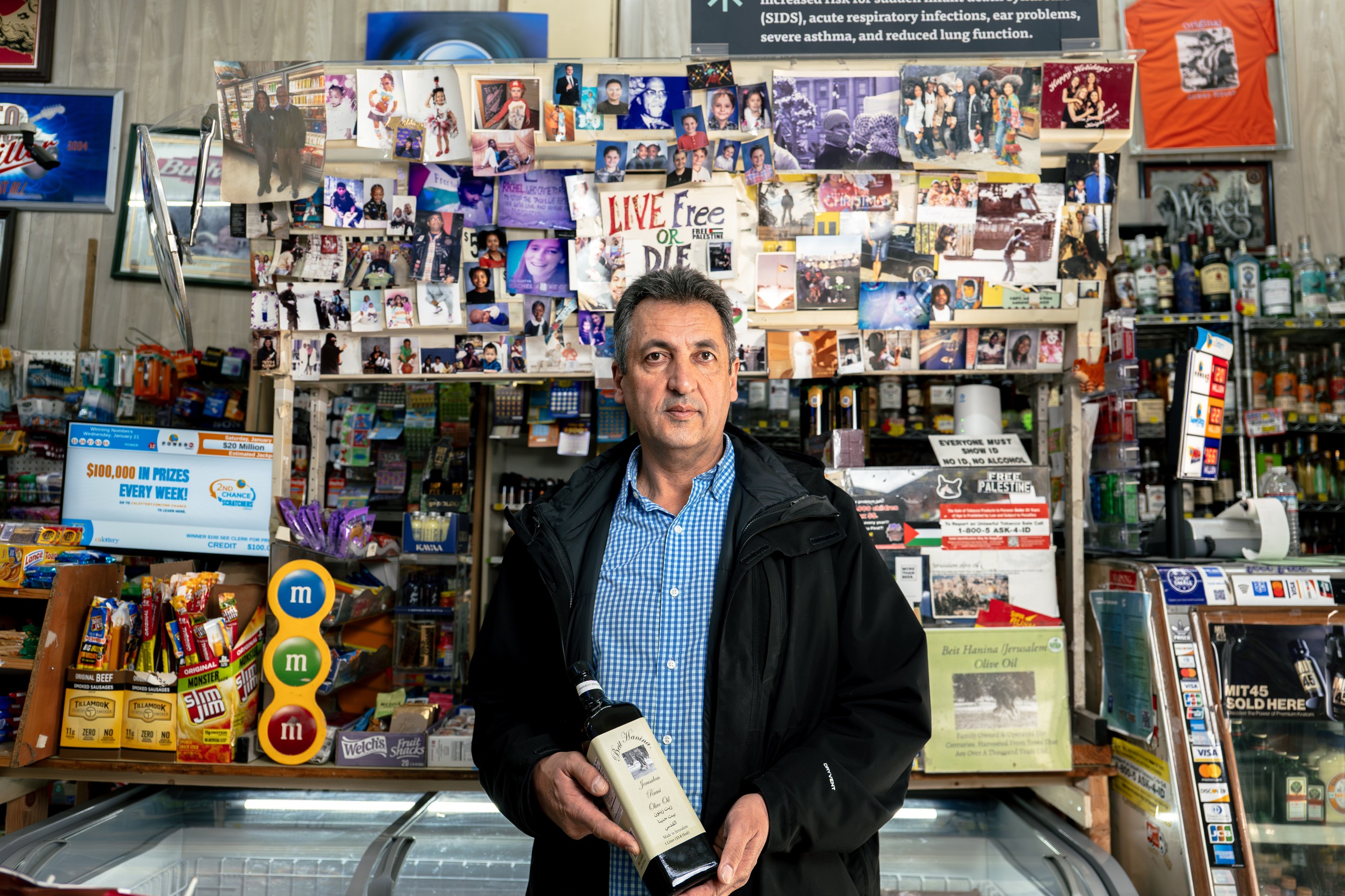

In 2013, Mohammad Ribhi left his home in San Francisco and took over his family’s land in Beit Hanina, East Jerusalem, which included 200 ancient olive trees. Born in Palestine, Ribhi, 56, spent most of his life in San Francisco. Over the next five years, he tended to the groves that his ancestors had cultivated for generations.
Ribhi returned to the Lower Haight shortly before the pandemic ground travel to a halt. He couldn’t visit Beit Hanina for the olive harvest in 2020 as he’d planned, but he nonetheless shared samples with his neighbors so they could have some “experience of a real olive oil.”
Five years later, bottles of Ribhi’s Beit Hanina Jerusalem Olive Oil — rich, raw, and unfiltered — are sold in stores like Bi-Rite and served in restaurants like Abu Salim across the city and beyond.
Each fall, the olive trees in the Levant fruit, bringing together family, friends, and volunteers to partake in the age-old Palestinian tradition of harvesting olives. But this year, Ribhi watched from afar a season marred by punishingly dry conditions and escalating violence under Israeli occupation of Palestine. Despite “one of the worst crops ever,” his mother, sisters, and children on the ground in Jerusalem still managed to pick and press the olives. Ribhi remains determined to share the fruits of their labor from his base in San Francisco.
When I spoke with Hanan Mohammad, one of Ribhi’s sisters, after the first rain of the season in late September marked the start of the harvest, her excitement was palpable. Mohammad, 46, lives in East Jerusalem with her three sons and her husband, an ironworker. They have their own acres of olive trees, whose oil they sell to her brother. They also assist their elderly mother with her land, although help is in no short supply.
“Everywhere you look, there’s hundreds of people,” Mohammad told me over the phone. While handpicking olives is hard work, she explained, it’s also a celebration. During the day, the smells of maqluba (layers of meat, rice, and veggies) and galayet bandora (fried tomatoes) waft up through the trees, and children's laughter echoes through the groves. There are “no phones, no social media,” Mohammad said. It’s a “time to get to know each other better.” The joyous occasion culminates in a bonfire, fueled by pruned branches.
The olive harvest is many things: a source of financial survival for many Palestinians, a symbol of resilience and rootedness in the land, and, sometimes, respite from the unrelenting warfare of recent years. “There's something about being under those huge olive trees. It makes you feel like you’re in a whole different world,” said Mohammad. “That there’s no wars, there’s no problems, that you're living in a life that doesn't exist.”
From October to November, the harvesters rise before dawn, picking olives from 5 a.m. to 7 p.m., long after sunset. When he’s there, Ribhi prefers to handpick the olives so as not to harm the trees, but he sometimes uses machinery with “little fingers” to safely reach their crowns.
“It’s like milking a cow,” Ribhi said, explaining how you simply grab a branch heavy with fruit and “just pull it down.” Sometimes the “olive trees will slap you,” he cautioned. “That has happened to me so many times.”
“It’s a traditional thing,” he conceded, noting that some of the younger generations would rather use machines to get the job done in a few hours as opposed to a whole day by hand.
There’s one olive tree that, from the thickness of its twisted trunk and stories passed down through generations, is believed to be around 2,500 years old. It belonged to Ribhi’s late maternal grandmother whose trees are, to this day, some of the best kept in all of East Jerusalem, according to him.
The oil business has always led Ribhi back to his ancestral home, even as he has spent most of his life in San Francisco. It was 1977, around the time that his grandfather and great-uncle closed the family’s nearly 40-year-old olive mill, that Ribhi’s parents moved him and his siblings to California. His father, a gifted tile setter, was called to work in the city where some of Ribhi’s aunts and uncles on his mom’s side already lived.
From the time that he was eight years old, Ribhi — the only boy of ten children — has been here with visits back to Jerusalem every other year in the summer or fall for months at a time. After studying at City College, he ran a mobile auto repair service for 25 years, mostly working on Ford Mustangs. When his grandfather passed away in 1993, he bequeathed to his son, Ribhi’s father, his acres of land.
His father chose not to move back to Jerusalem, but maintained the land for 20 years with the help of cousins living in Beit Hanina. Despite their efforts, the orchards fell into neglect, prompting Ribhi, a father of six, to take up the mantle of farmer in the late 2010s.
While olive oil from the family’s orchards was already being sold in Jerusalem and elsewhere in the region, Ribhi wanted to bring it to the States. He started with tiny 8.5-ounce bottles at the turn of the decade; today they sell bottles four times that size, plus Middle Eastern spices like sumac and za'atar, to about 20 retailers around the Bay and online.
Unlike some brands of olive oil found in supermarkets that may contain different varieties of olives from various countries, Beit Hanina is single sourced to one family’s centuries-old Rumi trees. The Rumi, also known as the Souri tree, is a variety commonly cultivated in Palestine and dating back to Roman times. Its olives are small, and range from light green to deep purple, depending on their ripeness.
The trees have “on” and “off” years, depending on how much fruit they bear, Ribhi explained. This year was an off year. In a good harvest, Ribhi would produce between around 400 to 500 gallons of olive oil from his groves. This time around, he made less than half of the low end of that range, in part due to extreme heat and a lack of rain, issues exacerbated by climate change, which studies show will significantly impact olive tree growth and olive oil production in the Mediterranean basin.
While olive trees are drought-resistant, each needs about five gallons of water a week. Empty wells and restrictions on water resources make nourishing the trees difficult. The Israeli government controls the water infrastructure, which flows to the settlements — illegal under international law — but not to Beit Hanina.
On top of the lack of water, “it’s hard to get around,” Ribhi said. Seven acres of his land is cut off by a wall, which fragments the occupied West Bank and East Jerusalem. Ribhi’s family must get a permit from the Israeli military to access that land once a year. “They’ve denied all the requests, so we weren't able to get to it this year,” he explained.
This year’s harvest has also been plagued by a surge in Israeli settler violence, with more than 126 attacks and thousands of trees vandalized in Palestinian towns and villages, according to the United Nations Office for the Coordination of Humanitarian Affairs. All this comes at a devastating cost to Palestinian farmers, many of whom rely on olive trees for their livelihoods.
While the olives typically take at least a month to harvest, Ribhi’s crew in Beit Hanina started early fearful of the violence and theft that has struck other Palestinian towns. They completed the harvest in four days because of the low yield and poor weather conditions. In spite of the many factors outside of their control, a batch of Beit Hanina Olive Oil is en route to San Francisco.
Because of when it’s harvested and how it’s extracted, Beit Hanina Olive oil is thick, green, and slightly sharp to taste. As soon as they’re harvested, bags and crates brimming with olives are sent to the mill where they’re cleaned and immediately cold pressed. It takes a few hours for them to be ground into a pulpy paste and malaxed, releasing the oil, which is then separated from the solid material and transferred into metal containers and bottles to be sold.
You can cook with it, but due to its relatively low smoke point compared to an avocado or grapeseed oil, Ribhi says it’s better for garnishing dishes like hummus — advice echoed by Beit Hanina Olive Oil’s biggest local buyer, the San Francisco-based grocery mini chain Bi-Rite.
In an email, Raph Mogannam, Bi-Rite Market’s category manager, praised Beit Hanina Olive Oil’s “balanced flavors” and “rich profile with notes of wild herbs that lead the way to a peppery finish.” He recommends drizzling it over Mediterranean appetizers such as labneh and grilled halloumi, using it to finish grilled meats, or topping off soups and grilled vegetables.
Extra virgin olive oil like this has other non-culinary uses as well. Ribhi’s mother uses it on her hair; some people use it to soothe muscle aches. You can even drink it, as Ribhi’s grandmother did (an eight-ounce glass each day, Ribhi recalled), or as he does now, as a shot in the morning and sometimes before bed.
Ribhi is hopeful for a better crop next year. His family’s resilient olive trees, the sort the Palestinian poet Mahmoud Dawish called “a friendly sister of eternity,” will continue to connect his family in San Francisco and Palestine. “The olives that we pick mean a lot to our families and our culture,” Mohammad said. “The trees are like a part of us.”
A version of this story ran in Gazetteer San Francisco Issue 2.