
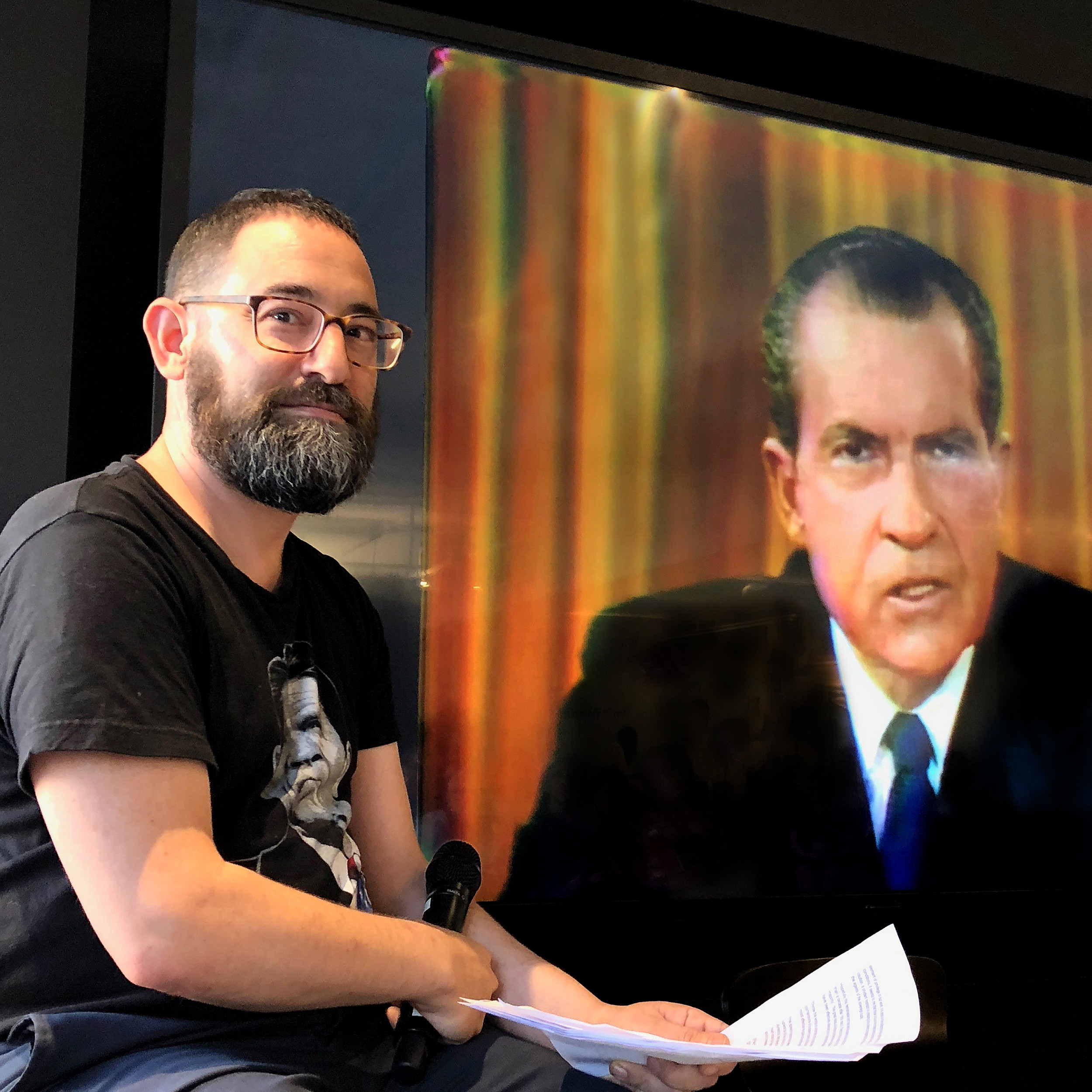
Rick Perlstein likes to keep his enemies close. For the last 30 years, the decidedly progressive historian has chronicled the rise of modern American conservatism, churning out five bestselling tomes on how right-wing ideologies came to dominate politics and culture in the United States since the 1960s.
Now, six years after the release of his last book, Reaganland: America's Right Turn 1976-1980, Perlstein has finished drafting his next one, tentatively titled Infernal Triangle: An Inquiry into How America Got This Way.
Like just about every other writer these days, he’s also tapping away on Substack. Last Tuesday, Perlstein re-launched his email newsletter, Rickipedia, which quickly amassed a few hundred paid subscribers and landed on Substack’s New Bestseller list. At one point, Rickipedia was ranked #2 on the leaderboard — just behind Andrew Tate, the chauvinistic manosphere magnate currently facing charges of rape and human trafficking in multiple countries. (At publication time, Tate sits at #5, and Rickipedia is at #12.)
Tate’s appearance on the list duly pissed off progressives online (okay, on Bluesky), who accused Substack of trumpeting hateful voices and happily taking a cut of all the money they rake in. We wanted to know what Perlstein thought about following closely behind Tate, given that he’s been following conservative messaging for the better part of his professional life. So we gave him a call.
Dialing in from Hyde Park, Chicago, Perlstein spoke — or riffed and rambled, as he warned us is his natural conversational style — with Gazetteer SF about his next book, why he thinks conservative voices on Substack are a “gift,” and the frameworks we need to decode the increasingly confusing online world.
This interview has been edited for length and clarity.
Your last book, Reaganland, was published in 2020. Obviously, so much has changed since then. What is the thesis of your next book?
The narrative of the book starts in the primary season of the year 2000, and, mainly for reasons of space, just goes to the year 2010. The title is Infernal Triangle, which is my own naming of a theory that was kind of unnamed all through this period.
One way of describing it is that any time any left-tending people get together — whether it’s kind of normie liberal wine mom types, or, you know, radical insurrectionist revolutionaries — the discussion kind of toggles between three poles. [First,] the metastasizing authoritarianism of the Republican party, which I describe in the book. I call it the “authoritarian ratchet.” It gets more and more undemocratic, more and more frantic, more and more more conspiracy-oriented, more and more violence-minded. [Second,] the fecklessness of the Democratic party. And the third part is incompetent media, the out-of-touch, arrogant, elitist, kind of cartelized, kind of self-dealing way of the people who signed up for the job of explaining America to Americans. So that’s the infernal triangle.
In the last few years, Substack has been the subject of a lot of controversy over monetizing really extreme, right-wing voices. As a result a lot of writers have chosen not to write there or left the platform. What brought you to Substack?
Well, since we’ll work our way around to Andrew Tate, I’ll start with what drew people's attention to this question about my Substack. Substack puts out the [bestsellers] listing, what is it, weekly? Do you know?
I figured it was real-time.
Well, that sets up a lot of questions already, right? How much of these technologies that shape our common life together — how we communicate, how we do politics, how we make community and society — are black boxes? We don’t know what this metric they put out meant. We know how the unemployment rate is created, right? We know, basically, the Federal Reserve has to put out the transcripts of its Open Market Committee. But there are a million different metrics or algorithms or ways of presenting information that these private companies have control over that we don't even imagine that we can kind of call them to account for how they make them. So that’s just a big problem.
So there’s this ranking and I show up number two, and Andrew Tate is number one, or whatever it is. To say it first off, Andrew Tate shouldn't be writing a Substack. He should be in jail.
Andrew Tate — and please quote me on this — is literally a person who enslaves women for his own profit and educates young men about how women should be strangled. Let’s be absolutely blunt. And in a staggering, mind-blowing level of corruption, he was rescued from another country’s justice system by an aspiring dictator who runs America.
But he does have a Substack, and it turns out that whatever day this metric came out, he had, whatever, the fastest growing Substack. The context is kind of important and interesting because when I started my Substack, what, nine days ago, I had zero paid subscribers. I zoomed up from zero to, and I'm going to be very transparent here, 250 [paid subscribers] to start. Now, I have 350. So, I don't want to be critical of the people who are pointing this out. I'm completely open to what they're saying. It's an important discussion. I’m in dialogue with people who are making really important points, and I have an argument to make about why I made the choice I made.
But let's just be very clear. People are like, “Substack is promoting it.” Let’s just make clear that we're only talking like, you know, subscribers in the dozens. It's not like they’re putting up a billboard saying, “Please subscribe to Andrew Tate.” Is there a moral decision involved? We have no idea.
So why do I go on Substack? Why did I make that decision knowing, certainly knowing, that people boycott Substack? We can move out a little, even, to why I go on X. Frankly, my anti-fascist strategy is to get my anti-fascist ideas in front of as many eyeballs as possible. People might see this list and say, “Let me check out this Perlstein guy,” and that really speaks to one advantage of that strategy, which is that people who might not ordinarily read me might read me.
I don’t have many fantasies about, you know, making the scales fall from people's eyes. But quite frankly, we all know about how networks work and the network effect and how those networks get enshittified. I’m very much a student and an admirer of Cory Doctorow’s theory about how, basically, these institutions rely upon getting large numbers of people addicted, so they can screw them later. But quite frankly, it’s a very good network, and they use their algorithms to tell more people to look at Perlstein. And, you know, there’s ego involved, but there’s also an active political vision involved.
This is the place where you can reach the most people. And these alternate platforms don’t have that kind of network effect. I’m building an audience. I’m not really super concerned about money at this point in my career, so it’s not even a financial decision. Although, I’m not going to say I’m not going to take the money. Milton Friedman used to say, “Yeah, I hate Social Security, but I’m still going to cash my check.” Hate the game, not the player, right? And the thing I’ve been kind of snarking back at people is, look, I’ve published three books with Simon & Schuster. They go back a century. They published a lot of fascists in those 100 years, literal fascists. But no one thinks to say, “Don’t publish with Simon & Schuster. Don’t publish with Random House.” These giant corporations that also platform, quote-unquote, terrible people.
That’s true. That’s an interesting point.
So here’s the thing about platforms that is really interesting and important: The real way to kind of fight all this terrible stuff is a politics that’s much more structural in thinking. Not individual decisions. First of all, I hate the idea of Substack in the first place. I mean, it’s a total neoliberal idea. Like it comes from a vision of labor in which you look yourself in the mirror and say, “What do I have to sell today?” It’s individualistic, instead of creating collectives that used to be called magazines, where people help each other and pay each other. I’d much rather be doing this that way. But guess what? We allowed that whole infrastructure to wither. So pull yourself up by your own bootstraps. And fuck that, but you know, hate the game, not the player.
Do you think platforms should be held accountable as if they were publishers?
Sure, that’s one thing. But I mean, we’d have to kind of rewind the clock to even the idea that the public can hold corporations accountable at all. We just consider it completely natural that there’s nothing we can do. We’ve kind of forgotten that we can do things besides make these individual decisions. And I’m not a free speech absolutist like, “Oh my god, Andrew Tate has the right to say whatever he wants!” But I also don’t think it’s a good idea to say, “We’re going to have our own little Substack over here,” and silo ourselves. It kind of reminds me of radical feminists in the ‘70s, who were like, “The solution to patriarchy is we’re going to have these women-only communities.” Well, that’s a choice. That’s an individual choice that I can respect, but it’s not going to solve the problem of patriarchy. And getting off Substack because bad people are on it… I can respect that decision. But I don’t think it’s going to solve the problem. So that’s what I want to say.
Actually, and this is my last point: It’s a saying, you know? Keep your friends close, but your enemies closer. Would you rather have Andrew Tate organizing in some Signal chat? The fact that he’s available to be consumed by people who are his political adversaries is a gift that Substack gives to us.
What sort of frameworks can we use to better understand what’s happening when we see things like, say, Andrew Tate on the Substack bestseller list?
Media literacy is something we used to teach when I was a kid in school. We had a unit in second or third grade about like, “This is how commercials work, and this is how they try to fool you.” We learned about the bandwagon effect. That stuck with me. So making media literacy part of the school curriculum would be great. I also think a lot of this stuff is a product of isolation and alienation. Motivated reasoning is impossible to fully escape, but if you are discussing it with other people and consuming things as part of a community, maybe that’s the answer. Just like, posting it and asking, “Does this seem right to people?” Like, we’re in this together. Anything that isolates people into individual consumers equals bad.