
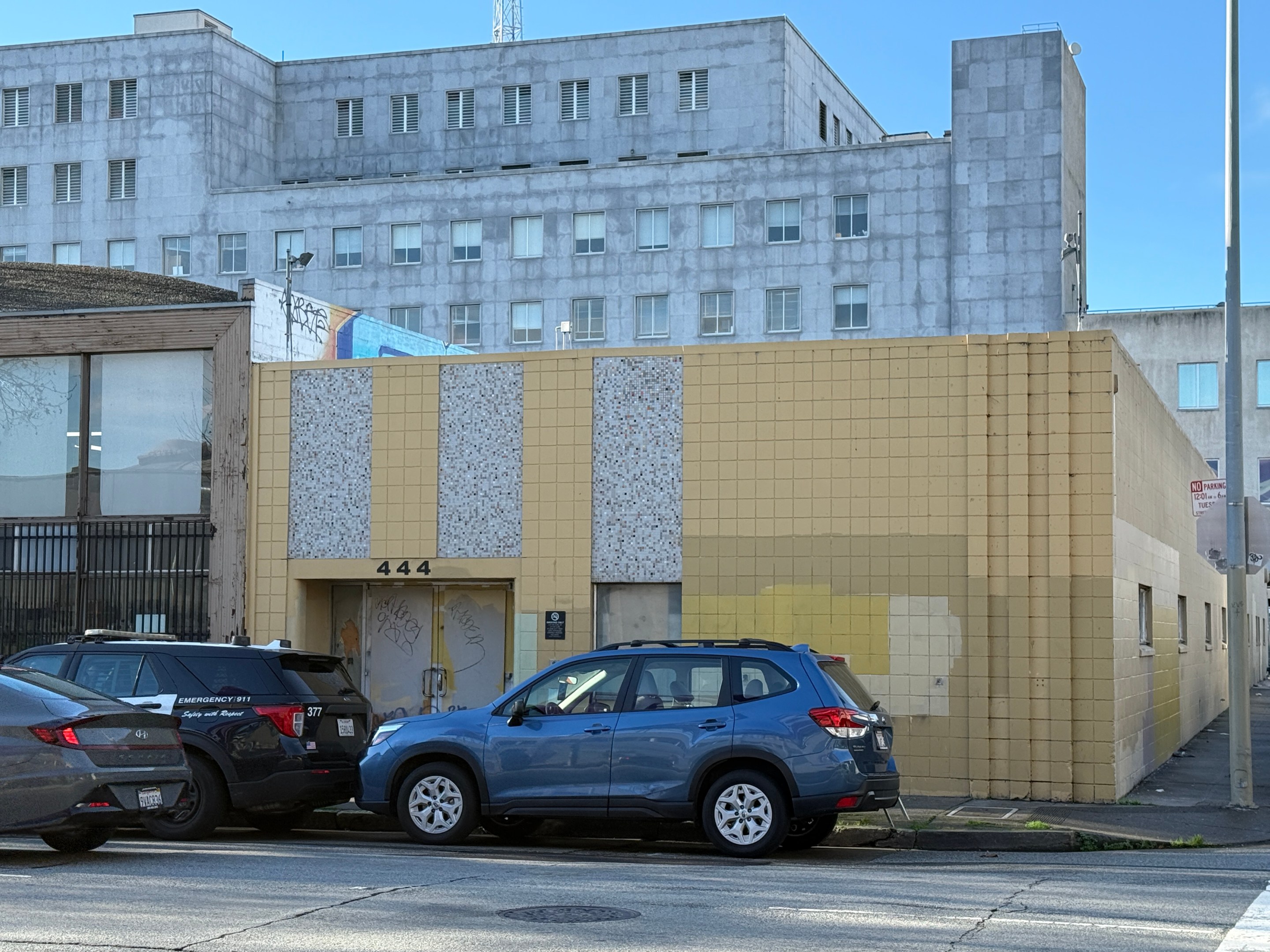

In mid-November, Mayor Daniel Lurie announced the 2026 opening of a “sobering center” at 444 Sixth Street where people struggling with public intoxication and addiction would be held temporarily and offered medical attention in lieu of jailing. The mayor touted the new center at an AI event as a place to “take the first step” toward treatment, and get “connected to the right resources at the right time.”
An opening originally set for December was bumped to January. As the Board of Supervisors is set today to vote on several items for the city’s 2026 budget, including a contract for a company to run treatment programs at the sobering center, its opening is again being postponed to the spring.
San Francisco Sheriff Paul Miyamoto confirmed Monday in an interview with Gazetteer SF that the center may begin accepting people in March or April. “There’s no guarantees,” Miyamoto said cautiously. “March, April would probably be closer to what we’re looking at.”
He went on to explain: “The process to secure the funding, and make sure that all the renovations are done on the building, have pushed it a little further down the road.”
The center now has a name: RESET, which stands for Rapid Enforcement, Support, Evaluation and Triage. Lurie has for months heralded the center as an alternative to jail, part of an agenda to “go hard” in the city’s fight against the fentanyl crisis. Miyamoto said the city is still developing the total budget for RESET. The role of the Sheriff’s Office is expected to cost between $1.5 million and $2 million annually, including for two deputies on site around the clock. The rest of the budget will be discussed at the hearing today at City Hall. (Lurie’s office declined to comment by press time.)
Miyamoto said he recognizes RESET is a modest start to addressing a difficult, entrenched problem, but it fulfills a longtime professional ambition. In his 30 years of law enforcement, Miyamoto has been frustrated working with the city’s harm-reduction policies, which promote the reduction of drug use over time and programs like clean-needle exchanges. This approach stands in contrast to zero-tolerance rules, and abstinence requirements to access services such as treatment and housing. He pointed to the Linkage Center in the Tenderloin as an example, which the city has said was intended as a temporary site.
Relying on drug users to “volunteer to stop doing self harm, you don’t see a lot of positive results,” Miyamoto said. “I almost feel like we’re enabling people to continue their addictions when there isn’t a tough love, heavier-hand approach to getting people to deal with their demons and challenges.”
Miyamoto said that while law enforcement officers have arrested people for selling drugs, San Francisco generally hasn’t arrested drug users until now. Users taken to RESET will first be arrested by Sheriff's deputies and San Francisco Police Department officers. “Instead of letting them just use on the streets, we now have a tool, once this place opens, for law enforcement to bring them in,” he said. They’ll be given 23 hours to stay at the center. If people cycle through RESET multiple times, and a connection to treatment doesn’t happen, they can be jailed, Miyamoto said.
Asked about criticism that long term drug users can’t be expected to kick a habit in 24 hours, Miyamoto said there’s three steps for users: an initial sobering phase, followed by withdrawal or detoxification, and then withdrawal management. RESET is designed to deal with just the first step, he said.
Instead of being locked up in a “drunk tank,” a holding cell where users are sleeping on the floor, people admitted to RESET will be in 16 to 25 reclining chairs, and a “nurturing environment,” Miyamoto said. The idea is that the space will convince those taken to the center to embrace the drug and health services, and residential treatment beds, offered in coordination with the Department of Public Health. People coming from RESET will have priority for those services, Miyamoto said.
While Miyamoto repeatedly described the “warm handoff” those admitted to RESET would be offered to health services, he also repeatedly returned to its different, harder approach to dealing with chronic drug users. The RESET acronym is intended to convey care and support, he said, and at the same time, that “this isn’t a voluntary thing.”
“From my perspective as the sheriff, it’s like a big drunk tank that’s not in a jail,” Miyamoto added.
Miyamoto insists RESET is “just the beginning.” In conjunction with the mayor’s office, the city has identified larger locations to handle more people, possibly within the next year, he added. “We’re hopeful that this will be an example of what we can do on a larger scale,” Miyamoto said.