

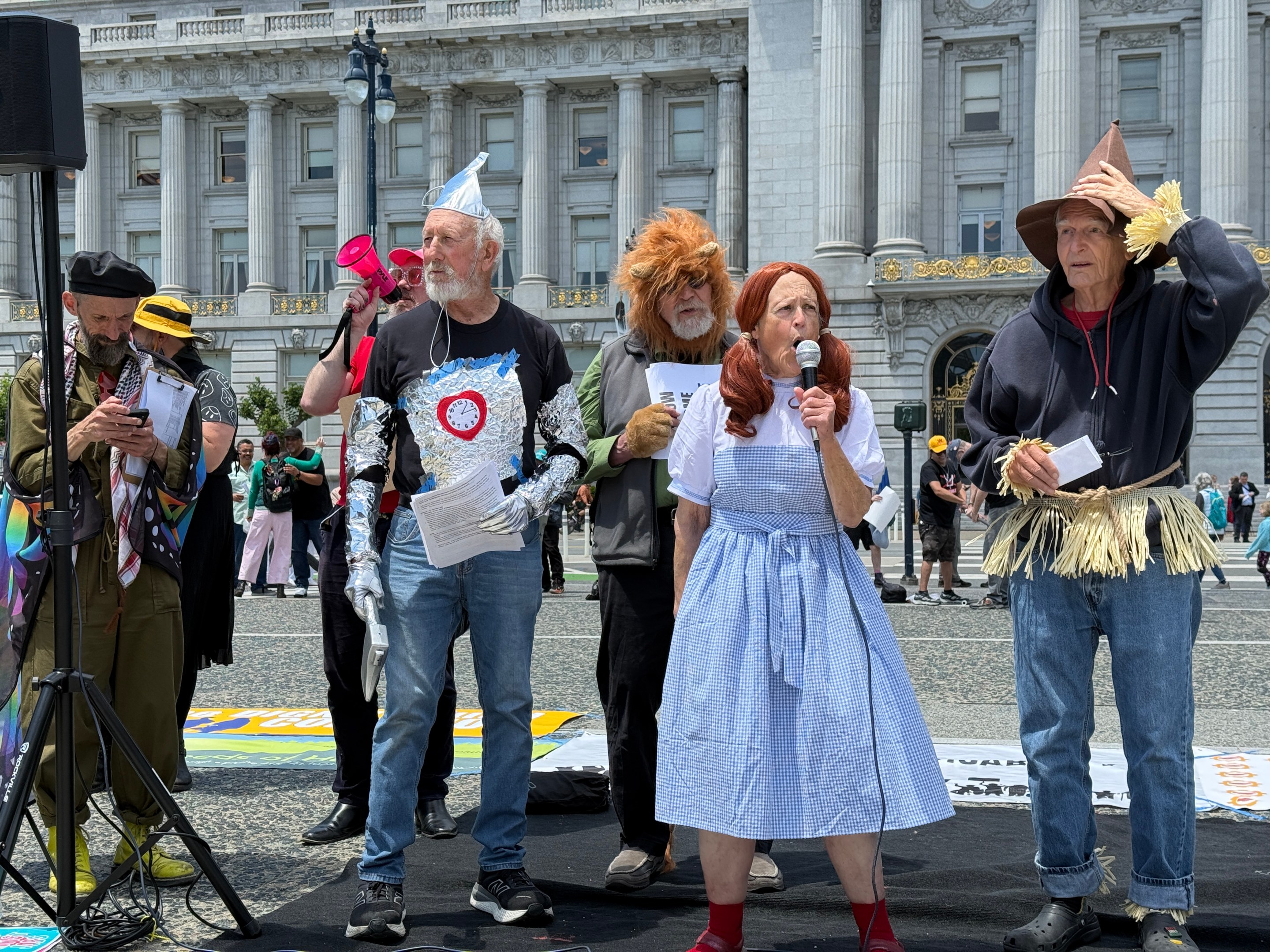
Protesters representing labor unions, nonprofits, community organizations, and perhaps, the Lollipop Guild, to judge by the ones dressed as characters from The Wizard of Oz, were back at San Francisco City Hall Thursday to show their opposition to Mayor Daniel Lurie’s budget cuts.
Their message: “Use your brain, have a heart, show some courage,” said Anya Worley-Ziegmann, coordinator at the San Francisco People’s Budget Coalition, and an organizer of the protest. Longtime activist Hene Kelly was there dressed as Dorothy, leading songs and chants outside before the group entered the building and stood in front of the mayor’s office to demand his presence.
The protest was more theatrical, though not nearly as well attended as a similar rally last month. The biggest difference was on the other side of the mayor’s door: Just two weeks ago, Lurie drew a straight flush in primary elections, giving him an even stronger hand to ignore protesters’ demands.
From his support for Proposition B, neutralizing the city’s “progressive godfather,” to decisive wins for his supervisor allies Alan Wong and Stephen Sherrill, Lurie got what he wanted. His biggest prize: The mayor campaigned aggressively to kill Proposition D, the “overpaid CEO tax,” and won that one, too.
Prop D was the shaky foundation on which labor’s argument against Lurie’s cuts was premised. The campaign was a bet on the revenue it would generate, potentially rendering the mayor’s painful cuts unnecessary. D’s defeat lends even more credibility to the mayor’s claim that his cuts are required to stem habitual overspending and a ballooning deficit.
“Mayor Lurie, being the face of opposition to Prop. D, gets most, if not all, the credit” for its defeat, said Jason McDaniel, an associate professor of political science at San Francisco State University, in an interview with Gazetteer SF. The mayor’s election wins give him momentum in the budget debate, which was already built on support he won for last year’s budget, McDaniel added.
“Politicians look at those results, and they pay attention to them as a signal of the mayor’s popularity,” McDaniel said. “Winning begets winning in politics.”
Worley-Ziegmann, who has seemed indefatigable in their protests, acknowledged possible missteps and the cost of Lurie’s wins. The election results “leave us in a new and a different context,” they said.
“It makes me sort of reflect on, you know, all the things that we as community members could have done differently in the campaign to really let people know the stakes of what was on the line here,” Worley-Ziegmann added.
Thursday’s protest was mounted one week before a critical budget vote. While the Board of Supervisors will cast its final vote on Lurie’s budget in July or August, the budget committee is expected to vote on it June 25. Realistically, after that vote, little can be changed.
So far, Lurie has proven unwilling to reverse significant cuts, especially in the area of public health. The People’s Budget Coalition and unions have repeatedly pointed to Lurie’s closing of health clinics for the elderly and youth as an example of the city’s most vulnerable populations paying the real price of his cuts. Protesters raised the clinics again Thursday outside Lurie’s door.
The protests could be heard from inside the supervisors’ legislative chamber, Room 250 across from Lurie’s office, as a budget committee hurriedly finished its business. The goal of the protest was to give Lurie, and supervisors, a taste of the disruption the opposition can mount, Worley-Ziegmann said.
“We will make it a very, very difficult process for them to pass this budget if it’s one that we don’t agree with,” they told Gazetteer. At the protest, outside the mayor’s doors, an intern came out to tell the group Lurie wouldn’t meet with them or their little dog, too.